Part 2: The Fire on the High Mesa
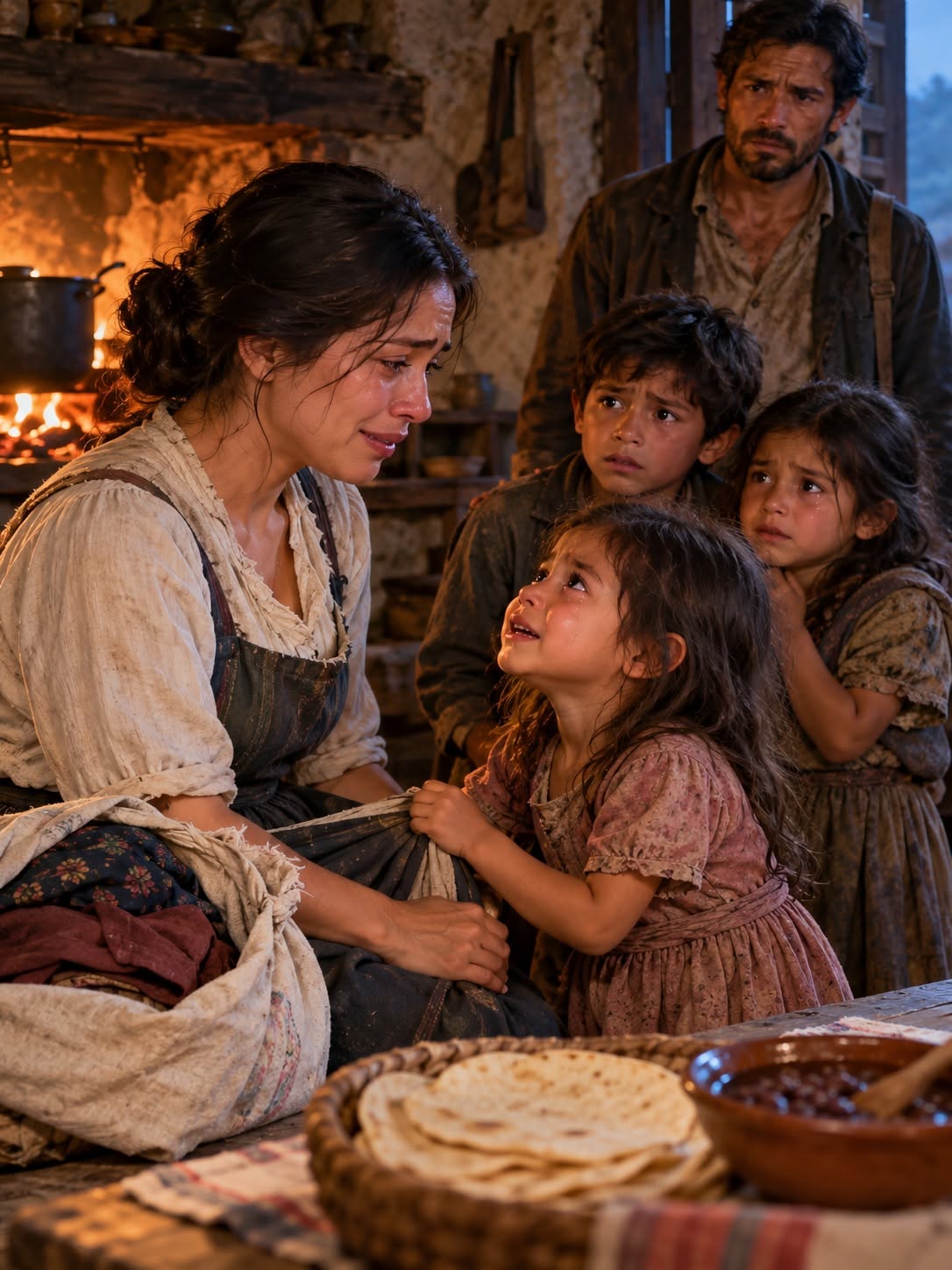
Part 2: The Fire on the High Mesa
The night wind moaned through the dry scrub of the yard, snapping the corners of the paper in William’s trembling eight-year-old fingers.
Elias lunged across the porch steps, dropping to his knees before his son. His broad, calloused hands gently took the crumpled sheet from William’s grip. His knuckles went white as bone under the lantern light.
“William…” Elias’s voice was a ragged whisper. “What did she tell you?”
“She said Papa was sick,” the boy wept, burying his face into Elias’s shoulder. “She said you were losing your mind because Mama died, and that the strange girl in the kitchen was stealing all our food. She told me if I wrote my name on the bottom, she’d buy Annie new shoes and pay off the bank so we wouldn’t have to sleep in the dirt!”
Charles Hargrove, the court clerk, stood by his mount, adjusting his wire-rimmed spectacles with a grim, troubled frown. “May I see that, Mr. Whitmore?”
Elias didn’t hand it over immediately. He read the hurried, uneven script, and I saw a vein cord and pulse along his temple.
“It’s an affidavit of neglect,” Elias rasped, his eyes turning wild with a father’s fury. “She wrote that I leave them locked in the cellar without bread. She made an eight-year-old boy affirm that his own father was unfit!”
Hargrove took the paper, holding it near his carriage lantern. “This is Doña Carlota de la Rosa’s handwriting. But Mr. Whitmore… an affidavit signed by a minor under duress holds no standing in equity. Yet Judge Morales has already signed the provisional writ of attachment based on this peтιтion.”
“Judge Morales is Carlota’s cousin,” I said, the bitter truth striking me like an icy draught.
The entire village knew the De la Rosa family. They owned the silver reduction hacienda in the canyon, the municipal water rights, and every magistrate who sat on the district bench. Two years ago, when Elias’s wife, Teresa de la Rosa, died of the wasting fever, her aristocratic parents hadn’t even attended the funeral in the village chapel. They had cursed Elias for a penniless peasant who had stolen their daughter away to a scrub-dirt farm.
“Why now, Charles?” Elias demanded, rising to his full height, towering over the clerk. “Teresa has been in the churchyard for two winters. Carlota hasn’t sent a single sack of flour, a single copper coin, or a birthday ribbon for Molly! Why drag my children into court tomorrow morning?”
Hargrove swallowed, glancing nervously toward the two mounted guards who accompanied him.
“Because of the railway survey, Elias.”
The yard went deathly still.
“What railway?” Elias whispered.
Hargrove opened his leather briefcase again, withdrawing a linen-backed surveyor’s blueprint stamped with the eagle of the Mexican National Rail Syndicate.
“The northern spur from Monterrey cannot cross the canyon without bridging your mesa,” Hargrove explained, keeping his voice low. “The syndicate surveyed the route last month. They offered fifty thousand gold pesos for the right-of-way through Section 4. But under Teresa’s marriage contract, that parcel was deeded in absolute trust to her surviving children—with the lawful guardian holding sole authority to execute the conveyance.”
My hand flew to my throat.
Fifty thousand gold pesos.
“They don’t want the children,” I breathed, horror washing over me. “They want the signature on the railway deed.”
“Once Carlota is appointed legal conservator,” Hargrove said, his voice laced with regret, “she signs the railway concession, collects the fifty thousand pesos, and places William, Annie, and little Molly into an insтιтutional boarding school in Guadalajara. You will never see them again, Whitmore.”
Elias turned toward the darkened farmhouse. Annie stood in the doorway now, clutching her little sister Molly against her nightgown, both girls staring out at the men with round, terrified eyes.
“I won’t let them take my babies,” Elias growled, his voice vibrating with absolute, lethal resolve.
“The writ is enforceable at dawn, Elias,” Hargrove warned, his boots crunching on the gravel as he backed toward his saddle. “Sheriff Mendoza rides with twelve men. If you refuse to surrender the children at sunrise, they will declare you in open rebellion against the court.”
Hargrove mounted his horse, gave a heavy, sorrowful nod, and wheeled his animal toward the road, his deputies following behind him into the dark.
Inside the farmhouse, the silence was suffocating.
Elias sat at the rough pine table, his head buried in his hands. The small velvet box containing the gold wedding ring sat between us, catching the faint yellow glow of the tallow candle.
“You should take your suitcase, Clara,” Elias said, his voice muffled and broken. “Run to the station before morning. If Mendoza finds you here, they’ll lock you in the town jail for harboring the children.”
I walked around the table.
I didn’t reach for my bag.
I reached down and picked up the gold ring.
With steady fingers, I slid the band onto the third finger of my left hand.
Elias looked up, his eyes bloodsH๏τ, stunned disbelief parting his lips. “Clara… what are you doing?”
“Under the civil code of this territory,” I said, my voice ringing clear and fierce as an iron bell, “a married household cannot be summarily broken by a provisional peтιтion if both spouses are present to defend the family estate. You asked me to be your wife, Elias Whitmore. And I gave you my answer.”
Tears welled in Elias’s eyes. He stood up, catching my waist with his calloused hands, pulling me against his chest with a desperate, reverent strength. “I have nothing to give you, Clara. Nothing but a fight that might cost us our lives.”
“You gave me a home,” I whispered against his collar. “Now let’s defend it.”
At sunrise, the high mesa was shrouded in a copper mist.
The rumble of horses shook the dust on our windowsill.
Sheriff Mendoza rode through the wooden gate at the head of eight heavily armed deputies, carbines resting across their saddle horns. Beside him rode an ornate black carriage drawn by two matched bays.
The carriage door opened.
Doña Carlota de la Rosa stepped down, dressed in stiff black lace, a gold crucifix glittering against her ʙosoм, her lips curved into a triumphant, predatory smile.
“Good morning, Elias,” Carlota called out, her voice sharp as broken glᴀss across the courtyard. “Bring the children out. The carriage is waiting.”
Elias stepped out onto the porch.
He didn’t carry a rifle. He wore his clean Sunday coat, his jaw shaved smooth, standing tall against the morning light.
And beside him, I stepped onto the planks, holding William’s hand on my right, while Annie and Molly stood beside my skirts.
Carlota’s eyes narrowed into slits of pure venom when she saw my fingers resting over the children’s shoulders—and saw the gold ring glinting on my left hand.
“What is this insolence?” Carlota hissed, pointing an ivory cane at my chest. “Mendoza, remove that thieving drudge from my daughter’s porch!”
“You’re trespᴀssing on private property, Doña Carlota,” Elias said calmly. “This is my lawful wife, Clara Whitmore. We exchanged our vows before God and this family last night. Under the territorial statutes of 1884, no child can be removed from a legitimate matrimonial home without a full hearing before the federal circuit court in Monterrey.”
Sheriff Mendoza spat tobacco into the dirt, resting his hand on the ivory grip of his revolver. “Don’t quote the law to me, Whitmore. Judge Morales signed the attachment order. Hand over the boy and the girls, or we drag them out through your blood.”
“You won’t touch those children, Mendoza,” an unfamiliar, booming voice echoed from the road behind the deputies.
The riders turned their mounts in confusion.
A military buckboard wagon tore through the gate, flanked by four federal cavalrymen wearing blue tunics and drawn sabers.
Sitting in the buckboard was an elderly gentleman in a spotless white suit, holding a silver-banded dispatch case.
Doña Carlota turned deathly pale. The ivory cane slipped from her fingers, clattering into the gravel.
“Don… Don Hernando…?” Carlota stammered, her voice shaking with sudden, stark terror. “You were in Spain!”
The old gentleman stepped down from the wagon, his sharp, gray eyes blazing with cold disgust as he looked at Carlota.
“I returned on the Veracruz steamer three days ago, sister,” Don Hernando de la Rosa said, his voice echoing off the adobe walls.
He looked toward the porch, his eyes softening with deep, aching sorrow as he gazed upon William, Annie, and little Molly.
“I came because my late niece Teresa left a private letter with the Royal Bank in Madrid,” Hernando announced, opening his dispatch case and pulling out a heavy, wax-sealed parchment stamped with the imperial seal of the Spanish Crown.
The old man turned his icy glare onto Carlota.
“Teresa didn’t die of a natural wasting sickness, Carlota. Before she pᴀssed, she sent a lock of her hair to the medical faculty in Paris. They found mᴀssive traces of arsenic in her blood—the exact same poison you purchase monthly to clean the silver vats in your mill.”
A collective gasp ripped through the deputies. Sheriff Mendoza took a stumbling step backward away from the old woman.
“That’s a lie!” Carlota shrieked, her face contorting into an ugly, demonic mask. “Teresa was weak! She threw her life away on a peasant!”
“And you murdered your own daughter to seize her trust,” Don Hernando said with lethal finality.
He walked up the porch steps, bowing deeply before me and Elias.
“Mr. Whitmore… Señora Clara… Teresa’s will named me the executor of her private estate. And under the terms of her final testament, the fifty thousand pesos from the railway line do not belong to the De la Rosa syndicate.”
Don Hernando reached into his coat, pulling out an iron key and a second, faded envelope.
He looked directly into my eyes, and what he said next made my heart stop ᴅᴇᴀᴅ in my chest.
“Teresa knew who you were, Clara Bennett. She wrote your name in this deed two weeks before she died.”
I stared at the old man, unable to breathe. “How could she know me? I never met her!”
Don Hernando’s voice dropped to a solemn, reverent whisper that carried across the frozen silence of the mesa.
“Because Teresa wasn’t the only child stolen from our family twenty-four years ago… and the woman standing before me is Teresa’s twin sister.”
TO BE CONTINUED… PART 3