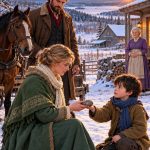
PART 2: THE CAVE HER FATHER HAD KEPT SECRET
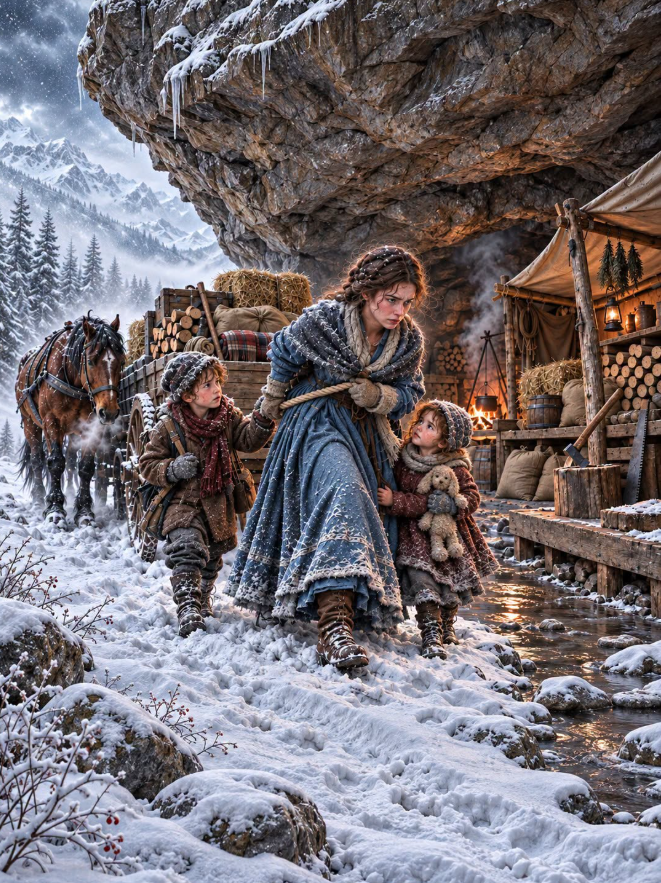
PART 2: THE CAVE HER FATHER HAD KEPT SECRET
Amos looked at Ruth for several seconds before closing the desk drawer.
“Nothing that concerns you.”
Ruth glanced at the fresh scratches around the lock.
“Then why did you lock it?”
“Because your father left debts, and somebody has to settle them.”
“Funny. You seem to know everything about his debts, but nothing about his belongings.”
Amos stepped between her and the desk.
“Your hour is nearly over.”
Ruth studied his face. She had spent eighteen years learning when a person was telling the truth. Her father had taught her that a man who answered a simple question with an insult was usually hiding something.
She didn’t argue.
Instead, she picked up the last bundle of blankets and carried it outside.
By the time Amos closed the front door behind her, the wagon was loaded, the children were seated beneath the canvas, and Boon was standing impatiently in the traces.
Ruth climbed onto the driver’s bench.
“Where are we going?” Eli whispered.
“Somewhere nobody can throw us out.”
June pulled her rabbit closer.
“Will Mama be there?”
Ruth looked toward the house.
“No, sweetheart. But we’ll take her with us.”
She clicked her tongue, and Boon started down the road.
Behind them, Amos stood on the porch.
He didn’t wave.
He didn’t apologize.
He simply watched until the wagon disappeared beyond the bend.
Ruth never saw him again that winter.
But she would remember his expression.
It was not the face of a man who had just collected a debt.
It was the face of a man afraid of what somebody might discover.
The road toward Half Moon Creek was barely recognizable.
Snow covered the wagon tracks, and the trees leaned over the narrow trail. Ruth kept Boon moving slowly, stopping whenever the wheels slipped against buried rocks.
Eli sat beside her, holding the reins whenever she needed to climb down and check the wagon.
June remained beneath the blankets.
“How far?” Eli asked.
“Another mile, perhaps.”
“You said that half an hour ago.”
“I was hoping the mountain had moved closer.”
He almost smiled.
Ruth looked at him.
“You remember the place?”
“Some of it.”
“Father took us there once. You were little.”
“I remember the cave. And the creek.”
“Then you’ll recognize it.”
Eli nodded, but his expression remained worried.
He was nine years old, yet he had started looking at the world like a grown man. Since their father’s death, he had begun checking the doors at night and counting the food in the pantry.
 Ruth hated that.
He should have been worrying about sleds, Christmas, and whether the creek would freeze enough to walk across.
Instead, he was trying to calculate how long three people could survive with two sacks of flour.
She reached over and squeezed his shoulder.
“You’re allowed to be a boy, Eli.”
He stared at the road.
“Somebody has to help.”
“You already do. But you don’t have to carry everything.”
He didn’t answer.
They reached the cave shortly before sunset.
The limestone opening stood beneath a high rock shelf, partly concealed by pine branches. The old timber lean-to remained, although one corner had collapsed.
Ruth climbed down and inspected the entrance.
The cave was deeper than she remembered.
A natural stone chamber extended perhaps thirty feet into the mountain, with a dry section toward the back and a narrow pᴀssage disappearing behind a wall of uneven rock.
Boon snorted.
June peeked through the canvas.
“Is that our house?”
“For now,” Ruth answered.
June looked uncertain.
“It doesn’t have a chimney.”
“We’ll manage.”
The first task was clearing the entrance.
Ruth and Eli removed loose branches and old timber while June gathered smaller sticks. The wagon was backed beneath the rock overhang, where it would be protected from falling snow.
They unloaded only what they needed.
The cave floor was uneven, but much of it appeared dry. Ruth spread the blankets over the raised section and arranged their provisions along the wall.
She kept the food covered.
She made a small fire in the open area near the entrance, where smoke could escape without filling the chamber.
It wasn’t comfortable.
It wasn’t pretty.
But it was shelter.
For the first time since leaving Leadville, Ruth allowed herself to sit down.
June crawled beside her.
“Can we have Christmas here?”
Ruth looked at the little girl.
“Of course.”
“Will there be presents?”
Ruth glanced at the wagon.
There was nothing wrapped beneath the blankets.
No money for toys.
No tree.
No church service.
But she remembered the small wooden horse her father had carved for Eli years earlier.
She had packed it without thinking.
“Your brother has something.”
Eli looked up.
“Me?”
“The wooden horse.”
He reached into the wagon and found it beneath the tool chest.
June’s face brightened.
“Can I play with it?”
Eli handed it to her.
“You can borrow it.”
June hugged the little horse.
For a few minutes, the cave sounded like a home.
Then the wind changed.
The first warning came shortly after midnight.
Boon began stamping in the traces.
Ruth woke immediately.
She stepped outside with the lantern and saw the sky.
It had turned an unusual shade of gray, even though the moon had been bright when she went to sleep.
The wind was coming down from the higher peaks.
Not blowing across the valley.
Coming down.
It carried a strange, deep sound, like distant machinery.
Ruth returned to the cave.
“Eli. Wake up.”
He sat upright.
“What happened?”
“Help me check the wagon.”
They secured the remaining supplies and moved Boon farther beneath the overhang.
When Ruth returned, she found June sitting up, rubbing her eyes.
“Is it morning?”
“Not yet.”
“Why is the wind angry?”
Ruth pulled the blanket around her.
“Mountains sometimes make their own weather.”
But she had never heard anything like this.
By sunrise, the snow was falling so heavily that the entrance had nearly disappeared behind a white curtain.
The temperature dropped again.
Then again.
The water in their kettle began freezing whenever it was left away from the fire.
Ruth knew they could not travel.
The wagon could not move through the storm, and Boon was too old to fight the mountain wind.
They were staying.
On the second day, Ruth noticed something strange.
The cave was warmer toward the back.
Not by much, but enough that June stopped complaining about her feet.
Ruth carried the lantern deeper inside.
She held her palm against the limestone wall.
It wasn’t warm exactly.
But it wasn’t as cold as the entrance.
She examined the uneven stones and noticed a narrow line running vertically behind a cluster of old hay.
The wall looked different there.
The stones were fitted together more carefully than the surrounding rock.
“Ruth?”
Eli stood behind her.
“What are you looking at?”
“Do you remember Father ever mentioning this part of the cave?”
Eli shook his head.
“No. But he told me not to climb near the back when I was little.”
Ruth turned.
“Why?”
“He said the stones were loose.”
She examined the wall again.
A small piece of timber protruded from a crack near the floor.
It was old, almost black with age.
She touched it.
Something shifted behind the stones.
Ruth stepped back.
Eli stared.
“Was that supposed to happen?”
“I don’t know.”
She fetched the lantern and examined the opening more carefully.
There was a gap behind the fitted limestone.
And something was moving air through it.
A faint current brushed her cheek.
Ruth looked at her brother.
“Stay with June.”
“Where are you going?”
“To find out what Father knew.”
By the third day, the storm had become something nobody in the valley had seen before.
The sky remained dark throughout the afternoon. Snow piled against the rock shelf, and the wind carried it in enormous sheets across the mountainside.
Ruth had heard stories about terrible winters, but stories were different from watching the world disappear beyond the cave entrance.
They had enough food for several days if they rationed carefully.
Boon had hay.
The children were frightened, but neither complained.
That evening, Ruth returned to the strange wall.
She removed the loose hay and studied the timber.
It wasn’t a natural formation.
Someone had built a small wooden frame behind the stones.
Her father had known about it.
Perhaps he had even helped construct it.
She found a narrow iron ring hidden beneath a layer of dust.
When she pulled gently, a wooden panel shifted.
A breath of air escaped.
Ruth raised the lantern.
Behind the panel was a narrow pᴀssage leading deeper into the mountain.
Eli appeared beside her.
“I knew it.”
“You knew what?”
“Father didn’t bring us here just to show us a cave.”
Ruth turned toward him.
“What do you mean?”
Eli hesitated.
“Before he died, I heard him talking to Uncle Amos.”
Her stomach тιԍнтened.
“When?”
“The week before the wagon accident.”
Ruth crouched.
“What did they say?”
Eli looked toward June, who was asleep beneath the blankets.
“Uncle Amos wanted Father to give him something. Father said it wasn’t his to sell.”
Ruth felt the cold travel down her back.
“What wasn’t his to sell?”
Eli shook his head.
“I don’t know.”
Then he reached into his pocket.
He pulled out a small brᴀss key.
“I found this in Father’s coat after the funeral. I kept it because I thought it belonged to his toolbox.”
Ruth stared at it.
There was a tiny mark on its head.
A star.
She looked at the wooden panel.
Then at the key.
And suddenly understood that her father had not brought them to Half Moon Creek merely because it offered shelter.
He had brought them there because he had wanted someone to find what lay behind that wall.
Ruth took the key.
It fitted into a small lock concealed beneath the iron ring.
She turned it.
Something clicked.
The wooden panel opened another few inches.
Inside, the lantern revealed a metal box resting on a shelf.
And carved into its lid were four words.
THOMAS CALDER’S TRUE DEBT.
Ruth stared at the inscription.
Behind her, Eli whispered:
“Ruth, why would Father hide a debt in a cave?”
She didn’t answer.
Because beneath the inscription, someone had carved another sentence.
One that made her hands tremble.
IF AMOS FINDS THIS, WE ARE ALL IN DANGER.
TO BE CONTINUED…