Part 2 — The Secret Wyatt Had Never Told His Wife
Part 2 — The Secret Wyatt Had Never Told His Wife
By midnight, the snow had swallowed the trail leading to Wyatt’s cabin.
Wind rattled the shutters, and the fire snapped in the hearth. Cora stood near the window, watching the white darkness outside.
“Is it always this bad?” she asked.
“Not always.”
“That’s reᴀssuring.”
Wyatt glanced up from the chair where he was repairing a leather strap. “You’re welcome.”
Cora turned toward him. “You have a remarkable talent for making a person feel welcome.”
“I warned you in my letter.”
“You warned me about the cold. You forgot to mention the conversation would be just as freezing.”
For a moment, Wyatt stared at her.
Then something unexpected happened.
He laughed.
It wasn’t a loud laugh. It sounded rusty, as though he hadn’t used it in years. But it changed his entire face. The hard lines around his mouth softened, and Cora suddenly understood that the man sitting across from her wasn’t quite as unpleasant as he pretended to be.
“You’re different from what I expected,” he admitted.
“So are you.”
“How?”
“I thought you would be impossible to live with.”
“And now?”
Cora considered him. “I’m still deciding.”
Wyatt shook his head and returned to his work, but the faint smile remained.
The following morning, he kept his promise.
He showed Cora how to recognize safe places along the creek, how to use the axe without straining herself, and how to judge the thickness of the ice before approaching it.
 He never mocked her when she made a mistake.
When she finally broke through a thin section and sent a splash of freezing water across her boots, Wyatt caught her arm and pulled her back.
“That’s enough for today.”
“I nearly had it.”
“You nearly had a wet foot and a miserable afternoon.”
“I can manage a miserable afternoon.”
“I know. That’s what worries me.”
She looked at him, surprised by the concern in his voice.
On the walk home, Wyatt carried the bucket while Cora followed his footprints.
For the first time, the silence between them didn’t feel uncomfortable.
It felt peaceful.
Over the next several days, the cabin began to change.
Cora washed the curtains, organized the pantry, and moved the hunting equipment into a small storage room. Wyatt complained about every rearrangement, but he never moved anything back.
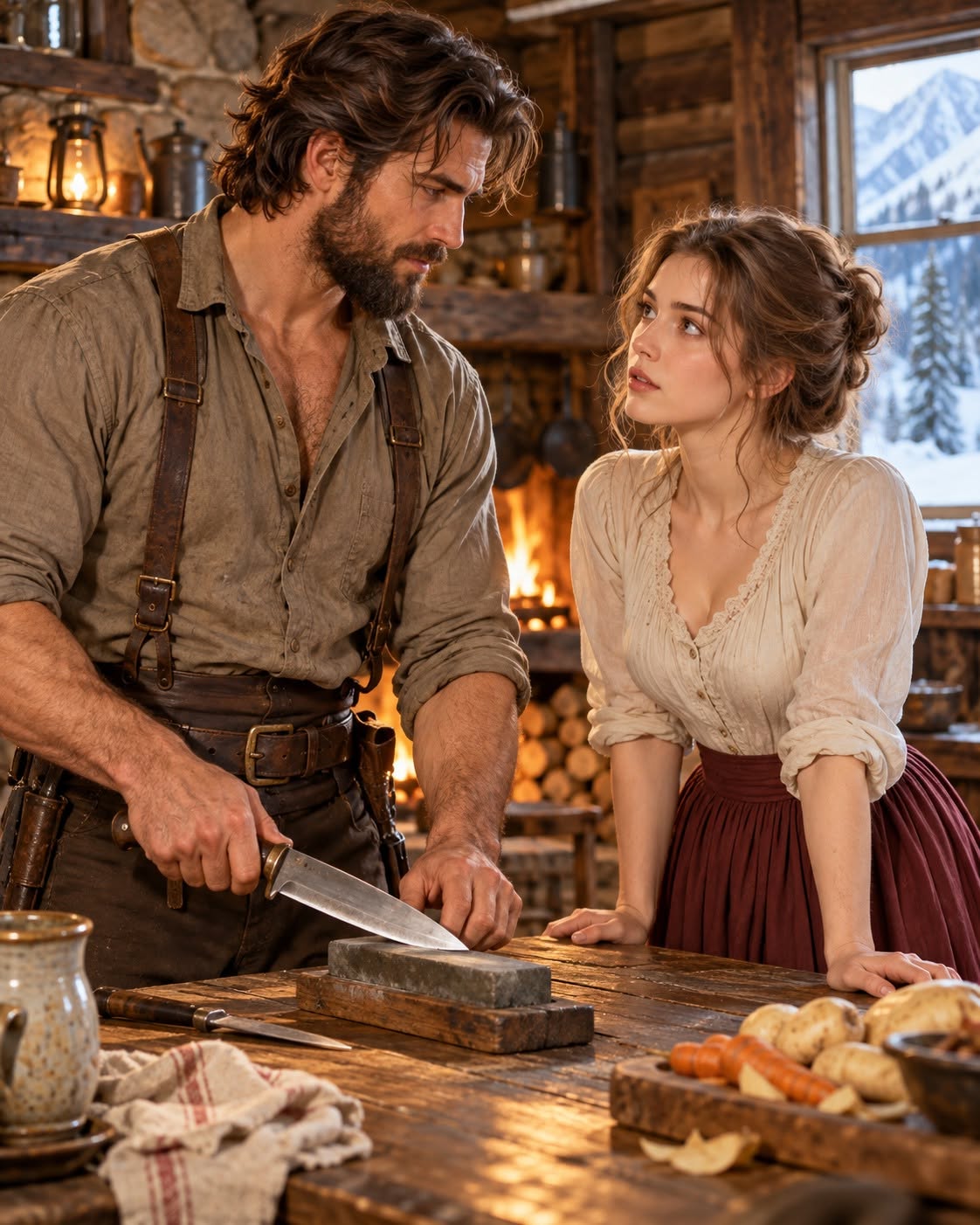
She also discovered that he was a terrible cook.
His idea of supper involved meat, salt, and whatever could be boiled in a pot.
One evening, she placed a plate of freshly baked biscuits beside his stew.
Wyatt examined them suspiciously.
“What are these?”
“Biscuits.”
“I know what biscuits are.”
“Then why are you looking at them like they might attack you?”
He broke one open. Steam rose from the soft center.
He took a bite.
Then another.
Cora folded her arms. “Well?”
“They’re acceptable.”
“Acceptable?”
“Quite acceptable.”
“That’s the finest compliment you’ve given me since I arrived.”
Wyatt reached for a third biscuit.
Cora smiled.
But her happiness didn’t last long.
The following afternoon, while searching through a cupboard for clean cloth, she found a small wooden box tucked behind a stack of old blankets.
Inside lay a faded pH๏τograph of a young woman standing beside Wyatt.
The woman was smiling.
Wyatt looked younger in the picture, too. His beard was shorter, his shoulders less burdened, and one arm rested gently around the woman’s waist.
Cora stared at the pH๏τograph.
“Who is she?”
The sound of footsteps stopped behind her.
Wyatt stood in the doorway.
For several seconds, he said nothing.
“Her name was Margaret,” he finally answered.
“Your wife?”
He nodded.
Cora carefully placed the pH๏τograph back in the box.
“I’m sorry. I didn’t mean to pry.”
“She died seven years ago.”
His voice was flat, but his fingers тιԍнтened around the doorframe.
Cora looked at him. “Were you married long?”
“Three years.”
“And you loved her?”
Wyatt lowered his eyes.
“More than I knew how to say.”
Cora felt an unfamiliar ache in her chest.
She had known Wyatt was lonely. She hadn’t realized his loneliness had a name.
“Why didn’t you tell me?” she asked quietly.
“Because you didn’t come here to hear about a ᴅᴇᴀᴅ woman.”
“No,” Cora replied. “I came here to marry you. I think that means I should know something about the life you had before me.”
Wyatt looked at her for a long moment.
Then he walked past her and picked up the box.
“Margaret loved this place,” he said. “She used to sit by that window and read while I worked outside. She wanted a garden in the spring. Said the mountain needed flowers.”
He paused.
“I never planted them.”
Cora glanced toward the snow-covered window.
“Perhaps you should.”
Wyatt looked at her as though the suggestion had never occurred to him.
That night, Cora couldn’t sleep.
She lay beneath the thick blankets, listening to the wind and the occasional creak of the cabin.
Then she heard a noise from the kitchen.
A heavy thud.
She sat up.
“Wyatt?”
No answer.
She reached for the lamp and stepped into the hallway.
The kitchen was empty, but the back door stood slightly open.
Cold air swept across the floor.
“Wyatt?”
Then she heard his voice outside.
“Stay inside, Cora!”
Naturally, she did not.
She pulled on her coat and hurried to the doorway.
Wyatt was near the woodpile, struggling to keep a large section of the roof’s outer covering from breaking loose in the wind. Snow had gathered around his boots, and another gust threatened to pull the loose boards away.
“Get back inside!” he shouted.
“Not until you tell me what happened!”
“The storm loosened the boards. Go!”
Cora looked at the roof, then at the rope lying near the woodpile.
“Tell me what to hold.”
Wyatt hesitated.
For the first time, he seemed torn between ordering her away and accepting her help.
“Take the rope. Keep clear of the loose boards.”
She did exactly as he instructed.
Together, they secured the covering enough to protect the cabin until morning. When they finally stepped inside, both were exhausted.
Wyatt closed the door and leaned against it.
“You should have stayed inside.”
“You should have asked for help.”
“I could have handled it.”
“Perhaps. But you didn’t have to handle it alone.”
He stared at her.
Those words seemed to reach somewhere deeper than she intended.
After a long silence, Wyatt removed his gloves.
“Margaret used to say that.”
Cora lowered her eyes.
“I’m not trying to replace her.”
“I know.”
“And I don’t expect you to forget her.”
“I know that, too.”
He looked toward the small wooden box on the shelf.
“After she died, I stopped thinking about the future. I kept this cabin running because it was what I knew how to do. Then last winter, when I broke my leg, I realized something.”
“What?”
“I could survive out here. But I couldn’t keep living as though surviving was all that mattered.”
Cora stood quietly.
Wyatt looked at her.
“That’s why I sent for a wife. I thought I needed someone to keep the house running. Someone to make sure I didn’t freeze or starve if I got hurt again.”
“And now?”
His gaze moved around the kitchen.
At the clean table.
The warm stove.
The biscuits Cora had covered with a cloth.
“I think I forgot that a person can need more than help.”
Cora felt her throat тιԍнтen.
“Wyatt, I didn’t come here expecting a grand romance. I came because I wanted a home where nobody could decide my future for me.”
He nodded slowly.
“Then I hope this can become that home.”
The next morning, Cora discovered something unusual.
A small parcel sat on the kitchen table.
It was wrapped in brown paper and tied with a piece of faded blue ribbon.
“For you,” Wyatt said.
She looked at him suspiciously.
“Is it another knife?”
“No.”
“An axe?”
“No.”
“Then I’m almost disappointed.”
Wyatt pushed the parcel toward her.
Inside was a pair of sturdy leather gloves, a warm wool shawl, and a small packet of flower seeds.
Cora touched the packet.
“Where did you find these?”
“They were in the trading post. The shopkeeper said they might grow in a mountain garden.”
She looked up.
“You remembered what I said about Margaret’s flowers.”
Wyatt nodded.
“I thought the spring might be a good time to try.”
Cora held the seeds carefully.
For a moment, neither spoke.
Then she stepped closer and placed one hand over his.
“Thank you.”
Wyatt looked down at their joined hands.
He didn’t pull away.
But before either could say another word, three sharp knocks sounded at the front door.
Wyatt’s expression changed immediately.
He crossed the room and opened it.
A stranger stood on the porch, covered in snow. He was carrying a leather satchel and holding a folded envelope.
“Wyatt Blackwood?”
“Who wants to know?”
The stranger glanced past him and noticed Cora.
“Is this your new wife?”
Wyatt stepped into the doorway.
“What is this about?”
The man handed him the envelope.
“Your brother sent me. He says you’ve ignored his letters long enough.”
Wyatt’s face went pale.
Cora had never heard him mention a brother.
He opened the envelope and read the message.
Then he read it again.
His fingers began to tremble.
“What does it say?” Cora asked.
Wyatt folded the letter.
“Nothing you need to worry about.”
But Cora noticed the name written at the bottom.
Thomas Blackwood.
And beneath it, in a second line, were five words that made her heart sink.
I know what happened to Margaret.
Wyatt stared at the letter as though the past had suddenly returned to claim him.
Then he looked at Cora.
“There’s something about my first marriage I never told you.”
Outside, the stranger stepped away from the porch.
And for the first time since their wedding, Cora wondered whether the greatest challenge to their marriage would come not from the mountain, but from the secrets Wyatt had buried there.