PART 5 — THE HOME THAT LOVE BUILT
PART 5 — THE HOME THAT LOVE BUILT
The following morning, Clara woke to the sound of Silas moving around the kitchen.
For once, he wasn’t preparing to leave before sunrise.
He had made coffee, warmed yesterday’s bread, and placed a small vase of blue wildflowers in the middle of the table.
Clara stopped in the doorway.
“What’s the occasion?”
Silas looked up.
“I thought we deserved one peaceful breakfast before the whole county starts asking questions.”
She smiled and sat down.
He poured her coffee.
Then he placed a folded piece of paper beside her cup.
“What is this?”
“A letter to the county clerk. I’m asking for an official examination of the northern spring and the mining records.”
Clara read it carefully.
“You’re including the neighboring farms?”
“Of course. If the spring belongs to the land, the people who depend on it deserve to be heard.”
She looked up.
“Your father would have been proud.”
Silas glanced toward the blue flowers.
“I hope so.”
For a moment, they sat quietly.
Then Clara reached across the table and touched his hand.
“Silas, there’s something I’ve been wanting to ask you.”
“Go ahead.”
“Do you ever feel guilty when you remember Elizabeth?”
His expression changed.
He looked toward the window before answering.
“Sometimes.”
Clara waited.
“I spent so long believing that if I allowed myself to be happy again, it meant I was leaving her behind. She was a good woman. She deserved a long life.”
“Loving someone again doesn’t erase the love you had before.”
“I know that now,” he said quietly. “I’m still learning to believe it.”
Clara looked at the blue flowers.
 “Then let’s keep them.”
Silas followed her gaze.
“Elizabeth’s flowers?”
“Yes. They were part of her life. We don’t have to hide them away to make room for ours.”
He nodded slowly.
“Thank you, Clara.”
She smiled.
“Besides, I think the kitchen looks better with them.”
Silas laughed.
And that small sound made the room feel warmer than the fire.
Two weeks later, the county hearing began.
Farmers, ranchers, and shopkeepers gathered inside the courthouse. Some had traveled for hours through difficult weather because they feared losing the water that kept their land alive.
Clara sat beside Silas.
Whitcomb stood before the county officials and admitted his involvement in the false property transfers. He presented the original documents and explained how the records had been altered.
The evidence was examined carefully.
The ledger showed that silver had been removed from the northern ridge without proper authorization. The original maps established the rightful property boundaries, and the water records demonstrated that the spring had long served the neighboring farms.
Cyrus Bell’s representatives argued that the company had acted under an earlier agreement.
But the original documents proved otherwise.
When Clara was asked to speak, she stood.
Her hands trembled slightly, but her voice remained steady.
“My father made mistakes,” she began. “He trusted the wrong people, and for a time, he believed silence would protect me. But he also spent his final years trying to correct what had happened.”
She placed his letter on the table.
“I cannot change the past. I cannot bring back the people who lost their farms or restore the years they spent fighting for what was theirs. But I can refuse to let the same thing happen again.”
She looked around the courtroom.
“The northern land is mine by inheritance. But the spring is important to more than one family. I don’t want to use it to make myself wealthy. I want it protected so the farms below the ridge can continue to grow and the people who depend on it can remain in their homes.”
Silence filled the room.
Then Silas stood.
“My father believed a man’s worth was measured by what he protected, not simply by what he owned. I didn’t understand that when I was younger. I understand it now.”
He looked at Clara.
“I support her decision completely.”
By the end of the hearing, the county ordered a full investigation into the mining operation. The disputed transfers were suspended, and the original land boundaries were recognized.
Bell could no longer claim the northern ridge through the false agreements.
The silver operation was placed under review, and the water rights were protected.
Whitcomb agreed to cooperate with the investigation and accept responsibility for his part in the deception.
For Clara, the greatest victory wasn’t the land.
It was knowing that her father’s final efforts had not been wasted.
Outside the courthouse, Silas helped her down the steps.
“Well,” he said, “I believe we have earned a proper supper.”
Clara laughed.
“Are you inviting me to dinner, Mr. Mercer?”
“I believe I’m asking my wife.”
“Then I accept.”
Spring arrived slowly in Copper Ridge.
The snow retreated from the mountains, wildflowers appeared along the creek, and the northern pasture turned green again.
With the land dispute resolved, Clara and Silas made a decision that surprised many people in town.
They would not sell the northern ridge.
Instead, they created a small cooperative with the neighboring farmers. The spring would remain protected, and the land would be managed so that no single company could take control of the water.
Silas also began repairing the old cabin near the ridge.
Clara asked him why.
He explained that it had once belonged to her father.
“I thought it deserved another chance,” he said.
Together, they restored the roof, repaired the windows, and built a small porch overlooking the valley.
Clara placed a table near the window and covered it with a new white cloth embroidered with blue wildflowers.
Silas noticed it immediately.
“Another one?”
She smiled.
“The first one brought us together. I thought this house deserved its own.”
He ran his fingers along the embroidery.
“Your mother taught you to make these?”
“Yes. She used to say flowers made even an ordinary room feel welcoming.”
Silas looked at her.
“She was right.”
Then he handed her a small wooden box.
Inside was a silver ring with a simple blue stone.
Clara looked up in surprise.
“Silas…”
“I know we’re already married,” he said. “But I wanted to give you something that had nothing to do with our fathers’ agreement, your inheritance, or the land.”
He paused.
“I wanted to ask you again, this time with no papers between us.”
Clara’s eyes filled.
“Will you build a life with me, Clara Whitfield? Not because someone arranged it. Not because either of us needs protection. Because we choose each other.”
She held out her hand.
“Yes, Silas. I choose you.”
He placed the ring on her finger.
And when he kissed her forehead, there was no fear in his expression, only the quiet happiness of a man who had finally stopped running from the possibility of love.
They held a small celebration that summer.
There were no grand decorations or expensive guests. Just neighbors, a few ranch hands, Ruth Bell from the old survey office, and the farmers who had helped defend the northern ridge.
Clara wore a simple cream-colored dress.
Silas stood beside her beneath the cottonwood tree outside their cabin.
On the table rested the old blue-flower cloth, a pot of fresh coffee, and a little vase of wildflowers.
During the celebration, Silas raised his cup.
“I used to believe a quiet house was a peaceful house,” he told the guests. “I thought needing nobody was a kind of strength.”
He looked at Clara.
“Then a woman arrived carrying one suitcase and a tablecloth. She filled my empty kitchen with flowers, and somehow, without asking for anything, she reminded me how to live.”
Clara lowered her eyes, smiling.
Silas continued.
“I cannot promise that every winter will be easy. There will be difficult days, hard work, and moments when neither of us knows what to do next. But I can promise that she will never have to wonder whether she belongs here.”
He took her hand.
“Because this is her home as much as it is mine.”
The guests applauded.
And Clara realized that the lonely man who had once offered her a bedroom and disappeared upstairs was now standing before their friends, openly declaring that he wanted a future with her.
That evening, after everyone had gone, they sat together beside the fire.
Silas poured two cups of coffee.
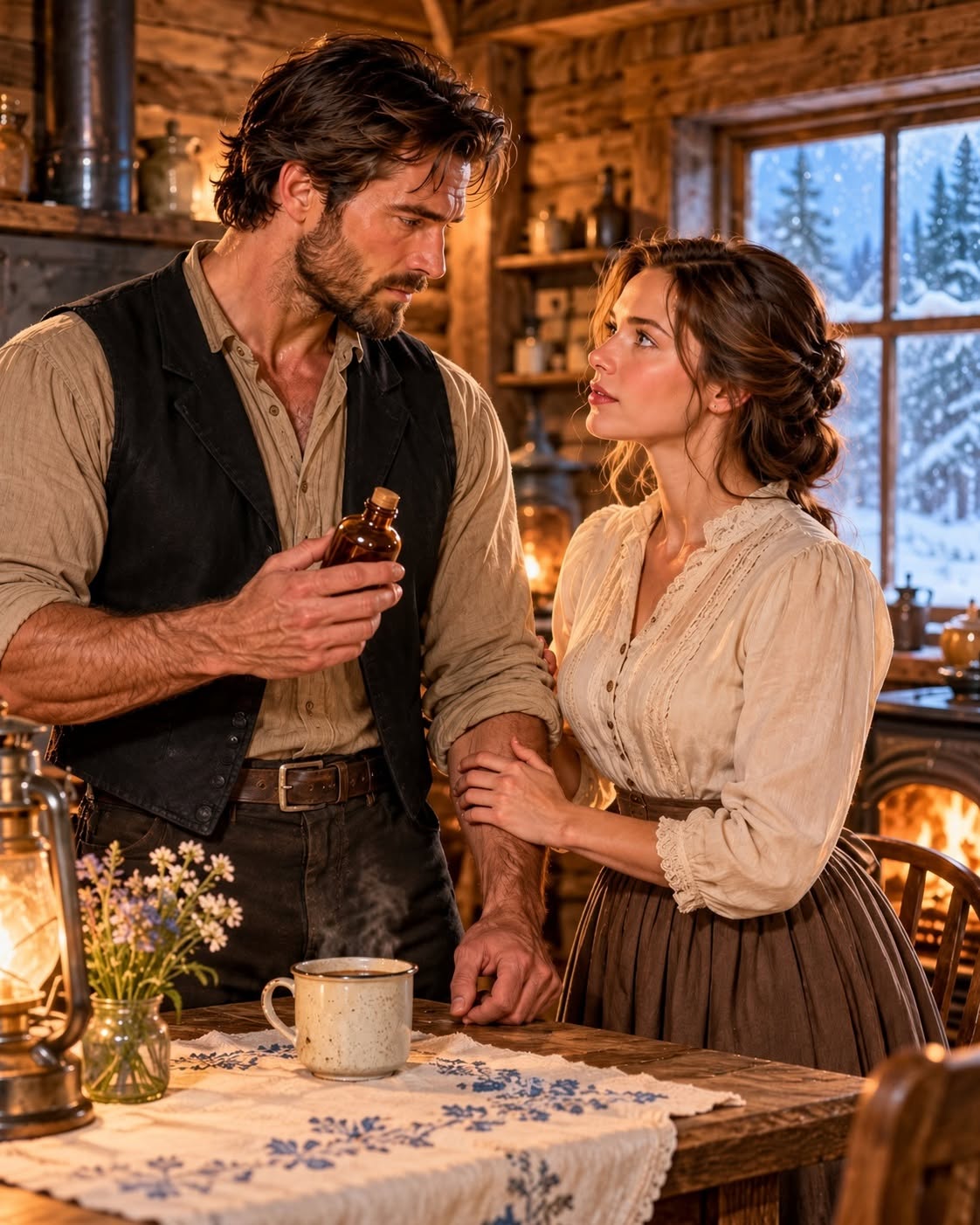
Clara noticed a familiar little brown bottle beside his cup.
“You still keep it?” she asked.
He picked it up.
“Of course.”
“My mother’s liniment?”
“The first gift you ever gave me.”
She laughed.
“It was hardly a romantic gift.”
“Perhaps not. But it was the first time someone noticed I was hurting and cared enough to do something about it.”
He placed the bottle carefully on the shelf.
“That’s when I began to understand that marriage could be more than sharing a roof.”
Clara leaned back in her chair.
“And what is it now?”
Silas looked around the cabin.
The blue flowers sat beside the window. The fire glowed warmly, and their two cups rested side by side on the table.
“It’s knowing someone will notice when your coffee goes cold because you’re worried,” he said. “It’s having someone to tell your stories to. It’s making plans for tomorrow because you finally want tomorrow to come.”
Clara reached for his hand.
“Then I think we’re doing rather well.”
He smiled.
“Yes, Mrs. Mercer. I believe we are.”
Years pᴀssed.
The little cabin became a gathering place for neighbors, travelers, and families who needed a warm meal during the winter.
The northern spring continued to provide water to the farms below the ridge, and the old mining records remained safely preserved in the county office.
Clara helped establish a small schoolhouse for the children of the surrounding settlements. Silas donated the timber and helped build the benches himself.
He still worked the ranch, but he no longer measured his life only by cattle, fences, and accounts.
He measured it by the sound of Clara reading beside the window, by the blue flowers returning each spring, and by the familiar warmth of two cups of coffee waiting on the table.
One autumn morning, Clara found him standing outside, watching the sun rise over the mountains.
She walked up beside him.
“What are you thinking about?”
Silas took her hand.
“The night you arrived.”
“You barely spoke to me.”
“I remember.”
“You told me the bedroom was mine and then disappeared upstairs.”
He laughed.
“I was afraid I’d say something foolish.”
“And now?”
He looked at her.
“Now I’m afraid of running out of years to tell you how grateful I am.”
Clara rested her head against his shoulder.
“You don’t have to say it every day.”
“I know.”
He glanced toward the cabin.
“But I’ll keep making the coffee.”
She smiled.
“That would be a fine beginning.”
Together, they watched the sunlight spread across the valley.
Silas had once expected a loveless marriage, a quiet arrangement, and a woman who would simply share his cabin.
Instead, he had found a partner who understood his grief without demanding that he forget it, who saw his pain without making him feel weak, and who taught him that a home was not made peaceful by silence.
It was made peaceful by trust.
And beside his morning coffee, the little brown bottle remained on the shelf—not as a reminder of an old injury, but as a reminder of the first time Clara had shown him that he no longer had to carry every burden alone.
THE END — SOMETIMES THE GREATEST INHERITANCE IS NOT LAND, SILVER, OR MONEY. IT IS THE LOVE THAT MAKES A HOUSE FEEL LIKE HOME.