PART 4 — THE LITTLE YELLOW DRESS AND THE HOME THEY BUILT
PART 4 — THE LITTLE YELLOW DRESS AND THE HOME THEY BUILT
The old survey office stood beyond the abandoned railroad station, half-hidden beneath snow and surrounded by tall, leafless trees.
Ruth Bell led Jackson and Eliza through its narrow doorway.
Dust covered the desks. Old maps hung from the walls, and a broken clock remained frozen at ten minutes past three.
“I haven’t been here in years,” Ruth said. “Your mother and I used to work at that desk.”
She pointed toward a wooden cabinet at the back of the room.
“The key opens the bottom drawer.”
Jackson helped Eliza across the uneven floor. She was tired, and the baby had been particularly active that morning, but she refused to let the others go without her.
Ruth inserted the key.
The drawer opened with a soft click.
Inside was a leather-bound ledger, several rolled maps, and a sealed envelope bearing Eliza’s name.
Her fingers trembled as she opened it.
My dearest Eliza,
If this letter has reached you, then the truth has finally survived longer than the people who tried to bury it.
I need you to understand something about the northern land. It was never intended to make you rich. It was meant to give you a place where nobody could force you to leave.
Jonathan Thorne helped me protect it because he believed the railroad was taking advantage of families who could not afford to defend themselves.
He also made me promise something.
If you ever met his son, Jackson, you should know that the Thorne family did not take your inheritance. They protected it. His father wanted the land to remain yours, even if that meant his own family would never own it.
Eliza paused.
She looked at Jackson.
He was standing beside her, reading the letter over her shoulder.
The next paragraph made her eyes fill.
I hope you will forgive me for not telling you everything when you were young. I wanted you to grow up knowing love, not fear. I wanted you to have a chance to choose your own future.
 If you find yourself at the Thorne ranch, remember that a home is not built from land or money. It is built by the people who choose to stay when life becomes difficult.
All my love,
Mother.
Eliza pressed the letter against her heart.
For years, she had believed her mother had left her with nothing but an old locket and a few memories.
Now she understood that Margaret had spent her final years trying to protect her daughter’s future.
Ruth opened the ledger.
Inside were the original survey records, the railroad’s altered accounts, and the deed proving that the northern acreage belonged to Eliza Hart.
But there was something else.
A second document, signed by Jonathan Thorne, stated that the ranch could continue using the land for grazing as long as the rightful owner agreed.
Jackson read it carefully.
Then he looked at Eliza.
“This means the ranch can stay where it is,” he said. “The northern pastures don’t have to be sold.”
“And the bank?”
“We’ll still have debts to settle. But the railroad cannot take the land to satisfy a claim that never belonged to them.”
Ruth nodded.
“There’s enough evidence here to challenge their entire agreement. I kept copies of the original records in case the railroad ever tried to destroy them.”
Jackson exhaled slowly.
For months, he had believed he was about to lose everything his father had built.
Now he knew the ranch had a future.
But Eliza was looking at another page.
It was a list of names.
Families whose farms had been included in the railroad’s altered survey records.
Some had lost their land. Others had paid debts that never should have existed.
“My mother kept all these names,” Eliza whispered.
“She wanted the truth known,” Ruth replied. “Not just for herself.”
Eliza turned toward Jackson.
“Can we help them?”
He studied the list.
Then he nodded.
“If the records prove what happened, we’ll help every family we can.”
It was the first decision they made together as partners.
And it would not be their last.
The following weeks brought a remarkable change to the Thorne ranch.
Jackson presented the original records to the county authorities. The documents were examined, and the railroad’s false claims were formally challenged.
Silas Whitcomb denied knowing anything about the altered agreements. But the ledger contained his signature beside several suspicious entries, and his explanations quickly began to fall apart.
The railroad withdrew its demand for the northern acreage.
The bank agreed to restructure Jackson’s remaining debt after the property dispute was resolved. Jackson sold a portion of his surplus cattle, reduced unnecessary expenses, and negotiated better prices for the coming season.
It wasn’t an instant fortune.
There were still long days, difficult decisions, and plenty of work.
But the ranch was no longer facing certain ruin.
And something else changed.
Jackson stopped treating the house like a place he visited between business matters.
He began eating breakfast at the kitchen table.
He asked Eliza what she thought before making important decisions.
He even learned to sew a ʙuттon onto his coat, although Eliza insisted the result looked more like a knot tied by an angry fisherman.
For the first time in years, laughter returned to the ranch house.
As winter deepened, Jackson prepared a proper room for the baby. He repaired the old cradle, painted the walls a soft cream color, and placed a small wooden rocking chair beside the window.
Eliza finished sewing the yellow dress.
She added a tiny embroidered sun near the collar.
One afternoon, Jackson found her sitting beside the cradle, holding the little garment.
“Still worried?” he asked.
“A little.”
“About the baby?”
“About being a mother.”
He sat beside her.
“You’ll be wonderful.”
“You can’t possibly know that.”
“I’ve watched you care for every creature on this ranch as though it mattered. I’ve watched you comfort the men when they were homesick and make a warm meal out of almost nothing.”
He took her hand.
“I don’t need to imagine what kind of mother you’ll be. I’ve already seen the kindness you carry.”
Eliza leaned against his shoulder.
“And what about you?”
“What about me?”
“Are you ready to be a father?”
Jackson looked at the cradle.
“No,” he admitted. “But I intend to learn.”
She laughed softly.
“That’s a good beginning.”
In early March, the first warm winds crossed the Wyoming plains.
The snow began to retreat from the pastures, the cattle grew restless, and the ranch hands started preparing for spring.
Then, one quiet evening, Eliza’s baby finally arrived.
The doctor was summoned from town, and Ruth Bell came to keep Eliza company. Jackson waited outside the bedroom, walking from one end of the hallway to the other.
He had negotiated with bankers, argued with railroad officials, and managed hundreds of cattle.
Yet he had never felt so helpless.
When the doctor finally opened the door, Jackson nearly forgot how to breathe.
“Congratulations, Mr. Thorne,” the doctor said. “You have a healthy little girl.”
Jackson stared at him.
“A girl?”
“A fine, strong little girl.”
A moment later, Ruth appeared.
“You may come in now.”
Jackson entered quietly.
Eliza lay against the pillows, exhausted but smiling. In her arms was a tiny baby wrapped in a soft blanket.
“Come meet your daughter,” she whispered.
Jackson approached the bed.
He looked at the baby’s little face, her dark hair, and the tiny fingers curled around the edge of the blanket.
Then he looked at Eliza.
“She’s beautiful.”
“She has your eyes,” Eliza said.
He sat beside them and gently touched the baby’s hand.
The little fingers closed around his finger.
Jackson’s eyes filled.
“I’ve spent years thinking the greatest thing I could leave behind was a successful ranch,” he whispered.
He looked down at his daughter.
“Now I know better.”
“What shall we call her?” Eliza asked.
Jackson smiled.
“Margaret. After your mother.”
Eliza kissed the baby’s forehead.
“Margaret Thorne,” she whispered.
And for the first time in many years, the old house felt completely full.
By the following summer, the northern acreage was officially registered in Eliza’s name.
She and Jackson decided not to sell it.
Instead, they made an agreement allowing the ranch to use the pastures while setting aside a portion of the land for families who needed a fresh beginning.
The old survey office was restored, and the records helped several local families recover property that had been wrongly taken from them.
Ruth Bell visited often.
She became something like an honorary grandmother to little Margaret, who seemed particularly fond of pulling the ribbons from Ruth’s hat.
As for Jackson, he became a different man.
He still worked hard. He still rose before sunrise and checked the cattle when storms approached.
But he no longer ate alone in his study.
There was always a place for Eliza beside him, and a little wooden cradle near the kitchen whenever their daughter needed to sleep.
One bright afternoon, Eliza stood on the porch watching Jackson carry Margaret across the yard.
The little girl wore the yellow dress her mother had made months before.
It had taken Eliza many evenings to finish, but now it fit perfectly.
Jackson stopped beneath the cottonwood tree.
“Look, sweetheart,” he told the baby. “That’s your mother.”
Eliza laughed.
“I’m right here, Jackson.”
“I know.”
He walked toward her and placed their daughter gently in her arms.
Then he reached into his pocket.
It was her mother’s old gold locket, polished and repaired.
“I thought you should have this back,” he said.
Eliza opened it.
Inside, he had placed a tiny pH๏τograph of Margaret, alongside a new pH๏τograph of their daughter.
Two generations, held together in one small keepsake.
Eliza looked at him.
“You didn’t have to do all this.”
“I wanted to.”
He took her hand.
“There’s one more thing.”
From beneath the porch bench, he retrieved a small wooden sign.
It read:
MARGARET’S HOUSE — A PLACE FOR EVERYONE WHO NEEDS A HOME.
Eliza stared at it.
Jackson explained that they planned to turn the unused guesthouse into a temporary home for women and children who had nowhere safe to go.
Her eyes filled with tears.
“You remembered what I told you,” she whispered.
“I remember everything you tell me.”
She looked toward the wide Wyoming plains, where the afternoon sunlight stretched across the northern pastures.
Months earlier, she had stood in this same house preparing to disappear. She had believed she needed to leave before she became a burden to the man she loved.
Now she understood that she had never needed to earn her place in his life.
Jackson slipped his arm around her shoulders.
“Do you ever think about that morning?” he asked.
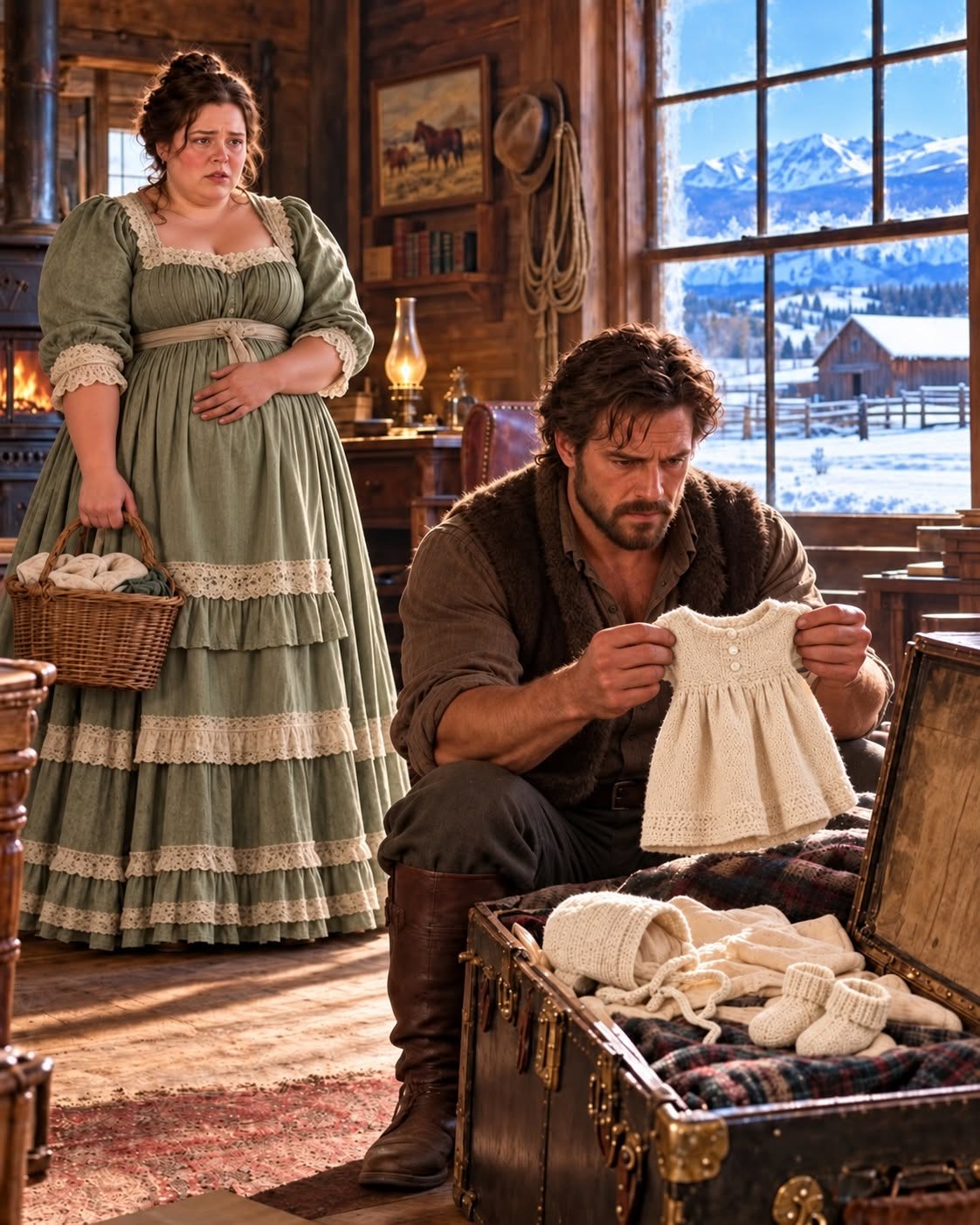
“When you opened the trunk?”
He nodded.
Eliza smiled.
“I thought my whole world was ending.”
“So did I,” he admitted. “Then I found a tiny yellow dress.”
“And what did you find?”
Jackson looked at his wife and daughter.
“My family.”
Eliza rested her head against his shoulder.
The ranch was no longer simply a cattle empire, and the old house was no longer a monument to loneliness.
It had become a home filled with voices, warm meals, small footsteps, and the sound of a baby laughing.
And every spring, when the Wyoming plains turned golden beneath the sun, Eliza dressed little Margaret in the yellow clothes she had once hidden beneath the blankets of an old black trunk.
Not because she was afraid anymore.
But because those tiny garments reminded her of the day a secret almost drove her away—and the day love gave her a reason to stay.
THE END — A FAMILY BUILT ON LOVE, TRUST, AND A SECOND CHANCE.