PART 2 — THE LITTLE GIRL WHO WASN’T AFRAID
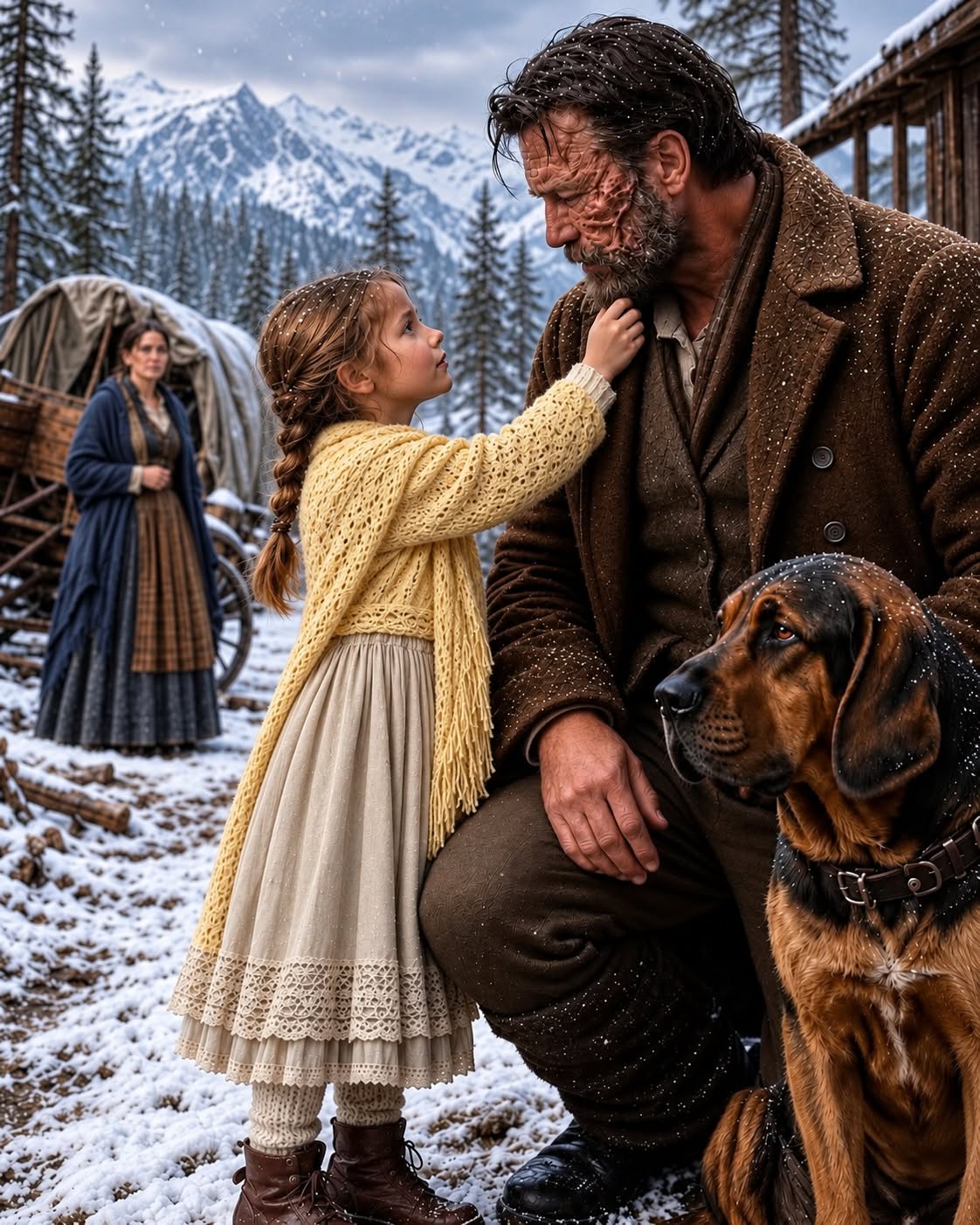
PART 2 — THE LITTLE GIRL WHO WASN’T AFRAID
Rascal’s growl came from deep in his chest.
Gideon Hail stopped with one hand on the cabin door.
For four years, he had heard almost nothing but the wind, the crackle of firewood, and the occasional howl of wolves. He knew the difference between a branch breaking beneath snow and a man stepping on frozen ground.
This was the latter.
He turned toward the trail.
Through the thickening snowfall, a wagon emerged between the pines. One wheel leaned at an ugly angle. The horse pulling it was thin, its breath rising in pale clouds. A man walked beside it, one hand gripping the reins, the other pressed against his chest.
The wagon lurched forward another few yards before stopping.
Then Gideon saw the woman.
She sat on the driver’s bench, wrapped in a faded brown shawl, her face pale with exhaustion. Beside her sat a little girl in a red wool coat, her feet barely reaching the wagon’s floor.
Seven years old, perhaps.
The child noticed Gideon first.
She stared at his scarred face for a moment, then climbed down from the wagon before her mother could stop her.
“Ellie!” the woman called.
But the girl was already walking toward him.
Gideon stood still.
He had seen fear in children’s eyes so often that he had learned to recognize it before they began crying. He expected the little girl to stop halfway, perhaps hide behind her mother.
Instead, she came right up to him.
She tilted her head.
“Did it hurt?”
Gideon looked down at her.
The question was so simple that, for a moment, he didn’t know what to do with it.
The child pointed gently toward the damaged side of his face.
“Your scars,” she explained. “Did they hurt when you got them?”
He hadn’t spoken to another person in four years.
He could have answered. His voice still worked. He knew that much.
But the words had become strangers, and he had no idea how to welcome them back.
So he said nothing.
The little girl seemed to accept his silence as an answer.
She turned toward the wagon.
“Mama can fix that.”
The woman hurried down from the bench.
“Ellie, sweetheart, you mustn’t bother the gentleman.”
But the child shook her head.
“I’m not bothering him. I’m telling him.”
The woman looked at Gideon.
 “I’m sorry,” she said. “We’ve been traveling since sunrise. My daughter talks when she’s frightened, and I’m afraid the cold has made her—”
Her sentence broke apart when she began coughing.
It was a deep, painful cough.
The man beside the wagon turned toward her.
“Clara, you need to sit down.”
“I’m fine, Thomas.”
She wasn’t.
Gideon saw the way her knees trembled. He saw the bluish color at the edges of her lips. He saw the man’s desperate attempt to hide his own exhaustion.
And he saw the wagon.
A broken wheel. A torn canvas covering. Two blankets. A small wooden chest.
Everything they owned, apparently.
The storm was getting worse.
Gideon looked toward the trail behind them. The mountain road was already disappearing beneath the snow.
He had two choices.
He could let them continue toward the valley, where the nearest settlement was twelve miles away.
Or he could open his door.
He hadn’t allowed strangers inside his cabin in seven years.
Not since the fire.
Not since the screams.
Not since the day he had learned that sometimes a man could survive something that should have killed him and still lose everything worth surviving for.
The little girl tugged at her mother’s sleeve.
“Mama, he’s cold.”
Gideon glanced down.
She was looking at his open coat.
He almost smiled.
Almost.
Then he stepped aside and pointed toward the cabin.
The woman stared at him.
“Are you sure?”
He nodded once.
That was all.
But for Clara Whitmore, it was enough.
“Thank you,” she whispered.
And the mountain hermit who had spent four years avoiding the sound of another human voice found himself opening his front door for a woman, a little girl, and a secret that would soon change everything.
The cabin was warm.
Not comfortable, exactly. Gideon had never cared much about comfort. But it was dry, solid, and safe from the storm.
Clara sat near the fire while Thomas examined the broken wagon wheel outside. Ellie had already made friends with Rascal, who seemed to have forgotten his age and dignity entirely.
Gideon placed a pot of stew on the table.
Clara watched him carefully.
“You don’t have to do all this,” she said.
He set down three bowls.
She looked at his hands.
They were enormous, scarred by years of work, but surprisingly gentle as he placed a spoon beside Ellie’s bowl.
“Thank you,” she said again.
Gideon sat at the far end of the table.
He didn’t eat.
He watched.
He watched Clara struggle to hold her spoon. He watched Thomas return with snow in his hair and a worried expression on his face. He watched Ellie eat as though the stew were the finest meal she’d ever tasted.
And he noticed something else.
The child kept looking at him.
Not at his scars.
At him.
As though she were trying to understand the man behind them.
After supper, Clara finally explained.
“We were traveling to Bellweather,” she said. “My husband has family there. We hoped to reach the town before winter.”
Thomas lowered his eyes.
“We should have left sooner.”
Clara shook her head.
“We had no choice.”
Gideon looked at her.
She seemed to understand the question.
“My husband lost his work in the spring. We sold our home. I thought we could start over in Bellweather.”
She paused.
“Then I became ill.”
Thomas reached for her hand.
Gideon watched the gesture.
It was familiar.
Painfully familiar.
Clara continued.
“The doctor in the last town said I needed rest. But we couldn’t afford to stay. We thought if we kept moving, we’d reach Bellweather before the snow.”
Her voice grew quieter.
“We were wrong.”
Gideon looked toward the window.
The storm was no longer gentle.
Snow slammed against the glᴀss.
He stood, walked to the door, and pulled on his coat.
Thomas rose immediately.
“Where are you going?”
Gideon pointed toward the wagon.
Then he held up three fingers.
Three days.
The road would be impᴀssable for at least that long.
Thomas stared at him.
“You mean we can stay?”
Gideon nodded.
Clara covered her mouth.
Ellie clapped her hands.
“See, Mama? He’s nice.”
Gideon turned away before anyone could see the strange feeling that had risen in his chest.
He had forgotten what it felt like to be called nice.
He had forgotten what it felt like to matter to anyone.
That night, he slept poorly.
Not because of the storm.
Because of the little girl’s voice.
“Mama can fix that.”
He had heard those words before.
Long ago.
From someone who had once believed that even the worst wounds could be healed.
Someone whose name he had not spoken in seven years.
Someone he had failed to save.
And for the first time in four years, Gideon Hail found himself wondering whether the mountain had protected him from the world…
Or whether he had been hiding from the one thing he could never outrun.
His past.