PART 3 — THE FATHER WHO RETURNED WITH AN EMPTY WAGON
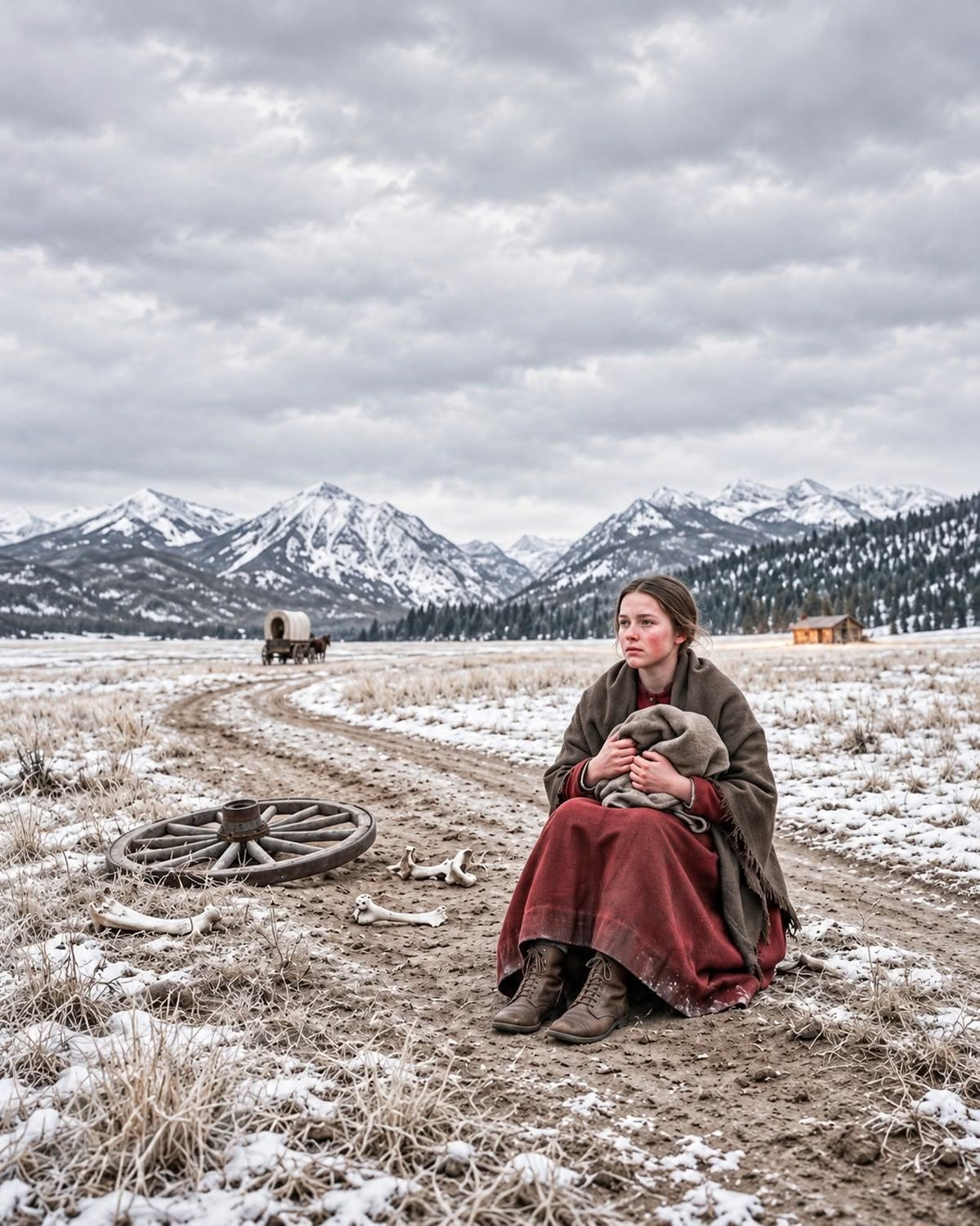
PART 3 — THE FATHER WHO RETURNED WITH AN EMPTY WAGON
The rider arrived just before sunset.
Elizabeth heard the horse first.
Its hooves struck the frozen ground slowly, as though the animal were exhausted.
She was splitting kindling beside the doorway when a familiar voice shattered the quiet.
“Elizabeth!”
The axe slipped from her hand.
For a moment, she could not move.
Then she looked up.
Josiah Rollins sat on a gaunt bay horse at the edge of the clearing.
His beard had grown longer.
His coat was stained with mud.
The proud man who had abandoned her on a freezing Montana road now looked like someone the wilderness had finally humbled.
But his eyes had not changed.
They moved immediately from Elizabeth to the stone house behind her.
Then to the chimney.
Then to the carefully stacked firewood beneath the overhang.
“Good Lord,” he muttered.
He dismounted.
“You built this?”
Elizabeth stood straight.
“Yes.”
“By yourself?”
“Mostly.”
Josiah approached the wall and pressed his hand against the masonry.
He examined the fitted stones, the roof beams, and the drainage trench that carried melting snow away from the foundation.
His expression shifted from disbelief to calculation.
“Who gave you permission to settle here?”
Elizabeth felt the old fear rise in her throat.
But she did not lower her eyes.
“Nobody gave me permission to survive, either.”
Josiah turned sharply.
“Watch your tongue.”
The words were so familiar that for one terrible second she felt twelve years old again.
She remembered standing in their Nebraska kitchen, holding a broken dish while her father shouted that careless girls deserved whatever punishment came.
 Then she looked at the house.
At the stones she had carried.
At the door she had fitted.
At the warm chimney breathing smoke into the winter sky.
She was not that frightened child anymore.
“Why are you here, Father?”
Josiah shifted his weight.
“Your sisters need shelter.”
Elizabeth’s heart тιԍнтened.
“Where are they?”
“At a supply cabin six miles east. The owner has been letting us stay, but he wants us gone by week’s end.”
“Are they sick?”
“Mariel has a cough. Josephine’s feet are swollen from the cold.”
Elizabeth stepped forward.
“Then bring them here.”
Josiah’s shoulders relaxed.
“I knew you’d come to your senses.”
He started toward the doorway.
Elizabeth moved in front of him.
“I said bring my sisters.”
He stopped.
“What?”
“You can leave them with me. I’ll make room.”
Josiah stared at her.
“Don’t be ridiculous. A father doesn’t surrender his daughters to a child.”
“Then why did you surrender me to the wilderness?”
Silence fell.
The horse snorted behind them.
Josiah’s face darkened.
“I did what was necessary.”
“You left me without food, a horse, or even a way to make fire.”
“The wagon was overloaded.”
“You threw out your daughter.”
His jaw тιԍнтened.
“We would all have starved if I hadn’t made hard decisions.”
Elizabeth shook her head.
“You kept the iron stove. You kept the trunk of land papers. You kept two crates of whiskey to trade.”
Josiah looked away.
“But you decided I was the weight you couldn’t carry.”
For the first time, he had no immediate reply.
Then his eyes returned to the house.
“Whatever happened, you’re still my daughter. This shelter ought to be shared with your family.”
“I will share it with Josephine and Mariel.”
“And with me.”
Elizabeth said nothing.
Josiah took another step.
“Elizabeth, don’t make me ask twice.”
She stood firm.
“You can ask a hundred times. The answer will be the same.”
His face flushed.
“You ungrateful little—”
A rifle hammer clicked behind him.
Amos Thacker emerged from the cottonwoods.
“That’s far enough, Rollins.”
Josiah spun around.
“Who are you?”
“Someone who knows what you did.”
Amos stepped closer.
“And someone who watched your daughter build what you couldn’t.”
Josiah glared at the older man.
“This is family business.”
“Not when you abandon a child on a public road.”
Josiah looked between them.
For a moment, Elizabeth thought he might try to force his way inside.
Instead, he slowly raised his hands.
“Fine.”
He turned toward his horse.
“You can keep your precious little house.”
Then he paused.
“But when the snow comes hard, don’t expect me to forget how you treated your own father.”
Elizabeth watched him mount.
“I haven’t forgotten how you treated your daughter.”
He rode away without another word.
That evening, Elizabeth sat beside her stone heater, staring into the embers.
She had dreamed of confronting him.
She had imagined shouting, crying, demanding an explanation.
But now that the moment had pᴀssed, she felt strangely empty.
Amos noticed.
“You all right, girl?”
Elizabeth nodded, though her eyes were wet.
“I thought if he came back, it would mean he missed me.”
Amos sat beside her.
“Sometimes people come back because they need what they threw away.”
She swallowed.
“Does that mean I shouldn’t help my sisters?”
“Of course not.”
He placed a hand on her shoulder.
“Just don’t confuse helping someone with letting them hurt you again.”
The following morning, Elizabeth packed dried meat, flour, blankets, and a small tin of salve.
Amos harnessed his mule.
Together, they traveled east toward the supply cabin.
They found Josephine and Mariel huddled beside a failing fireplace.
Josephine was fourteen.
Mariel was only nine.
Both girls stared in disbelief when Elizabeth entered.
Then Mariel screamed her name.
“ELIZABETH!”
She ran across the room and threw herself into her sister’s arms.
Josephine followed, crying so hard she could barely speak.
“We thought you were gone.”
Elizabeth held them тιԍнтly.
“I’m here.”
Mariel pulled back.
“Papa said the snow took you.”
Elizabeth closed her eyes.
Then Josephine whispered something that made her blood run cold.
“Elizabeth, there’s something you need to know.”
“What is it?”
Josephine glanced toward the doorway.
“Papa didn’t come back just because we needed shelter.”
Elizabeth frowned.
“What do you mean?”
Her sister reached beneath her coat and pulled out a folded document.
“I found this in his trunk.”
Elizabeth opened it.
The paper contained a rough survey of the creek valley.
At the bottom was the stamp of a land speculation company based in Helena.
And across the section where her stone house stood, someone had written a single sentence.
Potential mineral claim. Secure possession before spring.
Elizabeth stared at the words.
Josephine lowered her voice.
“Papa told a man in town that if you were alive, he’d make you sign the property over.”
Elizabeth felt the room spinning.
Her father had not returned only because he needed shelter.
He had returned because he believed there might be something valuable beneath the land where his abandoned daughter had survived.
And he intended to take it.
To be continued in Part 4.