PART 2: THE RECIPE BOX THAT DESTROYED MY FATHER
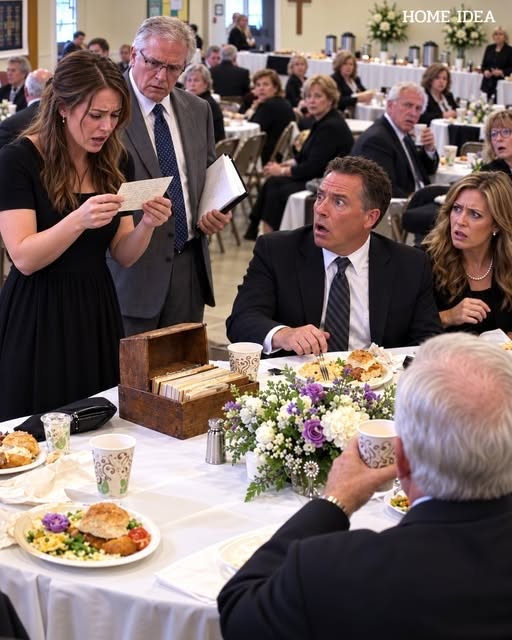
I swallowed hard and began reading.
“To everyone gathered here, especially my son Gordon, I hope you’ve enjoyed your lunch. Because before you leave this room, there are a few things you deserve to know.”
My father’s face changed.
“That’s enough, Nora.”
Mr. Kessler stepped forward.
“Please continue.”
I looked down at the card.
“Three years ago, when I became too weak to manage my own affairs, Gordon told me he would help protect my property. He brought me documents to sign, claiming they were ordinary banking and medical forms.”
A murmur spread through the fellowship hall.
My father put down his fork.
“This is ridiculous.”
I kept reading.
“I later discovered that those documents gave Gordon access to my accounts and allowed him to transfer money without my permission. When I confronted him, he told me I was confused and too old to understand my finances.”
My mother suddenly stood.
“June was on medication. She wasn’t thinking clearly!”
Mr. Kessler turned toward her.
“Mrs. Henderson, I strongly recommend you sit down.”
My hands were shaking.
But I continued.
“Over the next eighteen months, approximately $286,000 disappeared from my accounts. Gordon told me the money had been used for property repairs, taxes, and medical expenses.”
Brittany looked at our father.
“Dad?”
He ignored her.
“Those were legitimate expenses,” he snapped. “I managed her finances!”
Mr. Kessler opened his folder.
“Then perhaps you can explain these.”
He placed several documents on the table.
Bank transfers.
Invoices.
Property records.
And a signature authorization.
My father stared at them.
I looked at the card again.
“Some of that money was transferred to an account belonging to Brittany Henderson.”
My sister’s mouth fell open.
“WHAT?”
I continued.
“Some was used to pay for a luxury vehicle. Some was transferred to a company owned by Tanner Langford’s family.”
The entire room went silent.
Tanner slowly turned toward Brittany.
“What is she talking about?”
Brittany looked terrified.
“I don’t know anything about this!”
My father slammed his hand against the table.
“Enough! This is a funeral lunch, not a courtroom!”
Mr. Kessler didn’t raise his voice.
“Actually, Gordon, June specifically requested that these matters be addressed here.”
He removed another document.
“And she left instructions that I make sure the entire family understands why.”
I looked at the final paragraph.
Grandma had written it in larger letters.
“To my granddaughter Nora, the only person who never asked me for anything in return, I leave the one thing my son cannot take away.”
I paused.
My father looked almost relieved.
“Exactly. A recipe box. That’s all she got.”
Mr. Kessler shook his head.
“No, Gordon. That’s not all.”
He reached into his briefcase and removed a sealed envelope.
It had my name written across it.
“Nora, your grandmother asked me to give you this after you read the final card.”
I opened it.
Inside was a letter and a small brᴀss key.
The letter began:
My dearest Nora,
If you’re reading this, then your father has probably already laughed at the recipe box. Let him laugh. He has spent years believing that the most valuable things in this family are the things with dollar signs attached.
He has never understood what I was protecting.
I felt tears gathering in my eyes.
Then I read the next paragraph.
The farmhouse was never Gordon’s to control. And the $400,000 Brittany believes she has inherited is not what it appears to be.
Brittany stood abruptly.
“What does that mean?”
Mr. Kessler answered.
“It means the farmhouse is subject to a separate trust arrangement, and the $400,000 bequest is contingent upon certain conditions being met.”
My father went pale.
“What conditions?”
The lawyer opened another folder.
“June’s will contains a provision requiring the executor to investigate any unauthorized withdrawals from her accounts before distributing the remaining estate. The relevant financial records have already been submitted to the appropriate authorities.”
My father stared at him.
“You can’t do that.”
“I can, and I have.”
Then Mr. Kessler turned toward me.
“The key in your envelope belongs to a safe-deposit box at Lancaster County Bank. Your grandmother placed the original trust documents, property deeds, and several recordings inside.”
My father pushed his chair backward.
“Those documents belong to me!”
Mr. Kessler looked directly at him.
“They do not.”
For the first time that afternoon, my father had nothing to say.
But Grandma’s letter wasn’t finished.
I looked down at the final lines.
There is one more thing, Nora. The recipe box contains twenty-seven cards. The twenty-eighth card is hidden beneath the wooden lining. It will explain why I chose you to receive it.
I looked at the box.
Twenty-seven cards.
I counted them again.
One. Two. Three.
Twenty-seven.
My fingers slipped beneath the wooden divider.
There was a small gap.
I carefully lifted the lining.
A folded piece of paper fell into my lap.
It was an original deed.
And beneath it was a handwritten statement bearing my grandmother’s signature.
I unfolded the deed.
Then I read the address.
It was the farmhouse on Millers Road.
The very property Brittany believed she had inherited.
But the name listed as its legal owner wasn’t June Henderson.
It was Nora Henderson.
Mine.
I couldn’t breathe.
Mr. Kessler nodded.
“Your grandmother transferred the farmhouse into your name eleven months ago, following an independent legal ᴀssessment of her capacity. The transfer was properly recorded.”
Brittany stared at me.
“You’re lying!”
“No,” Mr. Kessler replied. “The recorded deed is here.”
My father looked as though someone had struck him.
“You can’t just give her that property!”
“June could. And she did.”
“But the will—”
“The will does not override a valid property transfer completed during her lifetime.”
My sister turned toward our father.
“You told me the farmhouse was mine!”
He didn’t answer.
Tanner stood up slowly.
“Wait. You told my parents that the farmhouse was collateral for the business loan.”
Brittany looked at him.
“What loan?”
Tanner’s father, Mr. Langford, placed his coffee cup down.
“Gordon, you told me the тιтle was clear.”
My father looked around the room.
Forty people were watching him.
The same people who had laughed when he called me the help.
The same people who had congratulated him on receiving Grandma’s house.
Now nobody was laughing.
But then Mr. Kessler reached into his briefcase one final time.
“There is another issue.”
My father closed his eyes.
“Please don’t.”
The lawyer ignored him.
“June also left instructions regarding the house on Elm Street, which Gordon believes he inherited.”
He placed a final document on the table.
“That property was purchased using funds from June’s family trust. Under the original trust agreement, it could not be transferred to Gordon without the consent of the remaining beneficiary.”
I stared at him.
“Who is the remaining beneficiary?”
Mr. Kessler looked at me.
“You are, Nora.”
My father grabbed the edge of the table.
“That’s impossible!”
The lawyer calmly continued.
“June’s instructions were that Gordon could reside in the property for as long as he complied with the trust conditions. However, if evidence of financial exploitation was established, his right to occupy the property could be terminated through the appropriate legal process.”
My mother started crying.
Brittany looked between the lawyer and our father.
“Dad, tell me this isn’t true.”
He finally exploded.
“Your grandmother was manipulated! Nora spent three years poisoning her against me!”
I felt something inside me finally break.
Not into anger.
Into clarity.
I stood up, holding the recipe card.
“No, Dad. I spent three years changing her sheets, taking her to appointments, making her meals, and sitting beside her when she couldn’t sleep.”
My voice trembled, but I didn’t stop.
“You called that playing nurse. You said I had no career. You told everyone I was wasting my life.”
I looked at the forty guests.
“Maybe you were right about one thing. I didn’t inherit four hundred thousand dollars. I inherited a recipe box.”
Then I held it against my chest.
“But this box contains every Sunday dinner Grandma made for us. Every birthday cake. Every handwritten note she left when she knew I was having a difficult day.”
I turned toward my father.
“And it contains the truth you thought you could bury.”
He looked at me with hatred.
“You think you’ve won?”
I shook my head.
“No. I think Grandma finally got to tell her story.”
At that moment, two people entered the fellowship hall.
One was a woman in a dark suit.
The other was a uniformed deputy sheriff.
Mr. Kessler introduced the woman as an investigator from the county financial crimes unit.
She approached my father.
“Mr. Henderson, we’d like to ask you some questions regarding financial transactions involving the late June Henderson.”
My father stood frozen.
“This is a family matter!”
“Not anymore,” she replied.
Brittany backed away from him.
Tanner quietly removed his hand from hers.
My mother covered her face.
And I stood there holding the recipe box.
Then Mr. Kessler leaned toward me.
“There’s one more thing your grandmother asked me to tell you privately.”
I looked at him.
“What?”
He lowered his voice.
“She knew your father would try to sell the farmhouse. That’s why she transferred it to you. But she also knew he might come after you once he discovered what was inside the recipe box.”
My stomach тιԍнтened.
“Why?”
He handed me a final envelope.
On it, Grandma had written:
FOR NORA. OPEN ONLY WHEN YOU ARE ALONE.
I slipped it into my purse.
That evening, I returned to the farmhouse.
The kitchen was exactly as Grandma had left it.
Her favorite blue curtains.
The old wooden table.
The little ceramic rooster beside the stove.
I placed the recipe box on the counter and opened the envelope.
Inside was a single pH๏τograph.
It showed Grandma June standing beside a young woman I had never seen before.
On the back, she had written:
This is your mother, Nora. But not the woman who raised you.
My hands went cold.
I read the letter beneath it.
There is something I never told you about your birth. Gordon and your mother have kept this secret for twenty-nine years. You were not abandoned by the people who gave you life. You were taken from them.
I stared at the words.
Then my phone rang.
Unknown number.
I answered cautiously.
A woman’s voice whispered:
“Nora? My name is Eleanor. I’ve been trying to find you for twenty-nine years.”
I couldn’t speak.
She began crying.
“June promised she’d tell you the truth when the time was right.”
I gripped the counter.
“Who are you?”
There was a long silence.
Then she said:
“I’m your biological mother.”
And before I could ask another question, she added:
“Your father knows I’ve found you. Please, Nora. Don’t let him get to the farmhouse before I do.”
TO BE CONTINUED…