PART 2 — THE COWGIRL’S IMPOSSIBLE PROPOSAL
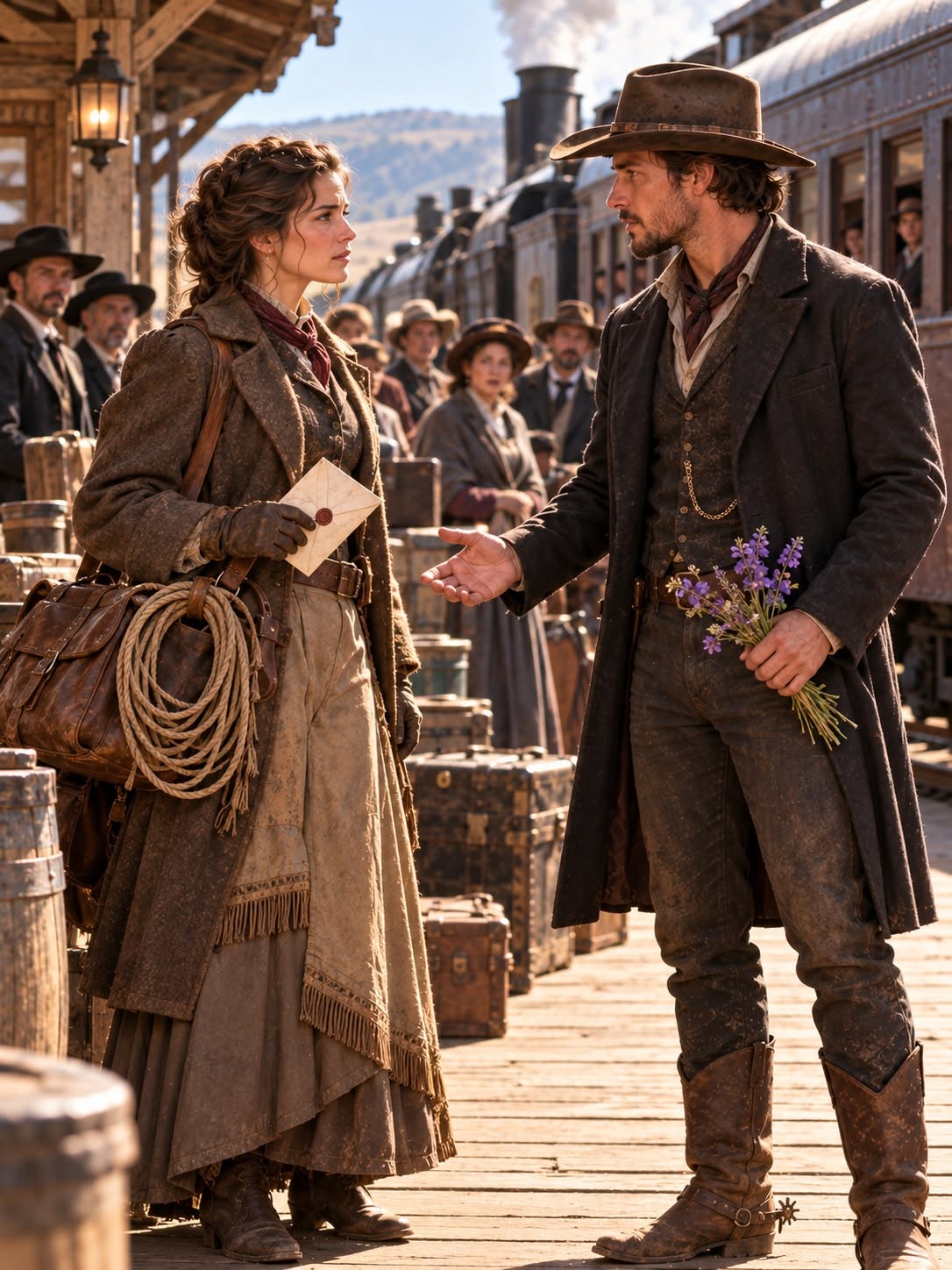
Wyatt watched her pencil move across the page.
She wasn’t reading like someone trying to understand a legal document. She was examining it like a rancher inspecting a fence line, searching for the weak place where everything might eventually break.
Finally, she looked up.
“Your father was a careful man.”
“He was.”
“Did he trust your cousin?”
Wyatt gave a humorless laugh.
“Not particularly.”
“Then why leave him half the ranch?”
“Because Cyrus was my father’s nephew, and my father believed family deserved a chance to prove itself.”
Josie tapped the paper.
“That sounds like a dangerous philosophy.”
“It became one.”
She turned to another page.
“Who wrote this will?”
“Mr. Hargrove. He was my father’s attorney for almost thirty years.”
“Is he still alive?”
“Yes. He lives in Omaha.”
“Good. We’ll need him.”
Wyatt frowned.
“We?”
Josie ignored the question.
“Does your cousin know about the marriage condition?”
“He knows everything.”
“Has he contacted you recently?”
“Three times this month.”
“What did he want?”
“To purchase my interest in the ranch.”
“How much?”
“Far below its value.”
Josie shook her head.
“Then he isn’t trying to help you. He’s waiting for you to fail.”
Wyatt leaned back.
“I’ve understood that for some time.”
“Then why haven’t you done anything?”
“Because I thought I had a solution.”
His eyes briefly moved toward the window.
“The letters from Constance began last October. My father had died six months earlier. I thought I could meet his condition without making a business arrangement out of marriage.”
Josie folded her arms.
“Yet that’s exactly what you’re doing now.”
“I know how it sounds.”
“Do you?”
He looked at her.
“Yes. I am not proud of the position I’m in.”
For a moment, Josie said nothing.
Then she pushed the will back toward him.
“There’s something else.”
“What?”
“Your father required you to be married and maintaining a household before May twenty-third. But this document doesn’t say anything about the bride being from Boston, having a wealthy family, or being someone your cousin approves of.”
Wyatt frowned.
“No, it doesn’t.”
“And it doesn’t say you must marry a woman who has never worked a day in her life.”
He almost smiled.
“That would have disappointed my father.”
“Perhaps.”
Josie leaned forward.
“But before you start imagining some convenient arrangement, understand something. I’m not desperate for a husband. I have cattle, money of my own, and a place to go when this business is finished.”
“I understand.”
“Do you? Because I won’t exchange one kind of dependence for another.”
Wyatt nodded slowly.
“Then perhaps we should stop talking about marriage.”
Josie blinked.
He continued.
“You came here to sell cattle. I came here to meet a woman who has already decided she doesn’t want me. Neither of us owes the other anything.”
For the first time, Josie seemed uncertain.
She glanced at the flowers resting beside her ledger.
“You’re an unusual man, Mr. Calder.”
“I’ve been called worse.”
“Most men who find themselves in your position would have tried to persuade me before I finished my coffee.”
“Would that have worked?”
“Absolutely not.”
“Then I made the sensible choice.”
She laughed again.
But the laughter faded when the H๏τel door opened.
A tall man in an expensive brown suit entered, carrying a leather case. His polished boots seemed out of place among the dusty ranchers and railroad workers.
Wyatt recognized him immediately.
“Cyrus.”
His cousin smiled.
“Wyatt. I was wondering when you’d arrive.”
Cyrus Calder was thirty-six, handsome in a carefully maintained way, with a thin mustache and the kind of smile that never reached his eyes.
His gaze moved to Josie.
“Who’s your friend?”
“Josie Farrow.”
Cyrus tipped his hat.
“Pleasure.”
Josie gave him a polite nod.
Cyrus pulled out a chair without asking.
“I heard about your little railway disappointment.”
Wyatt’s jaw тιԍнтened.
“Then you’ve heard enough.”
“Oh, come now. There’s no shame in it. Eastern ladies aren’t always prepared for the realities of Nebraska.”
His eyes drifted toward Josie.
“Although I see you’ve already found yourself another companion.”
“She’s a cattlewoman,” Wyatt replied.
“How interesting.”
Cyrus looked at the ledger.
“Are you selling livestock?”
“That’s my business,” Josie said.
“Perhaps I could make an offer.”
“I already have a buyer.”
“Everyone has a price.”
Josie closed her ledger.
“Not everyone is for sale.”
Cyrus’s smile thinned.
He turned back to Wyatt.
“I’ve come to make one final proposal. Sign the agreement transferring your interest in the eastern grazing section to me, and I’ll give you enough money to settle your debts.”
Wyatt stared at him.
“That section contains the best winter pasture on the property.”
“Exactly. It’s worth something.”
“It’s part of the ranch.”
“Not for much longer, if you fail to satisfy your father’s will.”
Cyrus opened his case and placed a document on the table.
“Twenty-nine days, Wyatt. You know what happens after that.”
Josie looked at the paper.
“That’s an agreement to sell land?”
Cyrus turned toward her.
“Private family business.”
“Then you should discuss it privately.”
He gave her a cold smile.
“With pleasure.”
But Josie didn’t move.
Instead, she pointed to a paragraph near the bottom of the document.
“What’s this clause?”
Cyrus glanced down.
“An ordinary provision.”
“It says the seller accepts responsibility for outstanding property taxes, unpaid labor obligations, and certain existing claims against the land.”
Wyatt leaned forward.
“Let me see that.”
Cyrus immediately pulled the paper away.
“You don’t need to concern yourself with it.”
Josie looked directly at Wyatt.
“Don’t sign anything.”
Cyrus stood.
“I don’t believe I asked for your advice.”
“No,” Josie replied. “You didn’t. But you put the paper in front of me, and I know how to read a bad deal.”
Cyrus’s expression hardened.
He gathered his documents.
“Enjoy your coffee, Wyatt. It may be the last peaceful morning you have on that ranch.”
He walked toward the door.
Before leaving, he turned back.
“And do remember, cousin. My attorney will be examining every arrangement you make before your birthday. A marriage of convenience won’t save you.”
The door slammed.
Wyatt remained silent.
Josie watched him.
“He’s confident.”
“He’s been waiting for this.”
“Then we need to find out why.”
Wyatt looked at her.
“What do you mean?”
“Your cousin didn’t come all the way to Larkspur just to insult you. He brought a contract, and he was very particular about which land he wanted.”
She tapped the table.
“That usually means there’s something he knows that you don’t.”
Wyatt stared at the closed door.
For the first time, he wondered whether Cyrus’s interest in the ranch had begun long before his father’s death.
That afternoon, Josie accompanied Wyatt to the Anchor Ranch.
She insisted on seeing the property before making any further suggestions.
The ranch stretched across eleven thousand acres of rolling Nebraska grᴀssland. A weathered white farmhouse stood near a line of cottonwood trees. Beyond it were cattle pens, barns, corrals, and miles of fencing that had survived generations of harsh winters.
Josie stood on the porch, studying the land.
“Your father built something impressive.”
“He spent forty years doing it.”
“And now you’re trying to keep it.”
Wyatt nodded.
“Every acre.”
Josie looked toward the distant pasture.
“How many cattle?”
“About seven hundred and fifty.”
“How many employees?”
“Eleven full-time hands, plus seasonal help.”
“Water sources?”
“Three wells, two windmills, and a creek that runs through the southern pasture.”
She looked at him.
“You’re not just protecting a house, Wyatt. You’re protecting a whole operation.”
“I know.”
“Then why are you letting your cousin convince you that marriage is the only thing standing between you and losing it?”
Wyatt sighed.
“Because that’s what the will says.”
“That’s what one paragraph says. It doesn’t mean the rest of the ranch has to fall apart while you wait for May twenty-third.”
He looked at her curiously.
Josie stepped off the porch.
“Show me the southern pasture.”
They rode for nearly an hour.
Josie inspected the water troughs, checked the fencing, and asked questions about the cattle’s condition. She noticed a damaged section of wire near the creek and pointed out that several calves were thinner than they should have been.
Wyatt listened carefully.
“You notice everything.”
“My father used to say a ranch tells you what’s wrong if you pay attention.”
“Sounds like a wise man.”
“He was.”
Her voice softened.
“He died three years ago.”
Wyatt glanced at her.
“I’m sorry.”
She nodded.
“After that, my brothers thought I would sell the cattle and move east. They believed a woman shouldn’t be running an outfit by herself.”
“And you proved them wrong?”
“I sold more cattle in two years than they had in five.”
Wyatt smiled.
“I suspect your brothers don’t enjoy hearing that.”
“They’ve learned to live with it.”
They reached the southern boundary near sunset.
Josie dismounted and examined a wooden survey marker.
Then she noticed something unusual.
A new set of stakes had been placed along the edge of the property.
She walked toward them.
“Wyatt, who put these here?”
He looked at the stakes.
“I don’t know.”
She pulled a small folded paper from beneath one of them.
It was a survey notice.
Wyatt read the name printed at the bottom.
Cyrus Calder.
His expression changed.
“He’s surveying my land.”
Josie examined the document.
“Not exactly.”
“What do you mean?”
She pointed to the boundary description.
“He’s surveying the water rights and the creek access.”
Wyatt looked confused.
“Why would he need those?”
Josie stared toward the creek.
“Because someone may be interested in more than your grazing land.”
Before Wyatt could answer, a rider appeared in the distance.
It was Thomas, the ranch foreman.
He galloped toward them, pulled his horse to a stop, and removed his hat.
“Mr. Calder, we’ve got trouble.”
“What happened?”
“Two men from Omaha came by the north gate. They said they were inspecting the water rights.”
Wyatt frowned.
“Who sent them?”
“They had papers signed by Mr. Cyrus.”
Josie looked at the foreman.
“Did you let them through?”
“No, ma’am. I told them they needed your permission.”
“Good.”
Thomas looked at her.
“Ma’am?”
Wyatt almost smiled.
“Miss Farrow has a habit of noticing things before the rest of us.”
Thomas glanced at the survey notice.
Then his face became serious.
“There’s something else, boss.”
“What?”
“The bank sent a letter this morning. They want payment on the ranch’s outstanding loan within thirty days.”
Wyatt went still.
“Thirty days?”
Thomas nodded.
“And there’s a lien notice attached.”
Josie looked at Wyatt.
“How much?”
“Forty-eight thousand dollars.”
She exhaled.
“That’s not a small amount.”
“No.”
“Can the ranch pay it?”
Wyatt looked toward the cattle.
“Not without selling a substantial portion of the herd.”
Josie shook her head.
“Which would weaken the operation just when you need it strongest.”
Wyatt said nothing.
For a moment, the only sound was the wind moving through the tall grᴀss.
Then Josie asked a question.
“Did your father know about this debt?”
“He believed it had been settled.”
“By whom?”
Wyatt looked toward the farmhouse.
“Cyrus handled some of the financial paperwork after Father became ill.”
Josie slowly turned toward him.
“And you trusted him?”
“I had no reason not to. He was family.”
She gave him a long look.
“That’s the second time today I’ve heard that word used as an excuse.”
Wyatt lowered his head.
He knew she was right.
That evening, they sat in the farmhouse kitchen.
Thomas had gone to town to contact the bank. Wyatt placed the will and the loan notice on the table.
Josie studied both documents.
Then she opened her cattle ledger and began calculating.
“What are you doing?” Wyatt asked.
“Trying to understand how much time you really have.”
She wrote several figures.
“If you sell enough cattle to pay the bank, you lose production capacity. If you don’t pay, the bank may begin foreclosure proceedings. If Cyrus gets control of the eastern grazing land, he can interfere with your access to the creek.”
Wyatt rubbed his forehead.
“You’re making this sound worse than I thought.”
“It is worse than you thought.”
She paused.
“But it isn’t necessarily hopeless.”
He looked up.
“What’s your idea?”
Josie closed the ledger.
“I have forty head of cattle waiting to be sold. They’re worth considerably more than I expected when I left Texas.”
“How much?”
“Enough to give me a choice.”
Wyatt frowned.
“Josie, I don’t want your money.”
“I didn’t offer it.”
“Then what are you suggesting?”
She stood and walked toward the window.
“I know cattle. I know how to manage a ranch. I know how to negotiate with buyers, lenders, and suppliers. I also know how to build a business without depending on a man to tell me what I’m worth.”
She turned toward him.
“You need someone who can help you keep this place operating. Not someone who simply stands beside you in a church.”
Wyatt stared at her.
“You’re proposing a partnership?”
“Something like that.”
“On what terms?”
Josie took a breath.
“First, I want to examine the ranch’s financial records. Every loan, every payment, every agreement your cousin has touched.”
“Agreed.”
“Second, I want a written contract giving me authority over cattle operations and a fair share of the profits generated by my work.”
“That’s reasonable.”
“Third, if we discover that Cyrus has been interfering with the ranch’s finances, we take the evidence to an attorney. We don’t make accusations without proof.”
Wyatt nodded.
“And the marriage condition?”
Josie looked down at the will.
“That’s where the impossible part comes in.”
He waited.
She walked back to the table.
“I’ll consider marrying you.”
Wyatt froze.
“But not because you need a bride,” she continued. “And not because your father decided your future from beyond the grave.”
“Then why?”
“Because I might want a life here. Because I like the way you treat people. Because I believe this ranch deserves a chance.”
She raised one finger.
“But there will be conditions.”
“Tell me.”
“Separate financial property. My cattle remain mine. My earnings remain mine. I will not be expected to abandon my work or become some decorative wife sitting on a porch.”
Wyatt nodded.
“Agreed.”
“And if either of us decides this arrangement isn’t right, we discuss it honestly. No threats. No guilt. No pretending a marriage contract gives either person ownership of the other.”
He looked at her for a long moment.
“Josie, I don’t want a wife who feels trapped.”
“Good. Because I won’t stay anywhere I feel trapped.”
A faint smile crossed his face.
“Then we may understand each other.”
She extended her hand.
“One more thing.”
“What?”
“We need to speak to the attorney who wrote your father’s will. Tomorrow.”
Wyatt shook her hand.
“Tomorrow.”
But before they could say anything else, the front door opened.
Thomas rushed into the kitchen carrying a telegram.
“Mr. Calder, this just came from Omaha.”
Wyatt took it.
His eyes moved across the message.
Then his face went pale.
“What is it?” Josie asked.
He handed her the paper.
It contained only a few lines.
NOTICE OF LEGAL ACTION.
Mr. Cyrus Calder has filed a peтιтion challenging the validity of any marriage entered into by Wyatt Calder within thirty days of his birthday.
He alleges that the proposed marriage arrangement is fraudulent and intended solely to defeat the terms of the late Mr. Calder’s will.
At the bottom was the name of Cyrus’s attorney.
Josie read it twice.
Then she looked at Wyatt.
“He’s moving faster than I expected.”
Wyatt lowered himself into a chair.
“He knows.”
“Knows what?”
“That I was considering asking you.”
Josie placed the telegram on the table.
“Then he knows something else, too.”
“What?”
“That he might lose.”
She looked toward the darkened window.
“And men who believe they’re about to lose something valuable often make mistakes.”
The following morning, they traveled to Omaha to meet Mr. Hargrove, the attorney who had drafted Wyatt’s father’s will.
He was a thin, silver-haired man with a stern expression and a habit of adjusting his spectacles whenever someone asked a difficult question.
After reviewing the proposed marriage arrangement, he removed his glᴀsses.
“I need to be very clear,” he said. “Your father’s will is not a romantic document. It is a legal instrument with specific conditions. If you intend to satisfy those conditions, you must do so honestly.”
Wyatt nodded.
“That’s what we intend.”
Mr. Hargrove looked at Josie.
“And you understand that your marriage would be subject to scrutiny?”
“I do.”
“Your financial independence must be protected. You should have your own attorney review any agreement.”
“I wouldn’t consider doing otherwise.”
The lawyer studied her for a moment.
Then he turned back to Wyatt.
“There’s something I never told you about your father’s final instructions.”
Wyatt leaned forward.
“What?”
“Your father asked me to include the marriage provision, but he also gave me a separate sealed statement.”
“Why wasn’t it included with the will?”
“Because it wasn’t intended to become public unless someone challenged the inheritance.”
Mr. Hargrove opened a locked drawer.
He removed a brown envelope bearing the late Mr. Calder’s signature.
Wyatt stared at it.
“My father wrote that?”
“Yes.”
The attorney broke the seal.
Inside was a single sheet of paper.
He read silently for several seconds.
Then his expression changed.
“Mr. Calder,” he said carefully, “I believe your father anticipated that Cyrus might attempt to interfere with the ranch.”
Wyatt felt his chest тιԍнтen.
“What did he write?”
Mr. Hargrove placed the letter on the desk.
“Your father instructed me to investigate any attempt by Cyrus to obtain control of the eastern grazing land or the ranch’s water rights.”
Josie leaned forward.
“Why those specifically?”
The attorney looked at her.
“Because your father’s records indicated that Cyrus had been negotiating with a railroad representative before the will was even signed.”
Wyatt stared at him.
“Negotiating to sell my father’s land?”
“Not exactly.”
Mr. Hargrove turned the page.
“He was attempting to secure an agreement involving the creek, the eastern pasture, and a proposed railway access route.”
Josie looked at Wyatt.
“That’s why he wanted the survey.”
The attorney nodded.
“Your father suspected that Cyrus intended to use the inheritance dispute to force a sale.”
Wyatt felt anger rise inside him.
“Why didn’t you tell me this before?”
“Because your father instructed me to wait until there was evidence of interference. At the time, I had suspicions but nothing conclusive.”
Mr. Hargrove reached into another drawer.
This time, he produced a second envelope.
“However, there is one more thing.”
Wyatt stared at the envelope.
“What now?”
The attorney placed it between them.
“Your father left instructions that this document be opened only if you were in genuine danger of losing the ranch.”
Josie glanced at the seal.
“Then perhaps we should read it.”
Mr. Hargrove opened the envelope.
His eyes moved across the page.
Then he looked directly at Wyatt.
“Your father did not intend for you to keep the Anchor Ranch alone.”
Wyatt frowned.
“What does that mean?”
The attorney turned the letter around.
At the bottom was a paragraph written in his father’s own hand.
“If my son finds a woman who understands the land, respects the work, and chooses the ranch freely, I want him to give her a genuine place in its future. Not as a servant, not as a possession, and not merely as a wife. I want her to have a voice in its management.”
Wyatt looked at Josie.
She was reading the words over his shoulder.
For the first time since they had met, she appeared completely speechless.
Then Mr. Hargrove added something that made both of them go still.
“There’s a codicil to the will. It provides that if Wyatt marries before his thirtieth birthday, his spouse may receive a defined management interest in the ranch. But only if the marriage is genuine and both parties sign a separate agreement.”
Josie slowly turned toward Wyatt.
“Your father wanted you to find a partner.”
Wyatt nodded.
“Not simply a bride.”
The attorney looked at the clock.
“There’s something else you should know. Cyrus has already requested a copy of this codicil. He knows it exists.”
Wyatt’s jaw тιԍнтened.
“Then why hasn’t he shown it to the court?”
Mr. Hargrove hesitated.
“Because he has submitted a different document claiming that your father revoked it shortly before his death.”
Josie stood.
“Do you have the original?”
The attorney nodded.
“Yes.”
“Then we need to compare the signatures.”
Mr. Hargrove opened another folder.
And when he placed the disputed document beside the original, Josie noticed something that made her eyes narrow.
The signature looked convincing.
Almost perfect.
But the date at the top was impossible.
She pointed to it.
“Mr. Hargrove, look at this.”
He adjusted his spectacles.
Then his face went white.
Wyatt leaned forward.
“What?”
Josie looked at him.
“Your father died on February seventeenth.”
She tapped the document.
“This says he signed it on March fourth.”
Nobody spoke.
Then Mr. Hargrove quietly closed the folder.
“That document may be forged.”
Wyatt stared at the paper.
His cousin hadn’t merely been trying to take the ranch.
He might have been trying to rewrite his father’s final wishes.
And now, with only twenty-eight days remaining, Josie Farrow was no longer simply a woman who had arrived on the wrong train.
She might be the one person capable of helping Wyatt uncover the truth before Cyrus took everything.
But as they left the attorney’s office, a man waiting across the street lowered his newspaper.
He watched Josie and Wyatt climb into their carriage.
Then he reached into his coat and pulled out a small notebook.
He wrote down their names.
And beneath them, he added one sentence:
THE COWGIRL MUST BE STOPPED BEFORE THE WEDDING.