PART 2: THE WIDOW, THE FARMER, AND THE SECRET THAT COULD COST THEM EVERYTHING
PART 2: THE WIDOW, THE FARMER, AND THE SECRET THAT COULD COST THEM EVERYTHING
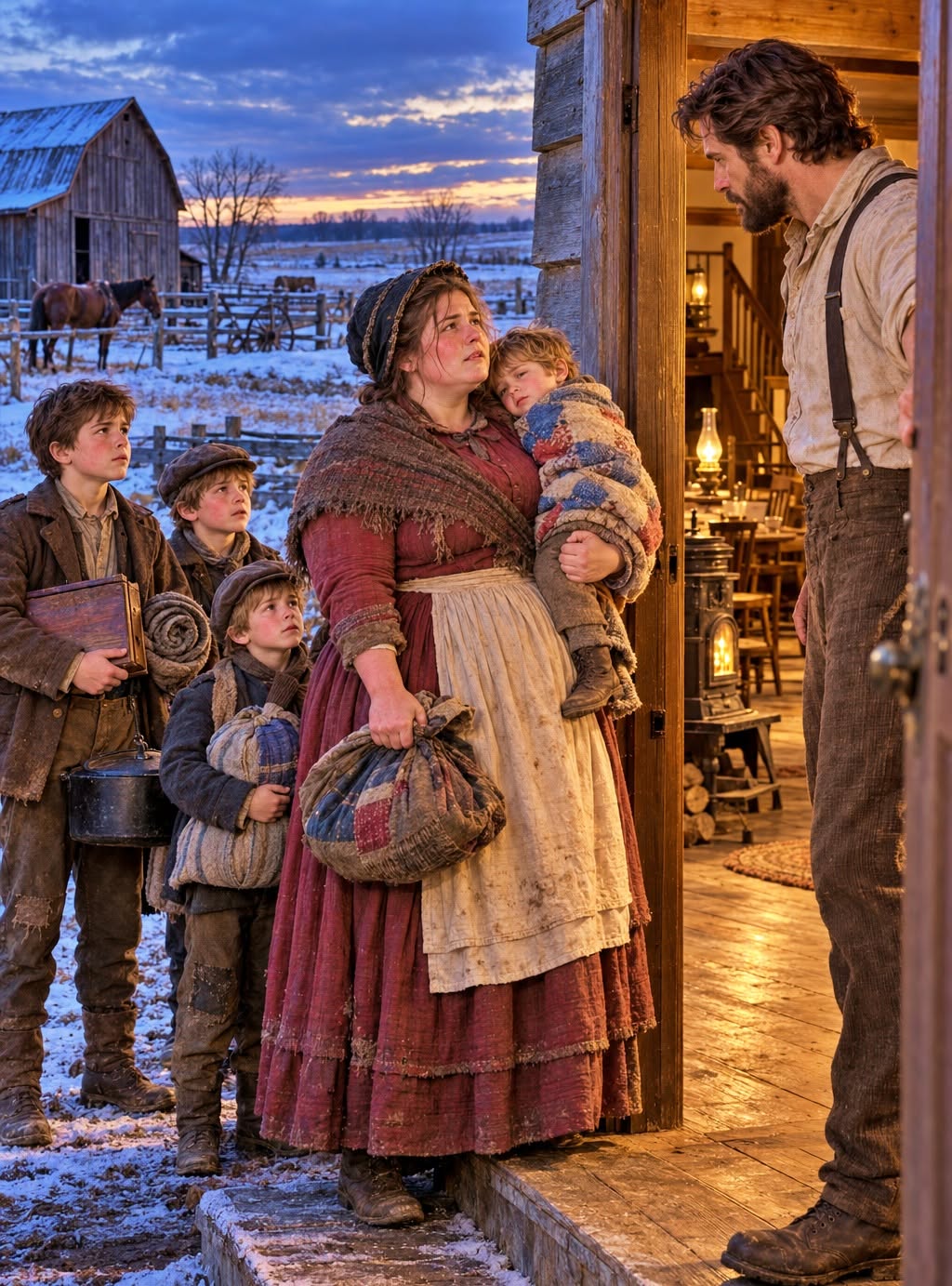
The first night at Jonathan Reed’s farmhouse, Evelyn Carter barely slept.
Not because the bed was uncomfortable. It was the first proper bed her children had slept in for nearly two weeks.
She lay awake listening to the unfamiliar sounds of the house: the wind rattling the shutters, the old clock ticking in the hallway, and four small boys breathing peacefully in the room beside hers.
For the first time since her husband died, nobody was asking her where they would sleep tomorrow.
And that frightened her almost as much as being homeless.
She knew better than to trust kindness too quickly.
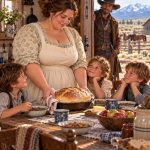
At sunrise, Evelyn was already in the kitchen.
She found a sack of flour, a few potatoes, some dried beans, and a little bacon. It wasn’t much, but she managed to prepare breakfast for six people.
Jonathan entered wearing his work coat, expecting to find an empty kitchen.
Instead, he stopped in the doorway.
The table was set. The stove was warm. Coffee was brewing, and four boys were sitting quietly, waiting for their mother to finish serving.
Jonathan looked at the biscuits.
“When was the last time you made breakfast for six?”
Evelyn gave him a cautious smile.
“Before my husband died.”
Jonathan pulled out a chair.
“Then I suppose this house has been waiting a long time for breakfast.”
For the first time in months, the farmhouse felt alive.
But the peace didn’t last long.
After breakfast, Jonathan showed Evelyn the property.
The barn needed repairs. Several fence posts had fallen. The chicken coop was nearly empty, and the vegetable cellar contained little more than potatoes and preserved apples.
The farmhouse itself needed attention. One bedroom had a leaking roof, and the kitchen floorboards creaked dangerously.
Evelyn studied everything carefully.
“How long have you been managing all this alone?”
“Six years.”
“And the farm?”
“Longer than that. My father left it to me.”
She noticed the hesitation in his voice.
“Is something wrong?”
Jonathan stopped beside the barn.
“The bank is giving me until spring to settle what I owe. If I can’t make the payment, they’ll take the property.”
Evelyn looked toward the fields.
“How much do you owe?”
“More than I can earn before planting season.”
He said it without bitterness, as though he had already accepted his fate.
But Evelyn wasn’t ready to accept it.
“Then we need to make this farm profitable again.”
Jonathan turned toward her.
“We?”
She immediately lowered her eyes.
“I mean, if you still want me working here.”
For a moment, he studied her.
Then he nodded.
“All right, Mrs. Carter. Let’s see what we can do.”
 The following weeks changed the farmhouse.
Evelyn reorganized the kitchen, repaired torn curtains, and began making bread to sell in the nearby settlement.
She discovered that Jonathan had been selling his eggs and ʙuттer to a middleman who paid him far less than they were worth.
She suggested taking their products directly to town.
Jonathan wasn’t convinced.
“The journey takes half a day.”
“Then we’ll leave before sunrise.”
“And who’s going to watch the farm?”
“Thomas is twelve. He can help with the animals after school. James can gather eggs. William can carry firewood, and Samuel can supervise everybody.”
Samuel, who was sitting nearby with a biscuit in his hand, looked offended.
“I can do more than supervise!”
Jonathan laughed.
It was the first time Evelyn had heard him laugh.
Within a month, the boys had become part of the farm’s daily rhythm.
Thomas learned how to repair fences under Jonathan’s supervision.
James discovered he was remarkably good with animals.
William became responsible for collecting eggs, although he occasionally forgot where he had placed the basket.
Samuel followed Jonathan everywhere, asking questions about horses, tractors, and why the moon sometimes appeared during daylight.
Jonathan answered every question.
Even the ridiculous ones.
And slowly, something unexpected happened.
The boys began calling him Mr. Jonathan.
Then one evening, Samuel accidentally called him Papa.
The little boy froze.
Evelyn immediately reached for him.
“Samuel, sweetheart—”
But Jonathan simply knelt beside the child.
“You don’t have to call me anything you don’t want to.”
Samuel looked down.
“I didn’t mean to.”
Jonathan placed a gentle hand on his shoulder.
“It’s all right, son.”
Evelyn turned away before either of them could see the tears in her eyes.
By December, the farm was earning more money than it had in years.
Evelyn’s bread had become popular in town. Their ʙuттer sold quickly, and a local shopkeeper offered to purchase eggs regularly.
For the first time, Jonathan began to believe he might save his father’s land.
But someone else had noticed the sudden improvement.
His name was Mr. Harlan, the banker who held the mortgage.
One afternoon, he arrived in a polished carriage.
He stepped inside without waiting for an invitation.
“Reed, I see you’ve found yourself some help.”
Jonathan stood from his chair.
“Good afternoon, Mr. Harlan.”
The banker’s eyes moved toward Evelyn.
“And who might this be?”
“Evelyn Carter. She manages the household and helps with the farm.”
Harlan examined her worn dress and the four boys standing near the fireplace.
“Four children? That’s quite an expense for a man already struggling with debt.”
Evelyn remained silent.
Jonathan’s expression hardened.
“They’re working members of this household. And they’re not part of our financial discussion.”
Harlan gave a thin smile.
“Of course.”
He placed a leather folder on the table.
“I’ve brought the final notice. You have until March first. After that, the bank will begin foreclosure proceedings.”
Jonathan looked at the papers.
“Spring is only three months away.”
“Then I suggest you find the money.”
Harlan turned toward the door, then paused.
“One more thing, Reed. I wouldn’t become too attached to your new arrangement. The bank has already received another offer for this property.”
Jonathan’s face changed.
“From whom?”
Harlan smiled.
“Someone who understands its true value.”
Then he left.
That evening, Jonathan sat alone in the barn.
Evelyn found him there after putting the boys to bed.
She carried two cups of coffee.
“Mr. Harlan said someone wants to buy the farm.”
Jonathan nodded.
“Silas Whitcomb. Owns the largest grain operation in the county. He’s wanted these fields for years.”
“Why?”
“There’s a railway expansion planned nearby. If the new line comes through, this land could be worth three times what it is now.”
Evelyn sat on an overturned wooden crate.
“Then perhaps that’s why he’s so determined to take it.”
Jonathan stared into his coffee.
“I’ve spent six years trying to keep this place alive. My wife died here. My father died here. Every corner reminds me of someone I’ve lost.”
His voice became quieter.
“I don’t know how to start over somewhere else.”
Evelyn looked around the barn.
“Then don’t start over somewhere else.”
He turned toward her.
“That’s easier said than done.”
“Perhaps. But you gave four children a home when nobody else would open a door. I won’t stand by and watch someone take it without a fight.”
Jonathan studied her for a long moment.
“Why are you doing this, Evelyn?”
She looked down at her hands.
“Because my boys finally sleep without worrying about tomorrow. Because they laugh again. Because I wake up knowing there’s a place where they belong.”
She paused.
“And because you deserve to have someone fight for you, too.”
For several seconds, neither spoke.
Then Jonathan reached for the ledger on the workbench.
“Tomorrow, we make a plan.”
The next morning, Evelyn went into town with Thomas to deliver bread.
While waiting outside the general store, she overheard two men discussing the railway.
“Whitcomb already knows exactly where the new line will run,” one said.
The other lowered his voice.
“Of course he does. He’s been buying up land before the official announcement.”
Evelyn stopped arranging the bread baskets.
“Excuse me,” she said politely. “Did you say Mr. Whitcomb knows where the railway will run?”
Both men looked at her.
“That’s what people are saying.”
“Is there proof?”
The older man shrugged.
“Ask the county surveyor. He’s the one who drew the original maps.”
Evelyn thanked them and continued her deliveries.
But something had begun to take shape in her mind.
When she returned to the farmhouse that afternoon, she found Jonathan repairing a broken gate.
She told him everything.
He listened carefully.
Then she asked a question that made him stop working.
“Jonathan, have you ever seen the original deed to this farm?”
“Of course. It’s in my father’s old document box.”
“Does it mention the eastern boundary?”
“I believe so. Why?”
Evelyn took a folded paper from her coat pocket.
It was a small advertisement she had picked up in town.
The county was offering compensation to property owners whose land would be affected by the proposed railway.
She pointed to the map printed beneath the announcement.
The proposed route crossed the eastern edge of Jonathan’s property.
But according to the map, that strip of land belonged to someone else.
Jonathan frowned.
“That’s impossible. My father owned that ground.”
“Then someone needs to explain why the county map says otherwise.”
He looked at her.
For the first time, Jonathan realized that Evelyn wasn’t simply a woman who knew how to cook, sew, and manage a household.
She knew how to notice things other people overlooked.
He went inside and returned carrying an old wooden box.
Dust covered its lid.
“My father kept every important paper in here.”
They opened it together.
There were receipts, letters, pH๏τographs, and several folded documents.
Then Evelyn discovered an envelope bearing the seal of the county land office.
It was dated six years earlier.
The same year Margaret had died.
Jonathan stared at the handwriting.
“I’ve never seen this before.”
Evelyn carefully unfolded the letter.
Her expression changed as she read the first paragraph.
“Jonathan…”
“What is it?”
She looked up.
“This letter says your father registered a legal claim to the eastern land before his death. And according to this document, the claim was approved.”
Jonathan took the paper from her.
His hands began to tremble.
If the document was valid, Silas Whitcomb might have been trying to acquire land that legally belonged to the Reed family.
But there was something else.
At the bottom of the letter was a handwritten note.
Jonathan recognized the signature immediately.
It belonged to his late wife, Margaret.
And the final sentence read:
Jonathan must never sell the farm until he knows what happened to the original survey.
Before either of them could speak, a horse suddenly galloped into the yard.
Thomas jumped down from the saddle, his face pale.
“Mr. Jonathan! Mama!”
He held out a sealed envelope.
“Someone left this at the general store. He said you had to read it immediately.”
Jonathan opened it.
Inside was a single sheet of paper.
“Stop searching through your father’s records. The land belongs to Mr. Whitcomb now. If you continue, you may lose more than the farm.”
Jonathan slowly raised his eyes toward Evelyn.
Outside, the winter wind swept across the frozen fields.
Someone knew they had found the letter.
And whoever it was had been watching the farmhouse.
To be continued in Part 3…