PART 2: THE SCREAM THAT SHATTERED THE SILENCE
“MA’AM! HELP ME!”
Cora dropped the wooden spoon she was holding.
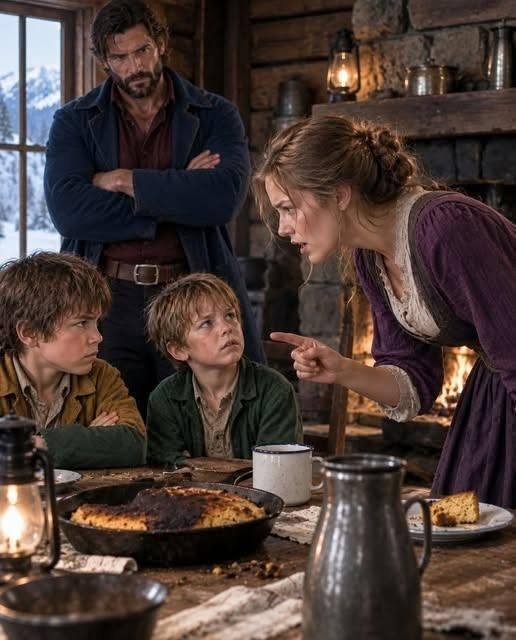
For three weeks, she had learned to recognize every sound Wyatt’s mountain house made: the groan of timber in the wind, the crackle of logs in the fireplace, the heavy boots of Wyatt returning from the barn, and the endless arguments of two boys who seemed determined to make her regret every decision she had ever made.
But this scream was different.
It was high, terrified, and filled with a pain that made the blood drain from her face.
“Caleb?” she shouted.
Another scream came from somewhere beyond the eastern tree line.
“PLEASE! IT HURTS!”
Cora ran toward the back door.
She didn’t stop to grab her shawl. She didn’t even remember that she was wearing thin house slippers until the freezing air struck her bare ankles.
Outside, snow whipped across the yard in sharp, stinging sheets. The mountains were already dark, and the wind was strong enough to bend the branches of the pine trees.
“Caleb!”
No answer.
Then she saw it.
A trail of footprints leading away from the house toward the narrow ravine behind the old logging shed.
Beside them were dark red drops scattered across the snow.
Blood.
Cora’s stomach twisted.
She followed the trail, stumbling over frozen roots and slipping on patches of ice.
“Caleb! Answer me!”
“I’m here!”
His voice came from below.
Cora reached the edge of the ravine and looked down.
For one terrible second, she couldn’t breathe.
Ten-year-old Caleb was lying near the bottom of the slope, one leg trapped beneath a fallen pine branch. His trousers were torn, and blood was spreading across the snow around his lower leg.
His face was white with fear.
“Don’t move!” Cora shouted.
Caleb tried to pull himself free.
The branch shifted.
He screamed again.
“STOP!” she cried. “Caleb, listen to me! Don’t move another inch!”
He froze, trembling violently.
Cora scrambled down the slope, scraping her hands against rocks and frozen branches. When she reached him, she dropped to her knees.
“Look at me,” she said, forcing her voice to remain steady. “Look at me, Caleb.”
His eyes were wide and wet.
“I didn’t mean to!”
“Didn’t mean to do what?”
“I just wanted to see the trap! I thought I could get back before Father noticed!”
Cora glanced at the branch pinning his leg.
A short distance away, half buried in the snow, lay an old iron trap.
She understood immediately.
Wyatt had warned both boys to stay away from the ravine. He had also forbidden them from touching the traps he used to protect the livestock from predators.
Caleb had broken both rules.
But that didn’t matter now.
“You can explain everything later,” Cora told him. “Right now, we’re getting you home.”
She tried lifting the branch.
It barely moved.
She braced her boots against the frozen ground and pulled again, gritting her teeth.
Nothing.
Caleb began to sob.
“I’m sorry. I’m sorry, Cora. I didn’t think it would hurt this much.”
She stopped pulling.
For three weeks, the boy had refused to call her anything except you or that woman. He had never apologized to her for anything.
Now he was looking at her as though she were the only person in the world who could save him.
“Caleb, listen carefully. You’re going to be all right.”
“You don’t know that!”
His voice cracked.
“You don’t know! Mother said she would come back when she went away, but she never did! Father says people die on these mountains all the time!”
Cora felt something twist painfully inside her.
“Oh, sweetheart.”
The words escaped before she could stop them.
Caleb stared at her.
She had never called him that before.
Then he cried harder.
“I don’t want to die!”
Cora reached for his hand.
“You are not dying tonight. Do you hear me? I didn’t come all this way to let you give up on me now.”
“But my leg—”
“I know. I’m going to help you. You just have to trust me.”
For a moment, Caleb seemed torn between fear and the stubborn pride that had defined every interaction between them.
Then he squeezed her hand.
“All right.”
Cora looked toward the distant house.
Wyatt was working near the lower pasture. Even if she screamed, the wind might carry her voice in the wrong direction.
She had to get Caleb free.
And she had to do it quickly.
“CALEB!”
Wyatt’s voice thundered through the trees.
Cora had never heard a human being sound so frightened.
She looked up to see him charging down the slope, carrying a lantern in one hand and an axe in the other. His coat was unʙuттoned, and snow clung to his dark hair.
The moment he saw his son, he dropped the lantern into a patch of soft snow and fell to his knees.
“Sweet Jesus.”
“Wyatt,” Cora said quickly. “The branch is pinning his leg. There’s a trap nearby, but I don’t think it’s what caused the bleeding. I haven’t moved him more than necessary.”
Wyatt examined the situation with the grim concentration of a man accustomed to dealing with injuries in the wilderness.
“Caleb, can you feel your toes?”
The boy nodded, tears running down his face.
“Good. Don’t move.”
Wyatt positioned the axe beneath the branch and tested its weight.
Then he looked at Cora.
“When I lift, you pull his leg clear. Slowly. Don’t twist it.”
She nodded.
“Ready?”
“Yes.”
Wyatt strained against the branch.
His shoulders тιԍнтened, and the muscles in his forearms stood out beneath his rolled-up sleeves.
The wood shifted a fraction.
“Now!” he shouted.
Cora carefully guided Caleb’s injured leg free.
The moment it came loose, the boy screamed and clutched her arm.
Wyatt dropped the branch and gathered his son against his chest.
“Easy, boy. I’ve got you.”
Caleb buried his face against his father’s coat.
“I’m sorry, Pa.”
Wyatt closed his eyes for a brief second.
“Don’t you ever scare me like that again.”
“I didn’t mean to.”
“I know.”
Wyatt’s voice broke on the last word.
He held his son тιԍнтer.
Then he looked at Cora.
Her hands were bleeding from the frozen rocks. Her slippers were soaked, and her dress was torn at the knee. She was shaking so badly that she could barely stand.
“You came out here without a coat,” he said.
It wasn’t a question.
“Your son was screaming.”
“You could have frozen to death.”
“So could he.”
Wyatt stared at her.
For three weeks, he had watched Cora endure his sons’ hostility without asking him to intervene. He had seen her clean the kitchen, mend their clothes, teach them letters, and quietly set aside the portions of food she liked best so the boys could have more.
He had ᴀssumed she was simply fulfilling the terms of their arrangement.
Now, kneeling in the snow with blood on her hands, she was looking at Caleb as though his life mattered more than her own comfort.
Something in Wyatt’s expression changed.
“Give me your hand,” he said.
“I’m fine.”
“Cora.”
His voice was low, but there was no room for argument.
She held out her hand.
He looked at the cuts across her palm, then at her bare feet.
His jaw тιԍнтened.
“Lord have mercy. You’re freezing.”
“Caleb needs a doctor.”
“And you’re coming with us.”
He lifted Caleb into his arms.
Then, without asking permission, he took Cora’s hand and pulled her carefully up the slope.
She stumbled once.
Wyatt caught her around the waist.
For one brief moment, they stood close enough for her to feel the warmth of his body through their clothes.
His eyes searched her face.
“Can you walk?”
“Yes.”
“Don’t lie to me.”
“Then stop asking questions you already know the answer to.”
Under different circumstances, Wyatt might have laughed.
Instead, he тιԍнтened his grip around her waist and helped her toward the house.
Behind them, the snow began covering the blood.
The nearest physician lived nearly twelve miles away.
Wyatt sent his ranch hand, Thomas, riding through the storm to fetch him while he carried Caleb into the house and laid him on the sitting-room sofa.
Cora hurried to the kitchen for clean towels, H๏τ water, and the small box of medical supplies she had found in a cupboard during her first week at the house.
Wyatt knelt beside his son.
Caleb’s face was pale, and sweat beaded across his forehead despite the cold.
“Does it hurt badly?” Wyatt asked.
The boy nodded.
“I’m sorry, Pa.”
Wyatt brushed the hair from his son’s forehead.
“We’ll talk about what happened when you’re feeling better.”
“Are you angry?”
Wyatt stopped.
For a long moment, he looked at his son without speaking.
“I’m frightened,” he finally admitted. “There’s a difference.”
Caleb stared at him.
Cora, standing near the fireplace with a basin of warm water, felt her throat тιԍнтen.
She had never heard Wyatt speak that way.
The man who had proposed marriage as though he were negotiating the purchase of a horse had just admitted to being frightened.
Not angry.
Not disappointed.
Frightened.
Because he had nearly lost his child.
When Cora knelt beside the sofa, Caleb reached for her hand.
She immediately took it.
“Are you going to leave?” he whispered.
She looked at him in surprise.
“Why would I leave?”
“Because I was bad to you.”
Cora glanced at Wyatt.
He had gone very still.
Caleb swallowed.
“I threw your bread. I called you names. I told Seth that if he listened to you, Mother would be angry with him.”
His voice trembled.
“I thought if we were mean enough, you’d go away.”
Cora felt tears sting her eyes.
“Caleb, look at me.”
He did.
“You are allowed to miss your mother. You are allowed to be angry that she isn’t here. And you are allowed to wish things were different.”
She brushed a strand of hair away from his forehead.
“But you cannot hurt people just because you’re hurting.”
Caleb’s lower lip trembled.
“Are you going to forgive me?”
Cora squeezed his hand.
“I already have.”
The boy began to cry again.
This time, she leaned forward and carefully wrapped her arms around him, avoiding his injured leg.
Caleb clung to her.
And from the doorway, Wyatt watched his eldest son embrace the woman he had once been determined to drive away.
For the first time in four years, Caleb was crying in someone’s arms without asking them to leave him alone.
Wyatt turned away before either of them could see his expression.
The physician arrived shortly before midnight.
After examining Caleb, he determined that the boy had suffered a deep laceration and a badly bruised leg. Fortunately, there was no obvious fracture, though he would need careful observation over the coming days.
The physician cleaned the wound and applied a firm bandage.
“He’s fortunate,” he said, packing away his instruments. “Another fall, or a little more pressure from that branch, and we might be having a very different conversation.”
Wyatt stood beside the fireplace, his arms crossed.
“Will he recover?”
“I expect so, provided the wound stays clean and doesn’t become infected. Keep him warm, make sure he drinks plenty of water, and don’t let him put weight on that leg until the swelling improves. If the pain worsens, he develops a fever, or the redness spreads, send for me immediately.”
Wyatt nodded.
After the physician left, the house fell quiet.
Seth had been asleep in the upstairs bedroom, unaware of the accident until Thomas carried Caleb inside. Now he sat beside his brother’s bed, holding his hand and refusing to go back to his own room.
Cora brought them both warm milk.
Seth looked at her with red-rimmed eyes.
“Is Caleb going to die?”
“No,” Cora answered gently. “The doctor believes he’ll recover.”
“Promise?”
She knelt beside him.
“I won’t promise something I cannot control. But I will tell you the truth: Caleb is being cared for, and we’re going to do everything we can to help him get better.”
Seth looked down at his brother.
Then he whispered, “I told him to go.”
Cora’s expression changed.
“What do you mean?”
Seth twisted his fingers together.
“I told him I wasn’t scared of the traps. I said he was a coward if he didn’t go look at them.”
He began to cry.
“I didn’t think he’d get hurt.”
Cora put an arm around his shoulders.
“I know.”
“Is it my fault?”
“No. Caleb made his own decision, and you didn’t know this would happen. But you can learn from it.”
Seth leaned against her.
“Will you stay until he wakes up?”
Cora looked at Caleb, whose face had finally relaxed in sleep.
“Yes,” she said. “I’ll stay.”
Wyatt stood in the doorway.
He had heard every word.
When the boys finally drifted off, he quietly motioned for Cora to follow him downstairs.
She expected a lecture about disobeying him by running into the storm.
Instead, Wyatt placed a thick wool blanket around her shoulders and set a steaming cup of coffee on the table.
“Sit down.”
“I’m not tired.”
“Cora.”
She sat.
He pulled a chair opposite her and remained silent for several moments, staring at the fire.
Then he said, “I owe you an apology.”
She blinked.
“For what?”
“For bringing you into this house and expecting you to solve problems I haven’t known how to face myself.”
Cora looked at him carefully.
“You didn’t ask me to save Caleb tonight.”
“No. But I brought you here because I wanted someone else to do the work of raising my sons while I kept pretending that providing food and shelter was enough.”
His large hands тιԍнтened around his coffee cup.
“After their mother died, I thought the best thing I could do was keep this place running. Keep the ranch profitable. Make certain the boys never wanted for anything.”
He looked toward the staircase.
“I never understood why they were angry with me.”
“Because you were still here,” Cora said softly, “and their mother wasn’t.”
Wyatt looked up.
She continued carefully.
“Children don’t always know how to grieve. Sometimes they become angry at the person who remains because that person is easier to blame than the one they have lost.”
“Is that what you think Caleb has been doing?”
“I think he misses his mother. I think Seth is frightened that if he loves someone new, he’s betraying her. And I think you’ve been so afraid of losing them that you’ve forgotten they need more than protection.”
Wyatt stared at her.
“Where did you learn to understand children that way?”
Cora looked down at her hands.
“I was a teacher.”
“Were?”
“The schoolhouse burned down. The council dismissed me. And now I’m here.”
“You could have refused my proposal.”
She gave a small, humorless smile.
“With two nickels to my name and winter coming?”
Wyatt’s expression тιԍнтened.
“Was that the only reason you accepted?”
Cora considered the question.
“At first? Perhaps.”
The honesty seemed to surprise him.
She continued.
“But I stayed because I gave my word. And because those boys deserve someone who will not mistake their grief for wickedness.”
Wyatt leaned forward.
“And what about you?”
“What about me?”
“Who looks after you when you’re the one who’s hurting?”
Cora opened her mouth.
No answer came.
She had spent weeks worrying about shelter, food, and work. She had spent three weeks learning the moods of two grieving boys and the habits of a man who spoke more easily to horses than to people.
She had not considered what she needed.
Wyatt rose, walked around the table, and stopped beside her chair.
Then he held out his hand.
“Come with me.”
“Where?”
“There’s something I want to show you.”
He led her through the quiet hallway to a small room at the back of the house.
Cora had pᴀssed the door several times but had never seen it open.
Inside stood a writing desk, a bookcase, and a wooden table covered with old maps. A large window overlooked the snowy valley.
Wyatt lit a lamp.
“This was my wife’s room,” he said.
Cora stood very still.
“I’m sorry. I didn’t mean to intrude.”
“You haven’t.”
He walked toward the desk and picked up a small framed pH๏τograph.
His wife was young, with dark hair and a warm smile. She held a baby in her arms while a little boy stood beside her.
Caleb.
Wyatt stared at the pH๏τograph.
“She wanted the boys to learn to read before they were old enough to ride. She said a man who could read a contract would be harder to cheat.”
Cora smiled faintly.
“She sounds like a sensible woman.”
“She was.”
He set the pH๏τograph down.
“After she died, I couldn’t bear to come in here. I locked the room and left everything exactly as it was.”
“Why are you showing me now?”
Wyatt looked at her.
“Because tonight, when I found Caleb in the snow, I realized something.”
His voice grew rough.
“I’ve spent four years being afraid that if I let anyone else into this family, I would be betraying her.”
Cora’s eyes softened.
“But you weren’t betraying her by asking for help.”
“I know that now.”
He took a slow breath.
“And when I saw you holding Caleb, I realized that the boys weren’t forgetting their mother. They were learning that they could love someone else without losing her.”
Cora’s eyes filled with tears.
Wyatt looked away, visibly uncomfortable with the emotion in the room.
“I don’t expect you to love me, Cora. That was never part of our agreement.”
She said nothing.
“But I need you to understand something.” He turned back toward her. “You are not a hired servant in this house. You are not here because I purchased your obedience with a roof and a warm bed.”
He paused.
“You are my wife. And if you ever decide you want to leave, I won’t use that contract to hold you here.”
Cora stared at him.
“You would let me go?”
“Yes.”
“Even if the boys wanted me to stay?”
His jaw тιԍнтened.
“That would be the hardest thing I’ve ever done.”
“Then why would you say it?”
“Because I would rather have you stay because you want to than because you have nowhere else to go.”
For the first time since arriving at the mountain house, Cora had no clever answer.
She looked at this enormous, weathered man who had offered her a marriage without love because he believed love was something he could no longer afford to risk.
And she realized that beneath his practical words was a loneliness as deep as her own.
“Wyatt?”
“Yes?”
“I didn’t come here expecting romance.”
“I know.”
“But I don’t want our marriage to be nothing more than an arrangement forever.”
He went completely still.
Cora’s cheeks warmed.
“I don’t know what that means yet. I don’t know whether we could ever love each other. But I would like the chance to find out who you are when you’re not trying so hard to be the strongest person in the room.”
Wyatt looked at her for a long time.
Then he reached for her hand.
His palm was rough and warm against hers.
“I don’t know how to do that,” he admitted.
“Neither do I.”
She smiled faintly.
“Perhaps we can learn.”
He lowered his eyes to their joined hands.
Then, very gently, he lifted her fingers and pressed a kiss against her knuckles.
It was the first affectionate gesture he had offered her since their wedding.
And somehow, it meant more than any grand declaration could have.
The following morning, Cora awoke to find a small wooden box outside her bedroom door.
Inside lay a pair of lined leather boots, a new wool shawl, and a folded note written in Wyatt’s heavy handwriting.
For the woman who runs into blizzards without thinking about her own safety.
Next time, take your coat.
—Wyatt
Cora laughed so suddenly that Polly, who was carrying fresh linens down the hallway, stopped in surprise.
“What’s so funny, Mrs. Wyatt?”
Cora quickly folded the note.
“Nothing.”
But she could not stop smiling.
For the first time in months, she woke up thinking about something other than how she would survive the next day.
She thought about the boys.
She thought about Wyatt.
And she wondered whether a marriage that began without love might someday become something neither of them had dared to ask for.
Then she heard a commotion from upstairs.
“She’s going to leave us!”
It was Seth.
Cora hurried toward the boys’ room.
Caleb was sitting up in bed, his injured leg propped on pillows. Seth stood beside him, clutching a crumpled piece of paper.
“What happened?” Cora asked.
Seth thrust the paper toward her.
“I found it in Father’s study!”
Cora unfolded it.
It was a letter from a man named Henry Caldwell, a lawyer in Denver.
The first lines were ordinary enough.
Then she reached the sentence that made her blood run cold.
As agreed, the marriage arrangement may be dissolved at any time upon written request, and Mrs. Wyatt will receive the sum specified in the original contract.
Below it was a second paragraph.
However, should Mr. Wyatt die or become permanently incapacitated, the question of ownership over the eastern mining tract will immediately become subject to review.
Cora read it twice.
The eastern mining tract.
She had heard the name before. It was a stretch of land near the ravine where Caleb had been injured, rich in timber and rumored to contain valuable mineral deposits.
Why would a marriage contract mention it?
Before she could ask another question, Wyatt appeared in the doorway.
His expression changed when he saw the letter in her hands.
“Where did you find that?”
Seth shrank back.
“In your study, Pa. I wasn’t trying to steal anything.”
Wyatt took the paper from Cora.
For several seconds, he stared at it in silence.
Then he folded it and slipped it into his pocket.
“Both of you stay here,” he told the boys.
He turned to Cora.
“Come downstairs.”
Something in his voice made her follow without protest.
Once they reached the study, he closed the door.
“There’s something I should have told you before we married.”
Cora’s heart began to pound.
“What is it?”
Wyatt walked to the window.
“The land around this house belonged to my father. When he died, most of it pᴀssed to me. But the eastern tract was left in a separate trust.”
“Why?”
“Because my younger brother, Daniel, believed the land belonged to him.”
Cora stared at him.
“You have a brother?”
“Had.”
Wyatt’s face hardened.
“Daniel died five years ago in a mining accident. His widow claimed that the eastern tract should have pᴀssed to her son, but the boy disappeared after she remarried and left Colorado.”
“That’s terrible.”
“Yes.”
He turned toward her.
“Three months ago, someone began asking questions about that boy. Someone also began sending anonymous letters to my lawyer.”
Cora felt a chill creep over her skin.
“What do the letters say?”
“That I am hiding the rightful heir.”
“Are you?”
“No.”
His answer came immediately.
But there was something in his expression that made her wonder whether the truth was more complicated.
Wyatt continued.
“The marriage contract was drawn up partly to protect my sons. If anything happens to me, the eastern tract could become the subject of a legal dispute. My lawyer advised me to make certain that the boys would have a guardian who could act in their interests.”
Cora stared at him.
“So you didn’t just need someone to raise your sons.”
“I needed someone I could trust.”
“And you decided that marrying a homeless schoolteacher was the best way to accomplish that?”
Wyatt winced.
“When you put it that way, it sounds rather foolish.”
“It sounds as though you left out half the truth.”
“I know.”
She looked away, hurt by the realization that even after everything they had shared, he had kept something so important from her.
“Does this have anything to do with Caleb’s accident?”
Wyatt’s expression turned grim.
“I don’t know.”
“But you suspect it does.”
He didn’t answer.
Cora stepped closer.
“Wyatt, someone sent letters about a missing heir. Someone may have a financial interest in your land. And yesterday, your son was injured beside a trap that you specifically warned him not to approach.”
She took a breath.
“I don’t believe in coincidences quite that easily.”
Wyatt studied her.
Then he nodded slowly.
“Neither do I.”
He crossed the room and opened a locked drawer.
Inside lay a collection of letters tied together with string.
He placed them on the desk.
“I was going to wait until I had proof before involving you.”
Cora looked at the letters.
“And now?”
“Now I think you deserve to know what you married into.”
She met his eyes.
“Then tell me everything.”
Wyatt sat down.
And as the snow began falling harder outside, he opened the first letter.
What he read aloud next would change everything Cora believed about the mountain, the family, and the man who had offered her a loveless marriage.
Because the first letter was not addressed to Wyatt.
It was addressed to Caleb’s mother.
And it had been written six months before her death.
Wyatt’s voice faltered as he reached the final line.
If you want your boys to survive what is coming, you must tell them the truth about their uncle before it is too late.
Cora slowly looked up.
“Wyatt… what truth?”
He stared at the letter, his face drained of color.
Then, from upstairs, Seth screamed.
“PA! SOMEONE’S OUTSIDE!”
Wyatt snatched the rifle from its rack.
Cora ran after him.
They reached the upstairs window just as a shadow disappeared between the pine trees.
Near the back door, someone had left a small wooden object in the snow.
Wyatt went still when he saw it.
It was a child’s toy horse, carved from dark wood.
Cora recognized it immediately.
She had seen the same toy in the framed pH๏τograph of Wyatt’s late wife, resting in the hands of the little boy standing beside her.
Wyatt stepped into the snow and picked it up with trembling fingers.
On the underside, someone had carved three words:
THE HEIR LIVES.
Wyatt looked toward the dark mountains.
And for the first time since Cora had known him, the wealthy mountain man appeared truly afraid.
Because if the message was real, then someone had found the missing child.
And whoever had left that toy knew exactly where Wyatt’s sons were sleeping.