PART 2: THE WIDOW WHO BROUGHT SIX SONS TO TAME THE WILDEST BOYS IN MONTANA
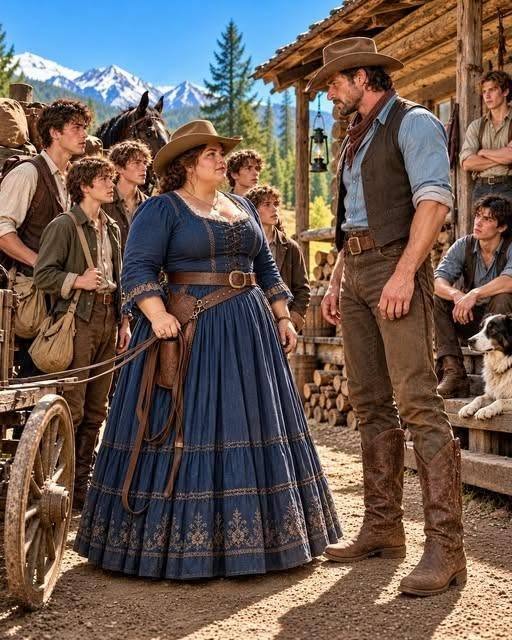
Standing near the flour barrels was a woman in a dark wool coat, a faded brown bonnet, and boots that had clearly seen more winters than most people in Red Fork had endured. She was perhaps thirty-five, with tired eyes, a straight back, and hands roughened by years of work.
She carried a carpetbag in one hand and held the reins of a small wagon through the window with the other.
There was nothing remarkable about her appearance.
But there was something in the way she stood that made Harlan pause.
She wasn’t smiling nervously.
She wasn’t looking at the floor.
And when she met his gaze, she didn’t flinch.
“You said you can cook?” Harlan asked.
“Yes, sir.”
“How many people have you cooked for at once?”
“Depends on the day. Sometimes twenty. Sometimes more.”
“Can you bake bread without burning it? Can you preserve meat? Can you stretch a sack of flour through a hard winter?”
“I’ve done all three.”
“Can you deal with five boys who have driven nine housekeepers off this mountain?”
The woman glanced toward the door.
“Are those the boys who put soap in the sugar jar?”
Harlan’s expression hardened.
“Who told you that?”
“Mrs. Higgins. I met her outside the mercantile. She was crying so hard she could barely explain what happened.”
Miller let out a low whistle.
“Then you’ve heard the stories. Best save yourself the trouble, ma’am. Those boys would make a saint reconsider her calling.”
The woman placed her carpetbag on the counter.
“My name is Eleanor Hayes. I’m a widow. I have six sons of my own, and I’ve been feeding hungry boys since before some of them could walk.”
Harlan stared at her.
“Six?”
“Six.”
“And you want to take on my five?”
“I want the job.”
Harlan leaned closer.
“Mrs. Hayes, I’m going to tell you something, and I want you to listen carefully. My boys aren’t ordinary troublemakers. They have frightened grown men, broken furniture, ruined food, and made grown women run from this ranch in tears.”
“I understand.”
“No, you don’t.” His voice grew rougher. “My oldest is sixteen. He thinks he’s a man. My youngest is eight, and he thinks every living thing is a toy. They’ll test you every hour of every day. They’ll lie to your face, steal your food, and make you miserable just to see if they can.”
Eleanor listened without interrupting.
Then she asked, “Are they cruel because they enjoy hurting people, or because they’re hurting themselves?”
Harlan went completely still.
Miller stopped polishing a glᴀss jar.
For a moment, the mercantile seemed quieter than it had any right to be.
Finally, Harlan straightened.
“They’re boys.”
“Yes,” Eleanor replied softly. “They are.”
He looked at her for a long time.
Then he asked the question that had driven away every other woman.
“What makes you think you can succeed where nine others failed?”
Eleanor picked up her carpetbag.
“Because, Mr. Harlan, I don’t intend to fight your boys.”
She looked him directly in the eye.
“I’m going to find out what they’re fighting.”
Harlan had no answer for that.
He had spent a year trying to control his sons through threats, punishments, and long silences. None of it had worked for more than a day.
Yet this stranger spoke as though she had already seen through the walls his boys had built around themselves.
He didn’t trust her.
But he was desperate.
“One month,” he said. “I’ll pay you double, and you can leave whenever you want. No hard feelings.”
Eleanor nodded.
“Agreed.”
“And if the boys become dangerous, you leave immediately.”
“Agreed.”
Harlan held out his hand.
She shook it firmly.
Neither of them noticed the six faces watching from the wagon outside.
Six boys, ranging from seventeen to seven, had been listening to every word.
The oldest, Thomas, leaned over the wagon seat.
“Ma,” he whispered, “are you really going to put up with five more boys?”
Eleanor climbed onto the driver’s bench.
“No, Thomas.”
Her oldest son blinked.
“No?”
She gathered the reins and gave him a small smile.
“I’m going to make sure all eleven of you learn how to live together.”
The six boys exchanged uneasy looks.
For the first time that afternoon, none of them laughed.
Because they knew their mother.
And they knew that smile.
It meant she had a plan.
1. The Arrival That Made Five Little Tyrants Go Silent
The following afternoon, the wagon climbed the narrow mountain road toward Harlan’s ranch.
Eleanor sat on the driver’s bench with Thomas beside her. Her other five sons rode in the back among flour sacks, cooking pots, rolled blankets, and a wooden chest that had belonged to their father.
The mountains rose around them, dark with pine forests and streaked with snow.
When the ranch finally appeared below the ridge, Thomas whistled.
“That’s a mighty big place.”
“It used to be bigger,” Eleanor replied. “A man’s grief can make even a large house feel empty.”
Thomas looked at her.
She said nothing more.
At the ranch, Jesse stood on the porch with his arms folded.
Emmett leaned against a fence post, grinning.
Luke and Sam crouched behind a woodpile, while Toby watched from the barn door, the ᴅᴇᴀᴅ snake from the previous day still dangling from his hand.
They had already decided what to do.
First, they’d frighten the new housekeeper.
Then they’d make her cry.
Then they’d watch her leave.
Jesse had even prepared a bucket of cold water to dump over the wagon when it pᴀssed beneath the porch.
“Remember,” he whispered to his brothers, “don’t do anything until I give the signal.”
Emmett nodded.
Luke snickered.
Sam covered his mouth.
Toby raised the snake.
“Can I put this in her bed?”
“No,” Jesse hissed. “We need something better.”
Then the wagon rounded the final bend.
Harlan emerged from the barn, wiping his hands on a rag.
“You’re late,” he called.
“The road was icy,” Eleanor answered. “I didn’t want to lose a wheel.”
She drew the wagon to a stop.
For a few seconds, she simply sat there, looking at the five boys.
Jesse lifted his chin.
Eleanor looked at his dirty face, his bruised knuckles, and the defiant set of his shoulders.
Then she looked at Emmett, who was trying not to laugh.
Luke and Sam peered around the woodpile.
Toby held up the snake.
“Look what I caught!”
Eleanor nodded politely.
“Well done, young man. Is it ᴅᴇᴀᴅ?”
Toby’s grin faltered.
“Yes.”
“Then I hope you washed your hands afterward. We’ll be preparing supper soon.”
Toby stared at her.
She turned to her sons.
“Thomas, take the flour inside. Samuel, carry the pots. Caleb, Nathan, and Peter, unload the blankets and wood. Matthew, check the wagon wheels before we leave it overnight.”
Her six sons immediately began moving.
Not because she shouted.
Not because she threatened them.
They simply obeyed.
Jesse watched with growing suspicion.
Then Eleanor climbed down and approached him.
“You must be Jesse.”
He frowned.
“Who told you?”
“Your father.”
“Did he tell you we don’t need a housekeeper?”
“Yes.”
Jesse looked surprised.
“And?”
“And I told him that was an interesting opinion for a boy who apparently eats raw potatoes when nobody cooks supper.”
Luke burst out laughing.
Jesse spun around.
“Shut up!”
Eleanor raised one eyebrow.
“Is that how you speak to your brothers?”
Jesse turned back toward her.
“You’re not my mother.”
“No,” Eleanor agreed. “I’m not.”
She held his gaze.
“But while I’m working in this house, I expect people to speak to one another with respect. You don’t have to like me. You don’t have to call me anything except Mrs. Hayes. But you will not make my sons miserable, and they will not make you miserable.”
Emmett pushed away from the fence.
“And what if we do?”
Eleanor glanced toward the barn.
“Then you’ll help repair whatever you break, clean whatever you dirty, and finish whatever work you interrupt.”
The boys exchanged looks.
They had expected threats.
They had expected tears.
They had expected a lecture about manners.
They hadn’t expected a woman who seemed entirely unimpressed by them.
Jesse stepped closer.
“You think you can control us?”
Eleanor smiled.
“No, Jesse. I think you can control yourselves. I’m simply going to stop helping you pretend otherwise.”
For a moment, Jesse looked as though he might say something cruel.
Then his gaze shifted toward the wagon.
Six boys were unloading supplies in perfect order.
Thomas carried the flour. Caleb stacked the wood. Nathan and Peter brought the blankets inside. Samuel carefully carried a heavy iron pot, while Matthew inspected the wheel.
None of them were laughing at Jesse.
None of them were afraid of him.
And that irritated him more than anything Eleanor had said.
“Come on,” Jesse muttered to his brothers. “Let’s see how long she lasts.”
They disappeared into the barn.
Eleanor watched them go.
Harlan came to stand beside her.
“You shouldn’t have challenged Jesse in front of the others.”
“I didn’t challenge him.”
“You did.”
She turned toward him.
“Mr. Harlan, that boy has spent a year making people leave before they can abandon him. If I let him decide the rules on the first day, he’ll spend the next month proving that nobody can stay.”
Harlan stared at her.
For a moment, he looked as if she had struck him.
Then he looked toward the barn, where his sons had vanished.
“Mary used to say something like that,” he murmured.
Eleanor’s expression softened.
“Then perhaps she understood her boys better than either of us realized.”
Harlan walked away without answering.
But that evening, for the first time in months, he stayed in the kitchen long enough to watch someone prepare supper.
And what happened next would change the ranch forever.
2. The Great Kitchen Disaster
Eleanor’s first rule was simple.
Everyone ate at the table.
No exceptions.
At five o’clock, she rang a small brᴀss bell.
The sound echoed through the house.
“Wash your hands! Supper is ready!”
Nobody came.
She rang it again.
A muffled voice called from upstairs.
“We’re not hungry!”
Eleanor glanced at Thomas.
He shrugged.
“That’s what we used to say when Ma made us eat turnips.”
She smiled.
“Then I suppose we’ll have to see whether these boys are as stubborn as you were.”
She walked to the staircase.
“Jesse, Emmett, Luke, Sam, Toby. Supper.”
“We’re busy!” Jesse shouted.
“Doing what?”
“Important things!”
Eleanor waited.
Then she calmly returned to the kitchen.
“Very well. I’ll save your portions.”
Thomas looked up from the table.
“You’re not going to make them come down?”
“No.”
“Why not?”
“Because hungry boys who choose not to eat will discover the consequences soon enough. Hungry boys who are dragged to the table will only learn to fight harder.”
She served the food.
There was beef stew, fresh bread, carrots, and a large dish of roasted potatoes.
Her six sons ate quietly.
Harlan sat at the head of the table, looking increasingly uncomfortable.
“You can’t let them get away with this,” he said.
Eleanor pᴀssed him the bread.
“I’m not.”
“But—”
“Mr. Harlan, have you ever noticed that the more you argue with them, the more determined they become to win?”
He opened his mouth.
Then closed it.
Upstairs, something crashed.
A moment later, Emmett appeared at the top of the staircase.
“Mrs. Hayes!”
Eleanor looked up.
“What is it?”
“The kitchen’s on fire!”
Harlan sH๏τ to his feet.
Eleanor was already moving.
She reached the kitchen to find a plume of smoke rising from the stove.
Luke stood beside a pot of scorched grease.
Sam held a wooden spoon.
Toby was waving a towel at the smoke.
Jesse stood near the doorway, trying to look innocent.
“What happened?” Harlan demanded.
“Nothing!” Jesse answered.
Eleanor took one look at the stove.
“Everyone step away.”
She ordered the boys out of the kitchen and dealt with the small fire safely, making sure the heat was cut off and the flames were contained. No one was injured, though the kitchen filled with smoke and the smell of burnt grease.
When the air cleared, she turned to the boys.
“Who started cooking?”
Nobody answered.
She looked at the scorched pot.
“Who poured grease into a H๏τ pan?”
Sam’s eyes shifted toward Luke.
Luke glared at him.
Finally, Toby raised his hand.
“Emmett said we should make something that would stink so bad she’d leave.”
Emmett spun around.
“Toby!”
Eleanor folded her arms.
“Thank you for telling the truth, Toby.”
The youngest boy looked uncertain.
“Am I in trouble?”
“You will help clean the kitchen. So will your brothers.”
Jesse scoffed.
“We’re not your servants.”
“No,” Eleanor said evenly. “You’re boys who made a mess. Everyone who makes a mess helps clean it.”
She handed Jesse a cloth.
Then she handed Emmett a bucket.
Luke and Sam were ᴀssigned to scrub the stove after it cooled, while Toby collected the dirty utensils.
Her own sons joined them without complaint.
For the next hour, the kitchen echoed with muttering, splashing water, and the occasional angry grunt.
Jesse worked furiously.
“This is ridiculous.”
Thomas, scrubbing the opposite counter, glanced at him.
“Then stop making messes.”
Jesse glared at him.
“Nobody asked you.”
“No,” Thomas replied. “But I figured you could use the advice.”
For one dangerous second, Jesse looked ready to swing.
Eleanor appeared between them.
“Hands down, Jesse.”
He froze.
She didn’t shout.
She didn’t threaten to tell his father.
She simply waited.
Slowly, Jesse lowered his fists.
“Good,” she said. “Now finish the counter.”
He did.
Harlan stood in the doorway, watching the scene.
For the first time, he saw his sons doing something together without destroying the house around them.
They were angry.
They were embarrᴀssed.
But they were working.
And when supper was finally cleared away, Eleanor did something none of the boys expected.
She brought out another plate of fresh bread.
“Anyone still hungry?”
Five hands went up.
Even Jesse’s.
Eleanor placed the bread on the table.
“Then eat.”
Jesse stared at her.
“You’re not going to lecture us?”
“No.”
“Punish us?”
“You cleaned the mess you made. That’s the consequence.”
He looked at the bread.
Then at his brothers.
For the first time that day, he seemed uncertain what to do with a grown-up who didn’t turn every mistake into a battle.
He took a slice.
And ate it.
3. The Widow’s Secret
That night, after the boys had gone to bed, Harlan found Eleanor sitting on the back porch.
The moon hung above the mountains, illuminating the frozen pasture.
She was holding a small wooden pH๏τograph frame.
Harlan recognized the picture.
A man stood beside a wagon, smiling at the camera. Six boys crowded around him, some grinning, some squinting into the sunlight.
“Your husband?” Harlan asked.
Eleanor nodded.
“Samuel Hayes. He died two winters ago.”
Harlan sat down on the opposite end of the bench.
“I’m sorry.”
“Thank you.”
They sat in silence.
Finally, Harlan said, “You handle boys well.”
“I’ve had practice.”
“Your oldest listens to you.”
“Most days.”
“Mine don’t listen to anyone.”
Eleanor looked toward the barn.
“Perhaps they’ve forgotten what it feels like to be listened to themselves.”
Harlan’s jaw тιԍнтened.
“I buried their mother on that ridge. Afterward, I did everything I could to keep the ranch running. I thought if I worked hard enough, if I kept food on the table and the cattle alive, the boys would be all right.”
He rubbed his face.
“But Mary did everything else. She knew when Jesse was frightened. She knew when Emmett was lying because he was embarrᴀssed. She knew when Luke and Sam were fighting because they missed each other, even when they were standing in the same room.”
His voice cracked.
“I don’t know how to do what she did.”
Eleanor lowered the pH๏τograph.
“Then stop trying to become Mary.”
He looked at her sharply.
“What?”
“Your sons don’t need you to replace their mother. They need you to be their father.”
Harlan stared at the dark valley.
“I don’t know how.”
“You begin by spending time with them when nothing is wrong.”
He gave a bitter laugh.
“When nothing is wrong? There’s always something wrong.”
“Then begin when something is wrong. Sit beside them. Ask them what happened. Listen before you decide what to do.”
Harlan said nothing.
Eleanor’s voice softened.
“Grief makes people feel helpless. Children especially. They don’t understand why someone they love can disappear from their lives forever. They only know the world has changed, and nobody can make it right.”
She paused.
“Sometimes they behave badly because anger is easier to show than sadness.”
Harlan looked at her.
“How do you know?”
Eleanor turned the pH๏τograph over in her hands.
“Because after my husband died, Thomas punched a hole through our pantry door. Caleb refused to speak to me for three weeks. And my youngest stopped sleeping through the night.”
She looked up.
“I could have punished them until they obeyed. But that wouldn’t have brought their father back.”
Harlan’s expression changed.
For the first time, he understood that Eleanor had not come to his ranch because she was fearless.
She had come because she knew what grief could do to a family.
And she had learned, through her own pain, how to help children survive it.
“Why did you take this job?” he asked quietly. “You have six sons to raise. You could have found work in town.”
Eleanor looked toward the wagon.
“Because I heard about your boys. I heard that nine women had left, and that people in Red Fork had started calling them monsters.”
She shook her head.
“No child should grow up believing that everyone has already decided what he will become.”
Harlan stared at her.
“And what do you think they’ll become?”
She smiled faintly.
“That depends on whether the people who love them give them a chance.”
A long silence followed.
Then Harlan asked, “What happens if they chase you away, too?”
Eleanor stood and brushed the snow from her skirt.
“Then I’ll leave knowing I tried.”
She paused at the door.
“But I don’t believe they will.”
“Why not?”
She looked toward the barn, where a faint light glowed beneath the door.
“Because I saw all five of them watching when my sons unloaded the wagon.”
Harlan frowned.
“What does that mean?”
“It means they’re curious.”
Eleanor opened the door.
“And curious boys haven’t given up yet.”
4. The Night Jesse Finally Broke
Three days pᴀssed.
The boys continued to test Eleanor.
They hid her sewing basket.
They moved the kitchen chairs.
Emmett put a frog in her flour bin.
Luke and Sam switched the labels on the salt and sugar jars.
Toby tried to convince her that a mountain lion slept beneath the pantry.
Eleanor answered each prank with the same calm determination.
The chairs were returned.
The flour bin was cleaned.
The jars were relabeled.
And Toby was ᴀssigned to help inspect the pantry, where he discovered that the only creature beneath it was a very annoyed barn cat.
The boys began to lose interest in their own mischief.
But Jesse grew more withdrawn.
He spent hours alone in the barn, repairing tack and avoiding the house.
One evening, Eleanor found him sitting on an overturned feed bucket, holding a small silver locket.
He quickly closed his hand.
“What do you want?” he demanded.
“Nothing. I was looking for the lantern.”
“Well, you found me. Now leave.”
Eleanor picked up the lantern.
Then she noticed the locket.
“Was that your mother’s?”
Jesse’s face hardened.
“Don’t talk about her.”
Eleanor nodded.
“All right.”
She turned toward the door.
But before she reached it, Jesse spoke.
“She used to sit right there.”
Eleanor stopped.
Jesse stared at the empty corner of the barn.
“Every evening, she’d sit on that stool while I brushed the horses. She’d tell me about the ranch when she was a girl. She said someday I’d run it better than my father.”
His voice became rough.
“Then she got sick, and everyone kept telling me she’d be fine.”
Eleanor stood quietly.
“She wasn’t.”
Jesse squeezed the locket.
“She died while I was out checking the north fence. I wasn’t even there.”
His shoulders began to shake.
“I should have stayed. I should have known.”
Eleanor set the lantern down.
“Oh, Jesse.”
He sprang to his feet.
“Don’t!”
She stopped immediately.
“Don’t tell me it wasn’t my fault! Everybody says that. Dad says it. The doctor said it. Even Emmett says it. But if I’d been there—”
His voice broke.
For a moment, he looked much younger than sixteen.
“I was supposed to protect her.”
Eleanor slowly approached him.
“You were her son, Jesse. You were never supposed to save her from death.”
He shook his head furiously.
“She needed me!”
“She loved you.”
“That’s not the same thing!”
“No,” Eleanor whispered. “It isn’t.”
He stared at her, tears streaming down his face.
“Then why did she leave?”
Eleanor’s heart ached.
She knew there was no answer that could make a boy stop missing his mother.
So she gave him the only truth she could.
“She didn’t leave because she wanted to. And she didn’t leave because you failed her.”
Jesse covered his face.
For the first time in a year, the oldest boy on Harlan’s ranch cried.
He cried like a child who had been trying to carry an impossible burden alone.
Eleanor didn’t touch him without permission.
She simply sat on the feed bucket beside him.
After several minutes, Jesse whispered, “I thought if I made every woman leave, it wouldn’t hurt when they went.”
Eleanor looked at him.
“That makes sense.”
He lowered his hands.
“It does?”
“It makes sense that a boy who lost someone he loved would try to stop himself from losing anyone else.”
Jesse looked down at the locket.
“But you won’t stay forever.”
“No,” Eleanor said honestly. “I won’t.”
His face crumpled.
“But I’m here now. And while I’m here, you don’t have to pretend you don’t care about anything.”
He wiped his nose with his sleeve.
“I hate you.”
Eleanor smiled gently.
“I suspect you don’t.”
Jesse let out a broken laugh.
Then he leaned forward and rested his forehead against her shoulder.
She put an arm around him.
And in the darkness of the barn, the boy who had frightened nine housekeepers finally allowed someone to see how frightened he had been himself.
Neither of them noticed Harlan standing just outside the open doorway.
He had come looking for Jesse.
Instead, he found the first honest conversation his son had allowed himself to have since Mary died.
Harlan turned away quietly.
For the first time in months, he understood that his sons weren’t trying to destroy his home.
They were trying to live in a world where the person who had made it feel like home was gone.
And he had been so busy keeping the ranch alive that he had forgotten to help them live in it.
5. The Blizzard That Changed Everything
A week later, the weather turned vicious.
Dark clouds rolled over the Bitterroots, and snow began falling before noon.
By dusk, the ranch was buried beneath a white blanket.
Harlan had sent the cattle hands to secure the southern pasture, but one rider had not returned.
Thomas noticed first.
“Where’s Mr. Cooper?”
Harlan checked the clock.
“He should have been back an hour ago.”
Eleanor stood near the kitchen window.
“Is there another route from the southern pasture?”
“The lower trail,” Harlan answered. “But nobody should be using it in this weather.”
Jesse appeared in the doorway.
“Cooper knows that trail better than anyone.”
Harlan grabbed his coat.
“I’m going after him.”
Eleanor looked outside.
“You won’t see ten feet in front of you.”
“I can’t leave him out there.”
“Then don’t go alone.”
Harlan turned toward her.
“This isn’t your concern.”
“Anyone missing in a blizzard is everyone’s concern.”
She faced the boys.
“Thomas, bring the lanterns. Caleb, prepare the spare blankets. Matthew, check the stable for the sure-footed horses. The rest of you, stay inside until your father gives you instructions.”
Jesse immediately grabbed his coat.
“I’m coming.”
“No,” Harlan said.
“I’m sixteen!”
“And I’m your father.”
Jesse’s face reddened.
“You don’t get to tell me to stay safe now when you haven’t even noticed what happens to us!”
The words struck Harlan harder than a fist.
The room went silent.
Jesse looked as though he regretted saying them.
But he didn’t take them back.
Harlan stared at his son.
Then he slowly removed his gloves.
“You’re right,” he said.
Jesse blinked.
“What?”
“I should have noticed.”
For a moment, neither of them moved.
Then Harlan held out a pair of thick mittens.
“You’re coming with me. But you’ll follow my instructions, and you won’t leave my sight.”
Jesse took the mittens.
“Yes, sir.”
Within minutes, Harlan, Jesse, and Thomas rode out into the storm, following the lower trail as far as they safely could.
Eleanor remained at the ranch, organizing the other boys and preparing the house for their return.
They filled the stove with wood.
They warmed blankets.
They set a pot of stew on the fire.
And when the wind became so fierce that the windows rattled in their frames, Eleanor gathered the boys in the kitchen.
“Tell me something about your mother,” she said.
Luke frowned.
“Why?”
“Because we’re waiting for your father and brothers. And I think it would be a good time to remember someone who loved this place.”
Sam looked down.
“Mom used to make cinnamon rolls when it snowed.”
Toby immediately raised his hand.
“She let me lick the spoon.”
Emmett smiled faintly.
“She used to hide cookies in the flour tin. Dad never found them.”
One by one, the boys began talking.
They remembered Mary’s singing, her terrible jokes, the way she scolded them for tracking mud into the house, and how she always left the porch light burning when Harlan came home late.
At first, their voices were hesitant.
Then the stories came faster.
They laughed.
They cried.
And for the first time since their mother’s funeral, the five brothers remembered her without turning the memory into an argument.
Outside, the storm howled.
Then, just after midnight, a horse whinnied in the yard.
Eleanor rushed to the door.
Harlan stumbled inside, covered in snow, with Jesse and Thomas behind him.
Between them, they supported an exhausted ranch hand.
Mr. Cooper was alive.
His horse had slipped on the lower trail, and he had injured his ankle. Harlan and the boys had found him sheltering beneath a rocky ledge and brought him home.
The boys crowded around the wounded man.
“Are you all right?”
“Did you break your leg?”
“Do you need the doctor?”
Cooper managed a weak smile.
“One question at a time, you little heathens.”
Jesse laughed.
Then he turned toward his father.
Harlan looked at his son.
For a moment, the years of silence between them seemed to disappear.
“I’m proud of you,” Harlan said.
Jesse swallowed.
“Thanks, Dad.”
It was only two words.
But Eleanor saw Harlan’s eyes fill with tears.
Later, after Cooper had been settled near the fire, Harlan found Eleanor washing the muddy blankets.
“You saved my boys,” he said quietly.
She shook her head.
“No. They helped each other.”
Harlan looked toward the kitchen, where Jesse and Emmett were arguing over who had brought in more firewood.
“They haven’t argued like that in months.”
“They’re brothers.”
He smiled faintly.
“Thank you for staying.”
Eleanor looked at him.
“I told you I wouldn’t leave because they were difficult.”
“And if they become difficult again?”
She smiled.
“Then we’ll deal with it together.”
For the first time since Mary died, Harlan believed that might be possible.
But the blizzard had brought another problem.
The ranch’s southern fence had been damaged, and several cattle had wandered beyond the boundary.
With branding season approaching, the loss could threaten the entire operation.
Harlan calculated the damage before dawn.
The numbers were grim.
He might have to sell part of the herd.
And if the bank refused to extend his loan, the ranch could be lost.
When Eleanor learned what had happened, she listened carefully.
Then she asked one question.
“How many cattle are missing?”
“Twenty-three, possibly more.”
“How long before the bank makes its decision?”
“Ten days.”
Eleanor nodded.
“Then we have ten days to find those cattle, repair the fence, and show the bank that this ranch is still worth saving.”
Harlan stared at her.
“That’s easier said than done.”
“Most worthwhile things are.”
She turned toward the boys.
“Jesse, how well do you know the southern trail?”
He straightened.
“Better than anyone.”
“Emmett, can you repair a fence?”
“Of course.”
“Luke and Sam, can you keep an accurate count of the herd?”
The twins exchanged a look.
“We can try.”
“Toby, can you follow instructions without frightening the cattle?”
Toby thought about it.
“Probably.”
Eleanor smiled.
“Good. Then we’ll begin after breakfast.”
Harlan looked at his sons.
For the first time, they were not waiting for someone to tell them they had failed.
They were waiting for someone to trust them with a job.
And that trust would soon be tested in a way none of them expected.
6. The Banker’s Visit
Three days later, the banker’s carriage arrived at the ranch.
Mr. Whitcomb was a narrow-faced man with polished boots and a habit of examining everything as though he were calculating its value.
He stepped into the house, removed his gloves, and looked around the kitchen.
“I understand you’ve hired another housekeeper, Harlan.”
“I have.”
Whitcomb glanced at Eleanor.
“Let’s hope this one lasts longer than the others.”
Eleanor continued kneading dough.
“Good morning to you, too, Mr. Whitcomb.”
He frowned, apparently unused to being answered without fear.
“I’ve come to inspect the property and discuss your outstanding loan.”
Harlan stiffened.
“Of course.”
Whitcomb opened his ledger.
“Your herd is smaller than projected. Your southern fence is damaged. And I hear you’ve been spending money on additional household help.”
“I need someone to run the house,” Harlan said.
“You need to reduce expenses.”
Eleanor wiped her hands.
“Mr. Whitcomb, how many cattle did your report say were missing?”
He glanced at her.
“Twenty-three.”
“Twenty-three were unaccounted for three days ago. Since then, the boys have located seventeen and secured them in the eastern pasture. The remaining six are being tracked by Mr. Cooper.”
Whitcomb looked surprised.
“Who told you to do that?”
“No one. We simply needed to know where the cattle were.”
She placed a ledger on the table.
It contained the number of cattle recovered, the fence repairs completed, and the estimated cost of restoring the damaged pasture.
Whitcomb examined the figures.
Harlan stared at the pages.
He hadn’t realized Eleanor had kept such detailed records.
She pointed to the final column.
“If the remaining cattle are recovered and the fence is repaired by the end of the week, the ranch should be able to meet the next payment without selling off the breeding stock.”
Whitcomb studied her.
“You’ve calculated this yourself?”
“With Harlan’s records and the boys’ reports.”
He looked at Harlan.
“Why wasn’t this information included in your last submission?”
Harlan hesitated.
“Because I hadn’t completed the ᴀssessment.”
Whitcomb closed the ledger.
“I’ll need to verify these figures.”
“Of course,” Eleanor said.
“And if they’re accurate, I may be willing to recommend an extension.”
Harlan exhaled.
It wasn’t a guarantee.
But it was a chance.
After the banker left, Harlan turned toward Eleanor.
“You may have just saved this ranch.”
She shook her head.
“No. Your boys did the work. I simply helped them organize it.”
Jesse stood in the doorway, pretending he hadn’t been listening.
“Does that mean we get paid?”
Harlan looked at him.
“For what?”
“For finding the cattle and fixing the fence.”
Emmett appeared behind him.
“Jesse says if we’re old enough to do a man’s work, we’re old enough to earn a man’s wages.”
Harlan opened his mouth.
Then stopped.
He looked at his sons—at the mud on their boots, the scratches on their hands, and the unexpected pride in their faces.
Mary had always insisted that boys needed responsibility as much as they needed discipline.
He had forgotten that, too.
“All right,” he said. “I’ll work out a fair payment for the work you’ve done.”
The boys exchanged astonished looks.
Toby raised his hand.
“Can I buy a pocketknife?”
“No,” Harlan and Eleanor answered together.
For the first time, the whole kitchen erupted in laughter.
And Harlan laughed with them.
It was a small sound.
But it was the first real laughter the house had heard in a very long time.
7. The Letter Beneath the Floorboards
That evening, Eleanor was moving an old storage chest when she noticed a loose board beneath the kitchen window.
She knelt and lifted it carefully.
Inside the narrow space was a folded letter wrapped in oilcloth.
The handwriting was unmistakable.
Mary’s.
Eleanor carried it to Harlan.
He stared at the envelope for a long time before opening it.
Inside was a letter written several months before Mary’s death.
My dearest Harlan,
If you’re reading this, then perhaps I’ve been gone longer than either of us wanted to imagine.
Please don’t mistake the boys’ anger for a lack of love. Jesse believes he must become a man overnight. Emmett hides his fear behind jokes. Luke and Sam fight because neither knows how to tell the other that he misses me. And Toby is still so young that he thinks people can come back if he asks nicely enough.
They will test you. They will test everyone who tries to help them.
But don’t let their behavior convince you that they are beyond saving.
They need boundaries, yes. They need consequences, too. But most of all, they need to know that love doesn’t disappear when they make a mistake.
And Harlan, please remember this: you are allowed to grieve. You are allowed to be tired. But you cannot build a home out of silence and expect your sons to know how to speak.
Let them see your tears. Let them see you make mistakes. Let them see you try again.
They don’t need a perfect father.
They need you.
Forever yours,
Mary.
Harlan read the letter twice.
Then he sat down and covered his face.
Eleanor stood beside him, saying nothing.
After a long moment, Harlan whispered, “I thought if I stopped crying, the boys would be stronger.”
Eleanor pulled out the chair beside him.
“Perhaps they were waiting for you to show them it was safe to cry.”
He looked at the letter.
“I should have done more.”
“You can still do more.”
He swallowed.
“Do you think they’ll forgive me?”
Eleanor glanced toward the staircase.
“Ask them.”
Harlan stood.
He walked into the main room, where all eleven boys were gathered around the fire.
Jesse was repairing a boot.
Emmett was carving a piece of wood.
Luke and Sam were arguing over a deck of cards.
Toby was half asleep against Thomas’s shoulder.
Harlan stopped in the doorway.
“Turn that down for a minute, boys.”
They looked up.
Jesse frowned.
“What’s wrong?”
Harlan held the letter in both hands.
“Nothing’s wrong.”
He took a breath.
“I just need to tell you something.”
The room grew quiet.
Harlan looked at each of his sons.
“I haven’t been the father you needed this past year. I thought keeping the ranch running was enough. I thought if I worked hard and made sure you had food, clothes, and a roof over your heads, I was doing my duty.”
He paused.
“But I wasn’t listening to you. I wasn’t paying attention. And when you were hurting, I treated it like bad behavior because I didn’t know what else to do.”
Jesse lowered his boot.
Harlan’s voice trembled.
“I’m sorry.”
Nobody moved.
Then Toby slid off the chair and walked toward his father.
“Are you crying, Dad?”
Harlan knelt.
“Yes, son.”
Toby studied him.
“Mom used to cry sometimes.”
“I know.”
“She said it was because her heart was full.”
Harlan let out a broken laugh.
“She was a wise woman.”
Toby threw his arms around him.
And then, one by one, the others came forward.
Luke.
Sam.
Emmett.
Finally, Jesse.
The oldest boy stood awkwardly for several seconds before kneeling beside his father.
Harlan reached for him.
Jesse leaned into the embrace.
“I miss her,” he whispered.
Harlan held him тιԍнтly.
“So do I, son. Every day.”
And for the first time in a year, father and son mourned Mary together.
Not as a man trying to control five boys.
Not as a boy trying to become a man too quickly.
But as a family that had finally begun to understand what it meant to lose someone—and what it meant to keep loving one another afterward.
Eleanor watched from the kitchen doorway.
Thomas came to stand beside her.
“Ma?”
“Yes?”
“Are we staying here?”
She looked toward the family gathered around the fire.
“I don’t know yet.”
Thomas frowned.
“Why not?”
“Because some decisions are too important to make in a hurry.”
He followed her gaze.
“But they need us.”
Eleanor nodded.
“They do.”
Then she turned toward her son.
“And perhaps we need them, too.”
8. The Offer Harlan Never Expected to Make
By the end of the month, the ranch had begun to change.
The southern fence was repaired.
The missing cattle had been recovered.
The kitchen was clean, the pantry was stocked, and the boys had learned that a household could function without turning every meal into a war.
They still argued.
They still tracked mud through the house.
Toby still tried to keep unsuitable creatures as pets.
But now, when something went wrong, they fixed it.
And when Jesse grew angry, he had begun to walk away before his temper took control.
Harlan noticed everything.
He noticed that Eleanor never humiliated his sons in front of others.
He noticed that she praised effort more often than she praised results.
He noticed that she expected the boys to work, but never asked them to pretend they were older than they were.
And he noticed something else.
The house no longer felt empty.
One evening, he found Eleanor in the garden behind the kitchen, gathering the last hardy herbs before the next snowfall.
“Mrs. Hayes?”
She turned.
“Yes?”
“I’d like to discuss something with you.”
She set down her basket.
“All right.”
Harlan removed his hat.
“The bank has agreed to extend the loan. The ranch is still in trouble, but we have a fighting chance now.”
“That’s good news.”
“It is.”
He hesitated.
“I also spoke to the town doctor. He says there’s a shortage of people willing to work up here through the winter.”
Eleanor waited.
“I was wondering whether you’d consider staying beyond the month.”
She looked at him carefully.
“As your housekeeper?”
“If that’s what you want.”
“And if I don’t?”
Harlan swallowed.
“Then I’ll thank you for what you’ve done and help you find work elsewhere.”
Eleanor studied him.
A month earlier, he would have demanded an answer.
He would have told her how badly the ranch needed her, how much his boys depended on her, how impossible things would become if she left.
Instead, he was giving her a choice.
She smiled.
“That’s a fair offer, Mr. Harlan.”
He nodded, though disappointment flickered across his face.
“But I need to think about it.”
“Of course.”
He put his hat back on.
Then he turned to leave.
“Mr. Harlan?”
He stopped.
“Yes?”
Eleanor looked toward the house.
“Ask your boys what they want.”
He blinked.
“What?”
“Ask them whether they want me to stay. And then listen to their answers.”
Harlan nodded slowly.
That evening, he gathered the boys around the table.
“I have a question,” he said.
Jesse looked up.
“Are we in trouble?”
“No.”
Emmett leaned back.
“Then this must be serious.”
Harlan smiled.
“It is. Mrs. Hayes has been offered the opportunity to stay with us through the winter. She hasn’t decided yet.”
Luke looked alarmed.
“She’s leaving?”
“She hasn’t decided.”
Sam put down his fork.
“Why would she leave?”
“Because she has a life of her own, Sam.”
Jesse stared at his plate.
Then he asked, “Did you tell her we wanted her to stay?”
“No. I wanted to hear what you thought first.”
For several seconds, nobody spoke.
Then Toby raised his hand.
“I want her to stay.”
Emmett nodded.
“Me too.”
Luke and Sam agreed.
Jesse remained silent.
Harlan looked at him.
“You don’t have to answer if you don’t want to.”
Jesse’s jaw тιԍнтened.
Then he looked up.
“I want her to stay.”
Harlan waited.
Jesse swallowed.
“Because when I get angry, she doesn’t act like I’m a monster. She tells me what I did wrong, and then she lets me try again.”
His voice grew quieter.
“And because when I talk about Mom, she doesn’t tell me to stop being sad.”
Harlan’s eyes filled with tears.
Jesse looked away.
“That’s all.”
But it wasn’t all.
The other boys began speaking, one after another.
They wanted Eleanor to stay because she made bread on Sundays.
Because she listened to their stories.
Because she didn’t laugh when Toby cried.
Because she expected them to work hard but never made them feel worthless when they failed.
Because, somehow, the ranch had started feeling like a home again.
Harlan listened until every boy had spoken.
Then he rose.
“All right,” he said. “I’ll talk to Mrs. Hayes tomorrow.”
But Jesse stopped him.
“No, Dad.”
Harlan turned.
Jesse stood.
“We should ask her ourselves.”
For a moment, Harlan stared at his oldest son.
Then he smiled.
“You’re right.”
And the next morning, eleven boys gathered on the porch while Eleanor prepared to leave for town.
Thomas stood beside his mother.
“Ready, Ma?”
Eleanor adjusted her bonnet.
“Almost.”
Then she looked up and saw the eleven boys standing in a line.
Jesse stepped forward.
“Mrs. Hayes?”
“Yes, Jesse?”
He swallowed.
“We’d like you to stay.”
Eleanor said nothing.
Emmett stepped beside him.
“We know we’ve been difficult.”
Luke nodded.
“We’re still going to be difficult sometimes.”
Sam added, “Probably a lot.”
Toby raised his hand.
“And I might accidentally bring another snake inside.”
Eleanor laughed.
“I should hope not.”
The boys smiled nervously.
Jesse took a breath.
“But we’re trying. And we don’t want you to leave before we get better at it.”
Eleanor looked at Harlan.
He stood behind his sons, his hat held against his chest.
He didn’t pressure her.
He didn’t plead.
He simply waited.
Eleanor turned back to the boys.
“There’s something you need to understand.”
All eleven boys stood straighter.
“I won’t stay because you need someone to do your cooking and cleaning. I won’t stay because your father needs help running the ranch. And I won’t stay because any of you are afraid of being alone.”
Jesse’s face fell slightly.
She smiled.
“I’ll stay if we agree that this house belongs to everyone who lives in it. That means everyone works, everyone shows respect, and everyone has the right to speak honestly.”
She looked at Harlan.
“That includes your father.”
Harlan nodded.
“Agreed.”
Then Eleanor turned back to the boys.
“And it means that when someone makes a mistake, we deal with the mistake. We don’t decide that the person who made it is beyond saving.”
Jesse’s eyes filled.
“Agreed.”
One by one, the boys nodded.
Eleanor looked toward Thomas.
He smiled at her.
“Looks like we’re staying, Ma.”
She laughed softly.
“Looks like we are.”
Harlan stepped forward.
“Then let me make you a proper offer. Not just a month’s wages. A place to stay through the winter, fair pay, and enough room for all six of your boys. If we decide to continue after that, we’ll discuss it together.”
Eleanor considered him for a moment.
Then she held out her hand.
“Agreed, Mr. Harlan.”
He shook it.
But as she turned toward the house, Harlan stopped her.
“One more thing.”
She looked back.
“What is it?”
He hesitated, suddenly looking more nervous than he had when the bank threatened to take his ranch.
“Would you allow me to take you to supper in town sometime? Not as my housekeeper. Just as a man who would like to get to know you better.”
The boys went utterly silent.
Then Emmett’s mouth fell open.
Luke elbowed Sam.
Toby whispered loudly, “Is Dad courting Mrs. Hayes?”
Harlan turned scarlet.
“That’s enough out of you.”
Eleanor looked at him for a long moment.
She had loved her husband deeply. She would always carry his memory with her.
But she had also learned that loving someone who had died did not mean she had to close her heart forever.
Harlan wasn’t asking her to replace Mary.
He was asking whether there might be room for a new friendship, one that could grow slowly without erasing the past.
Eleanor smiled.
“One supper, Mr. Harlan.”
His face brightened.
“One supper?”
“Let’s not get ahead of ourselves.”
The boys erupted into laughter.
And for the first time since Mary had died, Harlan laughed without feeling guilty.
9. The Promise on the Ridge
Winter slowly loosened its grip on the mountains.
The ranch survived.
The bank extended the loan, the cattle herd recovered, and the boys learned to work together instead of against one another.
Eleanor remained through the winter.
One month became three.
Three became six.
And somewhere between the spring thaw and the first summer branding, the ranch ceased to be Harlan’s lonely kingdom and became a home shared by twelve boys, one widow, and a man who had finally learned that strength was not measured by how much pain a person could hide.
Jesse began helping his father manage the cattle.
Emmett discovered that he had a talent for repairing wagons.
Luke and Sam became inseparable partners in the ranch’s recordkeeping, although they still argued over who was better at arithmetic.
Toby stopped bringing ᴅᴇᴀᴅ snakes into the house.
Mostly.
And Thomas, Eleanor’s oldest, became the first person Jesse trusted enough to tell when the weight of responsibility felt too heavy.
They were still boys.
They still made mistakes.
But they no longer believed that making a mistake meant they were beyond redemption.
One warm evening, Harlan found Eleanor standing on the ridge where Mary was buried.
She carried a small bouquet of wildflowers.
He stopped several feet away.
“May I join you?”
She nodded.
Together, they stood beneath the wide Montana sky.
Harlan looked at the grave marker.
“Mary would have liked you.”
Eleanor smiled.
“I think I would have liked her, too.”
He took a slow breath.
“I used to come here every day and apologize for not saving her. Then I stopped coming because I couldn’t bear the thought of the boys seeing me cry.”
He looked down at his hands.
“I thought grief was something a man had to conquer.”
“And now?”
“Now I think it’s something a man learns to carry.”
Eleanor placed the flowers beside the marker.
“That sounds like something Mary might have said.”
Harlan smiled.
“I suppose I should have listened to her more often.”
They stood quietly for a moment.
Then Harlan turned toward Eleanor.
“I know we’ve taken things slowly. I know you’ll always love Samuel, just as I’ll always love Mary.”
She looked at him.
“Yes.”
“And I don’t want you to think that if we build a life together, you’re expected to forget him.”
Eleanor’s eyes softened.
“Thank you.”
Harlan took her hand.
“I’d like to keep building that life with you. Not because the boys need a mother, and not because I need someone to run the house. I want you beside me because I’ve come to love the woman you are.”
Eleanor looked toward the ranch below.
She could see the boys working in the pasture.
Jesse was showing Toby how to saddle a horse.
Thomas was laughing with Emmett.
Luke and Sam were carrying a bucket between them, arguing about who had spilled the water.
The house stood warm and bright beneath the setting sun.
It was no longer a place where five grieving boys tried to drive everyone away.
It was a place where eleven boys had learned that love could survive anger, that family could be rebuilt, and that the future did not have to look like the past.
Eleanor turned back to Harlan.
“I can’t promise that every day will be easy.”
He smiled.
“With eleven boys? I wouldn’t expect it to be.”
She laughed.
“And I won’t promise to stop telling you when you’re wrong.”
“Mary never did.”
“Then you’ll be well prepared.”
Harlan squeezed her hand.
“Does that mean you’ll marry me?”
Eleanor looked at him for a long moment.
Then she smiled.
“Yes, Harlan. It does.”
He let out a breath he seemed to have been holding for months.
He kissed her gently.
And somewhere below them, Toby spotted the two figures on the ridge.
He cupped his hands around his mouth.
“JESSE! DAD’S KISSING MRS. HAYES!”
Jesse looked up.
Emmett began laughing.
Luke and Sam dropped the bucket.
Thomas shook his head.
Eleanor buried her face against Harlan’s shoulder, laughing until tears ran down her cheeks.
Harlan called back, “Get back to work!”
But he was laughing, too.
And the boys obeyed—not because they were frightened of him, but because they finally understood that a family could be held together by more than fear.
That night, they gathered around the long kitchen table.
There was roast beef, fresh bread, roasted potatoes, and a pie Eleanor had baked that afternoon.
Toby asked whether they could have a dog.
Harlan said no.
Jesse asked whether they could build a new barn.
Harlan said they could discuss it after branding season.
Emmett asked whether Thomas could teach him to repair the wagon.
Thomas agreed.
And when the meal was nearly finished, Harlan raised his glᴀss.
“To Mary,” he said quietly. “For loving these boys enough to make this home worth saving.”
Everyone lifted their glᴀsses.
Then Harlan turned toward Eleanor.
“And to Eleanor, who reminded us that a family isn’t saved by finding someone who can make everyone behave.”
He paused, his voice thick with emotion.
“It’s saved when people decide to stop running from one another.”
Eleanor reached for his hand.
Around the table sat eleven boys who had once believed that kindness was weakness, that love always ended in loss, and that the only way to protect themselves was to make everyone leave first.
Now they knew better.
They knew that love could set boundaries without cruelty.
That grief could be shared without shame.
And that sometimes the person who changed your life wasn’t the strongest person in the room.
Sometimes it was the widow who arrived with a battered wagon, six hungry sons, and enough courage to look at five supposedly feral boys and see what nobody else had bothered to see.
Not monsters.
Not hopeless cases.
Just children who needed someone to stay long enough to understand them.
And on that mountain ranch, where nine housekeepers had once fled in tears, the tenth woman did something none of them had expected.
She didn’t tame the boys by breaking their spirits. She helped them become strong enough to stop breaking themselves—and gave an entire family a second chance at happiness.