PART 2: The Secret His Bride Had Been Hiding
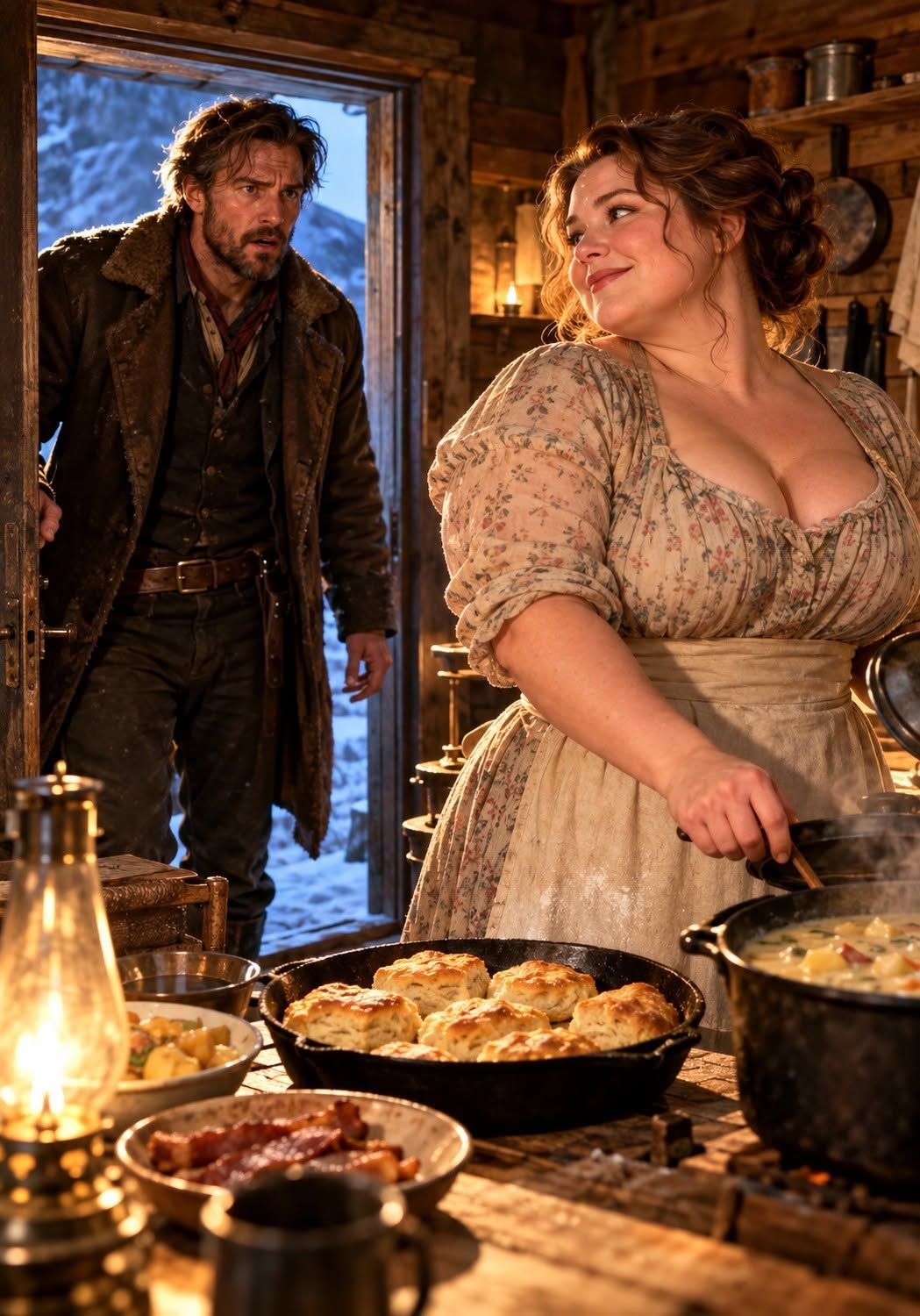
Caleb washed his hands at the basin, still watching Beatatrice from the corner of his eye.
He had eaten beans straight from a tin for nearly three weeks. He had forgotten what it felt like to sit down to a meal that smelled of anything other than smoke and desperation.
Beatatrice placed a bowl of potato chowder in front of him, followed by two golden biscuits.
“There’s more in the pot,” she said. “You look as though you’ve been trying to survive on coffee and stubbornness.”
Caleb almost smiled.
“That’s what I’ve been doing.”
“Then you must be very tired.”
Her words were simple, but something about the way she said them made him lower his eyes.
For four days, he had barely spoken to her except to give instructions. He had watched her climb from the stagecoach and secretly wondered how he would feed her through the winter. He had mistaken her quietness for weakness and her size for an inability to endure the hardships of ranch life.
Yet she had spent the day doing what he had neglected for months.
And she had done it without asking for praise.
The chowder was rich, warm, and surprisingly good.
“Where did you learn to cook like this?” he asked.
“Boardinghouses.”
“You worked in them?”
“For seven years.”
Caleb paused with his spoon halfway to his mouth.
“Seven years?”
“Since my mother died. Someone had to earn money.”
She sat across from him, folding her hands in her lap.
“I cooked for miners, railroad workers, traveling salesmen, and men who believed a woman couldn’t possibly understand hunger unless she was thin enough to count her ribs.”
Caleb felt the remark strike closer than he wanted to admit.
“Were you always a cook?”
“No. I learned because I had to. First, I learned how to stretch a sack of flour. Then how to make yesterday’s bread taste fresh. Eventually, I learned how to feed twenty people with enough food for ten.”
She glanced at his nearly empty bowl.
“Your pantry isn’t much different from those boardinghouses.”
For the first time, Caleb looked at her with something other than suspicion.
“I’m sorry I didn’t have more to offer you.”
Beatatrice studied him.
“Did you think I expected a mansion?”
“I thought you expected a husband who could provide.”
“I expected a husband who would give me a fair chance.”
Her answer silenced him.
Outside, the wind scraped against the cabin walls. Inside, the stove crackled, and the smell of warm biscuits lingered in the air.
Caleb wanted to apologize for what he had thought about her.
But the words felt too small.
So he finished his supper and helped her clear the table.
It was the first time he had ever washed a dish for someone else.
And Beatatrice, to his relief, didn’t laugh at him.
The following morning, Caleb awoke to the sound of hammering.
He pulled on his boots, grabbed his coat, and hurried outside.
Beatatrice stood near the woodshed, holding a hammer in one hand and a bent nail in the other.
“What are you doing?”
“Fixing this loose board.”
“You shouldn’t be doing that.”
She stopped and looked at him.
“Shouldn’t I?”
“I mean, it’s a man’s job.”
Beatatrice glanced at the hammer.
“Does the board know that?”
Caleb opened his mouth.
Then closed it.
She returned to her work.
“The wind came through the gap last night,” she explained. “If it gets colder, the wood will split. I thought it best to mend it before the weather turns.”
Caleb looked at the board. She was right.
He had noticed the problem weeks earlier and intended to repair it. Other emergencies had pushed it aside.
“How long have you been awake?” he asked.
“Since dawn.”
“You should have called me.”
“You were sleeping.”
“I could have handled it.”
“I know.”
Her calm agreement somehow irritated him more than an argument would have.
“Then why didn’t you wait?”
Beatatrice lowered the hammer.
“Mr. Hayes, I didn’t come twelve miles through freezing weather to stand in a corner while you do every difficult thing yourself.”
She held his gaze.
“I came here to build a life. If you want a wife who only sits in a chair and waits for you to tell her what she’s permitted to do, then you sent for the wrong woman.”
Caleb stared at her.
There was no anger in her voice. No attempt to humiliate him.
Only a quiet determination he was beginning to recognize.
“All right,” he finally said. “But next time, let me help.”
Beatatrice’s expression softened.
“That’s a reasonable arrangement.”
They repaired the woodshed together.
By noon, Caleb had discovered two things about his wife.
First, she could swing a hammer harder than he expected.
Second, she noticed everything.
She noticed the sagging chicken coop, the loose hinge on the barn door, and the leaking roof above the storage room. She even pointed out that the pantry shelves were arranged so poorly that half their supplies were difficult to reach.
“You’ve been looking at this place for one day,” Caleb said, “and you’ve found more problems than I have in five years.”
“No,” she replied. “You’ve been looking at the problems for five years. You’ve simply gotten used to them.”
He had no answer for that.
Because, once again, she was right.
By the sixth day, the ranch began to change.
Beatatrice organized the pantry, repaired torn curtains, and used scraps of fabric to patch the blankets. She found a way to keep the kitchen warmer by sealing gaps around the window frames.
She also discovered that one of Caleb’s cows had been producing less milk because its feed was poor.
“You need to mix the hay with the dried clover from the eastern field,” she told him.
Caleb frowned.
“How do you know that?”
“My father kept livestock before he lost his farm.”
“You grew up on a farm?”
“For the first twelve years of my life.”
He had ᴀssumed she came from a town and knew nothing about ranching.
He was beginning to understand how much he had ᴀssumed.
That afternoon, they rode out together to inspect the cattle.
Beatatrice wore Caleb’s spare coat, which was too large in the shoulders and too long in the sleeves. Her cheeks were pink from the cold, but she never complained.
When they reached the northern pasture, Caleb pointed toward a section of fence.
“The posts are rotten. I’ll have to replace them before the first heavy snowfall.”
Beatatrice studied the ground.
“Why don’t you move the fence six feet east?”
He looked at her.
“Because that’s where the old irrigation ditch runs.”
“Not anymore.”
She pointed to a shallow depression in the earth.
“The ditch has been dry for years. But look at the soil beyond it. It’s darker. The grᴀss is thicker. If you move the fence, the cattle will have better grazing, and you’ll need fewer posts because the ground rises there.”
Caleb dismounted and examined the area.
She was right again.
He looked at his wife, who sat quietly on the horse as though she hadn’t just found a way to save him money he desperately needed.
“Who taught you to see things like that?”
Beatatrice looked toward the distant hills.
“People who couldn’t afford to waste anything.”
For a moment, her face changed.
Caleb saw something behind her steady expression—a memory she had spent years learning to carry without letting it break her.
He wanted to ask what had happened.
Instead, he said, “You have a good eye.”
She turned back toward him.
“Thank you.”
It was the first compliment he had given her without immediately adding a qualification.
And he noticed that she remembered it.
That night, Caleb found her sitting beside the stove with a small, worn notebook open in her lap.
She quickly closed it when he entered.
“What’s that?”
“Nothing important.”
He recognized the expression. It was the same one he used when someone asked about the debts he kept folded inside his desk.
He should have let the matter go.
But something about her sudden embarrᴀssment made him curious.
“Is it a letter?”
“No.”
“A recipe book?”
“Not exactly.”
She rose and placed it inside her trunk.
Caleb noticed how carefully she locked the trunk afterward.
“Beatatrice, I wasn’t trying to pry.”
“I know.”
“Then why are you hiding it?”
She turned to him.
“Because I haven’t decided whether I can trust you with it.”
The words struck harder than he expected.
He had married this woman. He had brought her to his home, shared his table, and slept only a few feet away from her.
Yet she still didn’t trust him.
He couldn’t blame her.
“Fair enough,” he said quietly.
She looked surprised.
Caleb pulled out a chair.
“There’s something I should tell you, too.”
Beatatrice sat down.
“The ranch is in trouble,” he admitted. “The bank holds the mortgage. I owe money for cattle feed, repairs, and last spring’s seed. If winter comes early, I may not have enough hay to keep the herd alive.”
He rubbed his hands together, staring at the table.
“I didn’t tell you before we married because I thought you might change your mind.”
Beatatrice remained silent.
“I didn’t want you to think you’d made a mistake.”
“Caleb,” she said gently, “I already knew the ranch was struggling.”
He looked up sharply.
“How?”
“Your letter mentioned the damaged fences, the poor cattle prices, and the coming winter. You didn’t hide as much as you thought.”
“Then why did you agree to marry me?”
She held his gaze.
“Because I wasn’t looking for a rich man. I was looking for a place where my work might finally mean something.”
He swallowed.
“And you thought this was that place?”
“I hoped it might be.”
She paused.
“But hope isn’t the same as certainty.”
For the first time, Caleb understood that she had risked something by coming to Broken Spur, too.
She had left the only life she knew and traveled into a wilderness with a man who had barely looked at her.
And he had spent the first four days wondering whether she was worth the cost.
Shame settled heavily in his chest.
“I’m going to try to make this work,” he said.
Beatatrice nodded.
“Then we have something in common.”
Three days later, the bank’s representative arrived.
His name was Mr. Whitcomb, a narrow-faced man who wore a black coat too fine for the muddy ranch road. He dismounted beside the porch, brushed dust from his sleeves, and asked Caleb to step outside.
Beatatrice was kneading bread inside the cabin when she heard the man’s voice rise.
“Your payment is overdue, Mr. Hayes. The bank has been patient.”
“I know.”
“Patience doesn’t settle a debt.”
“I’ll have the money after the next cattle sale.”
“If the cattle survive the winter.”
Caleb’s jaw тιԍнтened.
Whitcomb continued, “There is another buyer interested in the property. He has offered to settle the mortgage immediately.”
Caleb went still.
“Who?”
“Mr. Harlan. He owns the adjoining tract.”
Beatatrice stopped kneading.
She knew the name. Caleb had mentioned Harlan once—a wealthy rancher who had spent the summer buying up smaller properties along the valley.
“I won’t sell,” Caleb said.
Whitcomb sighed.
“Then I suggest you find the money quickly. The bank’s patience ends in thirty days.”
The man climbed onto his horse and rode away.
Caleb remained outside, staring at the frozen ground.
When he entered the cabin, Beatatrice was standing beside the table.
“You could have told me the bank was coming.”
“I didn’t want to worry you.”
“I’m your wife, Caleb. If the roof is leaking, I need to know. If the bank is threatening to take our home, I certainly need to know.”
He flinched at the word our.
Our home.
She had claimed the ranch as hers without hesitation.
He hadn’t yet learned how to do the same with her.
“I don’t know how to fix this,” he confessed.
Beatatrice wiped her hands on her apron.
“Then we’ll start by finding out exactly how much you owe.”
He gave a bitter laugh.
“You make it sound simple.”
“No. I make it sound possible.”
She held out her hand.
“Show me the books.”
For the next two evenings, they worked at the kitchen table.
Caleb brought out receipts, loan documents, feed invoices, and the accounts he had kept in a battered ledger.
Beatatrice examined every page.
At first, he was impatient.
Then he grew curious.
By midnight on the second evening, she had identified three charges that appeared twice, a delivery fee that had never been explained, and a bill for fencing materials Caleb had never received.
“Who supplied these?” she asked.
“Mercer Trading Company.”
“Do you know the owner?”
“Not personally. Harlan recommended them.”
Beatatrice looked up.
“Did you sign for these materials?”
“No.”
“Then why are they on your account?”
Caleb stared at the ledger.
“I don’t know.”
She turned another page.
“And this charge? Two hundred dollars for replacement harnesses?”
“I bought one harness. Forty dollars.”
Beatatrice placed her finger on the entry.
“Then someone has been charging you for things you never received.”
Caleb’s face darkened.
“Are you saying someone is stealing from me?”
“I’m saying the numbers don’t match.”
She closed the ledger.
“We need copies of every invoice and a written statement from the suppliers. Don’t accuse anyone until we have proof.”
Caleb looked at her as if he were seeing a completely different person.
“You’ve done this before.”
“Yes.”
“Where?”
She hesitated.
Then she opened her trunk and removed the worn notebook he had seen earlier.
This time, she placed it on the table.
“My father was a bookkeeper before he became a farmer. When he died, I discovered that a man we’d trusted had been taking money from our accounts for years. By the time I understood what had happened, the farm was gone.”
Her fingers rested on the notebook’s cracked leather cover.
“I kept copies of everything I could save. Names, dates, receipts. I promised myself I would never again let someone convince me that numbers were too complicated for a woman to understand.”
Caleb felt cold despite the fire.
“Did you ever catch the man?”
“Yes.”
She looked directly at him.
“But by then, we had lost almost everything.”
He reached across the table, then stopped before touching her hand.
“I’m sorry.”
Beatatrice looked at his outstretched fingers.
After a moment, she placed her hand in his.
“Then help me make sure it doesn’t happen again.”
The following morning, Caleb rode into Oak Haven with the questionable invoices tucked inside his coat.
Beatatrice stayed behind to prepare the cabin for the coming storm.
By late afternoon, Caleb returned with a look on his face she had never seen before.
He was angry.
But beneath the anger was something more dangerous.
Fear.
“What happened?” she asked.
He placed a folded paper on the table.
“Mercer Trading Company doesn’t exist anymore.”
Beatatrice frowned.
“What do you mean?”
“The building is empty. The man who ran it left town two months ago.”
She unfolded the paper. It was a copy of a notice filed with the county clerk.
The company had been dissolved.
Yet Caleb had received invoices dated weeks after its closure.
She looked at him.
“Who signed them?”
Caleb pointed to the bottom of the page.
There was a name.
Silas Harlan.
For several seconds, neither of them spoke.
Then Caleb pulled another document from his coat.
“This was waiting at the bank.”
It was a formal notice stating that Harlan had offered to purchase Caleb’s outstanding debt in exchange for the ranch.
Beatatrice read the final paragraph twice.
“If the bank accepts,” she said slowly, “Harlan could foreclose on the property.”
“That’s what I thought.”
She placed the paper on the table.
“But why would he risk fraud to get your land?”
Caleb looked toward the window, where the first flakes of snow were beginning to fall.
“Because the northern pasture isn’t worth much for cattle.”
“Then why does he want it?”
Caleb’s expression hardened.
“There’s something beneath it.”
He crossed the room and took an old survey map from a drawer.
Years earlier, a government surveyor had marked a narrow blue line running under the northern ridge. Most people believed it was an abandoned spring.
Caleb had always suspected otherwise.
“The water table under that ridge feeds half the valley,” he explained. “If someone controls the land above the spring, they can control access to the water.”
Beatatrice studied the map.
“So Harlan doesn’t want your cattle.”
“No.”
“He wants your water.”
Caleb nodded.
“And he knows I can’t afford to fight him.”
The wind struck the cabin, rattling the windowpanes.
Beatatrice slowly rolled up the map.
“Then we’ll have to make sure you can.”
Caleb stared at her.
“You don’t understand. Harlan has money, lawyers, and friends in the county office. We have a failing ranch and thirty days.”
She walked to the stove and lifted the lid, checking the bread inside.
“Then we’d better make the next thirty days count.”
For the first time, Caleb laughed—not because the situation was amusing, but because her confidence had reached him when his own had nearly vanished.
He stepped beside her.
“Beatatrice?”
“Yes?”
“When I met you at the depot, I thought I had made a terrible mistake.”
She kept her eyes on the stove.
“I know.”
“I thought I was bringing another burden into my home.”
She turned toward him.
“And now?”
Caleb looked around the cabin: the repaired curtains, the clean shelves, the warm stove, and the woman who had given him reasons to fight for a future he had almost surrendered.
“Now I think you may be the only reason I still have one.”
Her expression softened.
“Then don’t waste it.”
He reached for her hand.
This time, she didn’t hesitate.
But before either of them could say another word, a horse thundered into the yard.
Someone pounded on the door.
Caleb grabbed his rifle and opened it.
A young ranch hand stood on the porch, breathless and white with snow.
“Mr. Hayes! You need to come to the northern pasture!”
“What happened?”
The boy swallowed hard.
“Someone cut the fence. Half your cattle are loose, and the rest are crowding near the ridge.”
Caleb’s face drained of color.
“How many?”
“Almost the whole herd.”
He snatched his coat from the peg.
Beatatrice caught his arm.
“Caleb, wait.”
“We don’t have time.”
She pointed toward the map still lying on the table.
“The northern ridge. The water source. Harlan knows the cattle will be driven there if the fence is cut.”
Caleb froze.
The pieces fell into place.
The suspicious invoices. The debt. The offer to buy the ranch. And now the cattle being pushed toward dangerous ground just as the first real snowstorm arrived.
“This isn’t an accident,” he whispered.
Beatatrice pulled on her coat.
“Then we’re not going to let him decide how this ends.”
Caleb looked at her.
“You’re staying here.”
“No.”
“It’s freezing. The ridge is dangerous.”
“And those cattle are our livelihood.”
He started to argue, but she was already reaching for the lantern.
Then she said something that stopped him cold.
“Caleb, I didn’t come all this way to be protected from the life I agreed to share with you.”
Outside, thunder rolled across the Wyoming plains.
Caleb looked into her steady hazel eyes and finally understood that loving her would never mean keeping her behind him.
It would mean standing beside her.
He handed her the second lantern.
“Stay close.”
Together, they stepped into the storm.
Neither of them saw the shadow watching from the distant ridge.
Nor did they know that, hidden beneath the snow near the abandoned spring, someone had left behind a discovery that could destroy Silas Harlan—or cost Caleb Hayes his ranch, his freedom, and the woman he was only just beginning to love.
And by sunrise, one of them would be fighting for their life.