PART 4 — THE FINAL WINTER: A MOTHER’S VICTORY AND THE MOUNTAIN MAN’S PROMISE
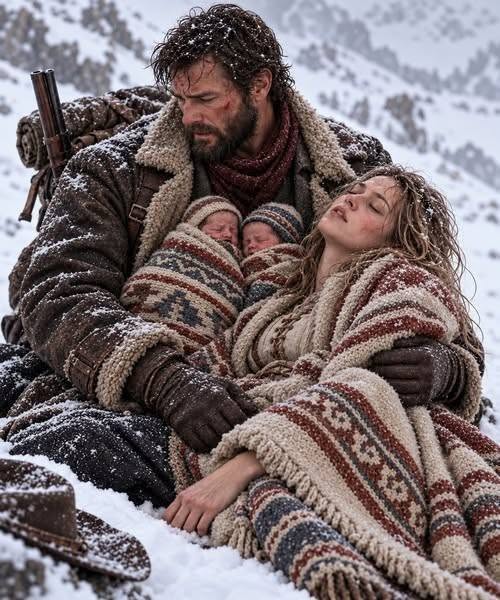
Five years after Elias Vance found Clara Whitmore dying beneath the snow, the mountains witnessed a different kind of winter.
This time, there was no blood staining the white ground.
No desperate cries vanished into the wind.
And no mother lay alone, wondering whether her children would live to see another sunrise.
Instead, laughter filled the valley.
Rose and Lily, now five years old, raced through the snow outside Elias’s cabin, their woolen hats slipping over their ears as they chased a pair of mischievous puppies around the woodpile.
“Rose! You’re cheating!” Lily shouted.
“I’m winning!”
“You can’t win if you change the rules!”
Elias stood on the porch, holding two steaming cups of coffee.
“Girls,” he called, “if you keep running that fast, you’ll both end up in the snowbank.”
They ignored him.
Clara stepped out beside him, carrying a basket of freshly baked bread.
“They have your stubbornness.”
Elias raised an eyebrow.
“Mine?”
“Absolutely.”
He glanced at her.
“You’re the woman who once threatened to throw my boots into the creek because I tracked mud into the cabin.”
“You tracked half the mountain into the cabin.”
“And you married me anyway.”
Clara smiled.
“Yes,” she said softly. “I did.”
Elias reached for her hand.
Five years earlier, neither of them could have imagined this moment.
Clara had arrived at his cabin broken, frightened, and convinced that the world would never allow her to live peacefully.
Elias had been a lonely man who believed his heart had already endured everything it could survive.
But slowly, through long nights, difficult conversations, and the ordinary work of building a life together, they had learned that love did not need to be loud to be powerful.
It needed patience.
It needed honesty.
And above all, it needed a choice freely made.
Their wedding had taken place the previous autumn, in a small wooden church overlooking the valley.
There had been no grand display of wealth, no powerful family demanding attention, and no guests who believed a person’s worth could be measured by their name.
Margaret Bell had attended.
Nathaniel Mercer had stood beside Clara.
The girls had scattered wildflowers along the aisle, although Lily had accidentally thrown most of hers at the minister.
Everyone had laughed.
And when Elias took Clara’s hands, he made her a promise.
“I can’t promise that life will never hurt you again,” he told her. “But I can promise that you will never have to face it alone if you want me beside you.”
Clara had looked into his eyes.
“That is all I ever wanted.”
Then she had kissed him.
Not because she needed saving anymore.
But because she had found someone who respected the woman she had become.
And now, as winter settled over their mountain home, Clara finally understood what it meant to be safe.
Not because danger no longer existed.
Because fear no longer made her decisions for her.
The day the past returned
The peace of their mountain home remained undisturbed until a letter arrived from Black Hollow.
It came on a cold Tuesday morning, delivered by a courier who refused to discuss its contents.
Clara recognized the sender’s name immediately.
Benjamin Whitmore.
She stood in the kitchen for a long time, holding the envelope.
Elias entered carrying a basket of firewood.
“What is it?”
She turned the letter over in her hands.
“Something from my past.”
He set down the wood.
“Do you want me to read it with you?”
Clara considered the question.
Then she shook her head.
“No. I need to read this myself.”
Elias nodded and returned to the porch, leaving her alone.
Clara opened the envelope.
Clara,
I have been released from the consequences of my conviction, but I have not been released from what I did.
I know you may never want to hear from me again. I understand that.
I have one request. I would like to meet Rose and Lily, if you believe it would be appropriate.
I am not asking you to forget the past. I am asking whether there is a way for me to begin taking responsibility for it.
Benjamin.
Clara read the letter twice.
Then she folded it carefully.
For years, she had imagined what she would say if Benjamin ever came back into her life.
She had imagined confronting him with her pain.
She had imagined demanding that he explain why he had abandoned his wife and newborn daughters in the snow.
She had imagined watching him suffer the shame he had once forced upon her.
But now, sitting in a warm kitchen with her daughters laughing outside, she felt something unexpected.
Nothing.
Not indifference to what he had done.
Not an excuse for his cruelty.
Simply the realization that his remorse no longer controlled her life.
She walked onto the porch.
Elias looked up.
“What did he say?”
“He wants to meet the girls.”
Elias was quiet for a moment.
“What do you want?”
Clara looked through the window at Rose and Lily.
“They deserve the truth about their father. But they deserve to be protected from him, too.”
“Then those two things can both be true.”
She turned toward him.
“You don’t think I’m being cruel if I refuse?”
“No.”
He took her hand.
“Protecting your children isn’t cruelty. And forgiveness doesn’t require you to open a door that isn’t safe.”
Clara leaned against him.
For the first time, she understood that she didn’t need someone else to tell her what the right decision was.
She needed the freedom to make it.
That evening, she wrote Benjamin a reply.
Benjamin,
The girls know who their biological father is, and when they are old enough to understand more of the past, I will tell them the truth.
I will not arrange a meeting simply because you want one. Any future contact must be considered carefully, with the girls’ safety and emotional well-being first.
If you are serious about taking responsibility, respect that boundary without argument.
You cannot undo what happened. But you can choose what kind of man you become from this day forward.
Clara.
She sealed the letter.
Then she placed it beside the front door, ready for the morning courier.
There was no triumph in the decision.
Only peace.
The daughters who changed everything
That spring, Clara took Rose and Lily to visit the memorial garden she had helped establish near Black Hollow.
It stood beside a small community center that offered shelter, legal ᴀssistance, and medical support to women and children escaping abuse.
The garden had been built in memory of those who had suffered in silence.
At its center stood a stone plaque bearing a simple inscription:
NO ONE DESERVES TO BE ABANDONED. NO CHILD IS BORN LESS WORTHY.
Rose traced the letters with her fingertips.
“Mom, what does this mean?”
Clara knelt beside her.
“It means every person deserves to be treated with kindness and respect.”
Lily tilted her head.
“Even people who are mean?”
Clara thought carefully before answering.
“Everyone deserves basic dignity. But that doesn’t mean we have to let someone hurt us.”
Lily seemed satisfied with that explanation.
Then Rose asked another question.
“Why did our first daddy leave us in the snow?”
Clara felt the old ache stir inside her.
She had known this question would come someday.
She drew both girls close.
“Your father made choices that were wrong. He was angry, and he cared too much about what other people thought. Instead of protecting you, he abandoned you.”
The girls looked at her quietly.
“Was it because we were girls?” Lily asked.
Clara’s heart тιԍнтened.
“No, sweetheart.”
She held Lily’s face gently between her hands.
“Nothing about being a girl made you less valuable. Nothing about you caused what happened. The choices belonged to the adults who made them.”
Rose leaned against her mother’s shoulder.
“Were you scared?”
Clara kissed the top of her head.
“Very scared.”
“Did you think we would die?”
Tears gathered in Clara’s eyes.
“Yes. I was afraid we might not survive.”
The girls hugged her тιԍнтly.
“But we did,” Rose whispered.
Clara closed her eyes.
“Yes. We did.”
A few steps away, Elias stood beside the garden gate, giving them the space to speak.
When the girls finally ran toward him, he opened his arms.
“Papa Elias!” Lily shouted.
Rose reached him first.
“Can we have ice cream?”
Elias looked at Clara.
“That’s a very serious question.”
“Please?”
He pretended to consider it.
“After dinner.”
Both girls groaned.
“Tomorrow?” Rose tried.
“After dinner.”
“Two scoops?”
“After dinner.”
They ran off, already planning their campaign.
Clara watched them with a smile.
Elias came to stand beside her.
“You handled that well.”
“I hope so.”
“You told them the truth without giving them the burden of your pain.”
Clara looked at him.
“Someone once told me that the choices of a father don’t determine the worth of his children.”
Elias smiled.
“Sounds like a wise man.”
“An infuriating one.”
He laughed, and Clara rested her head against his shoulder.
For years, the Whitmores had treated the birth of two girls as a family disgrace.
Now those same girls were growing into confident children who knew that their existence had never been a mistake.
And that was a victory no court could award and no fortune could buy.
The final confrontation
One year later, Benjamin sent another letter.
This time, he did not ask to meet the girls.
He wrote that he had begun working for a small construction company outside the region. He had no position of influence, no family estate to command, and no authority over Clara’s inheritance.
He said he had entered counseling and was learning to confront the beliefs that had shaped his behavior.
He did not ask Clara to forgive him.
He simply acknowledged what he had done.
Clara read the letter at the kitchen table.
Then she placed it in a drawer beside the first.
She didn’t reply.
Not because she wanted to punish him.
Because she had nothing left to prove.
The following winter, however, Benjamin appeared at the edge of the community garden.
Clara saw him from the doorway.
He looked older than she remembered. His coat was worn, his face thinner, and his posture no longer carried the arrogant confidence that had once made people step aside when he entered a room.
He did not approach the house.
He waited by the gate.
Clara walked outside alone.
Elias watched from the porch but did not interfere.
Benjamin removed his hat.
“Clara.”
She stopped several feet away.
“Why are you here?”
“I wanted to apologize in person.”
“You’ve already written to me.”
“I know.”
He swallowed.
“But there are things a letter can’t say.”
Clara folded her arms against the cold.
“Then speak.”
Benjamin looked toward the garden.
“I was wrong about the girls. I was wrong about you. I let my father convince me that power and reputation mattered more than people.”
He paused.
“But he didn’t force me to leave you on that mountain. I made that decision.”
His voice cracked.
“I heard you calling my name. I knew you were hurt. I knew the babies were there. And I rode away.”
Clara said nothing.
“I don’t expect you to forgive me,” he continued. “I only wanted you to hear me admit it without excuses.”
For several seconds, the wind moved between them.
Then Clara asked the question she had carried for years.
“Did you ever love me?”
Benjamin closed his eyes.
“I believe I did.”
She looked at him steadily.
“Then why did you treat me as if I were worthless?”
He had no answer.
At last, he whispered, “Because I cared more about being accepted by my father than about being worthy of your love.”
Clara felt the words settle inside her.
They did not heal the past.
But they finally named it.
“You know what hurt the most?” she asked.
Benjamin shook his head.
“It wasn’t that you wanted a son. It wasn’t even that you were angry when the girls were born.”
She took a slow breath.
“It was that you looked at me, the woman you had promised to protect, and decided that my life no longer mattered because I had disappointed you.”
Benjamin’s eyes filled with tears.
“I am sorry.”
Clara nodded.
“I believe you may be sorry now.”
He looked up, hopeful.
“But that doesn’t mean I can trust you. And it doesn’t mean the girls owe you a relationship.”
His shoulders fell.
“I understand.”
“If you truly want to become a better man, do it because it’s the right thing to do. Not because you expect me to reward you for it.”
“I will.”
Clara turned toward the house.
Then she stopped.
“One more thing, Benjamin.”
He looked up.
“Never tell anyone that my daughters were the reason your life fell apart.”
His face тιԍнтened with shame.
“They weren’t.”
“No,” Clara said. “They were the reason I found the strength to survive.”
She walked away.
Benjamin remained by the gate for several minutes before putting on his hat and leaving.
Clara did not watch him go.
She didn’t need to.
The past had finally become something she could acknowledge without allowing it to dictate her future.
A promise beneath the mountain sky
That evening, Elias found Clara standing outside the cabin.
The sky was clear, and the stars shone above the snow-covered peaks.
He approached quietly and draped a warm blanket around her shoulders.
“Are you all right?”
Clara nodded.
“I think I finally said everything I needed to say.”
“Does it feel different?”
She considered the question.
“Yes.”
“Better?”
“Lighter.”
He took her hand.
From inside the cabin came the sound of Rose and Lily arguing over a storybook.
Then Rose shouted, “Papa Elias! Lily skipped three pages!”
“I did not!”
“You did!”
Elias sighed.
“I believe we’ve been summoned.”
Clara laughed.
“Go. You’re the only person who can settle a dispute about fictional woodland rabbits.”
“It’s a highly specialized skill.”
He started toward the door, but Clara held his hand a moment longer.
“Elias?”
He turned.
“Thank you.”
“For what?”
“For finding me.”
His expression softened.
“I didn’t know who you were when I found you.”
“I know.”
“I didn’t know about the inheritance, the Whitmores, or what would happen afterward.”
“I know that, too.”
He brushed a strand of hair from her face.
“I only knew that you were alive, and you needed help.”
Clara’s eyes filled with tears.
“That was enough.”
He kissed her forehead.
“It still is.”
They entered the cabin together.
Inside, the fire burned warmly, and the girls sat on the rug surrounded by books, wooden toys, and the remains of a half-finished puzzle.
Rose immediately climbed onto Elias’s knee.
Lily squeezed between him and Clara.
“Tell us the mountain story!” Rose demanded.
Clara smiled.
“Which mountain story?”
“The one about the day Papa Elias found you.”
Elias glanced at Clara.
“Are you sure you’re ready to hear it again?”
Both girls nodded vigorously.
So Clara settled beside them and began.
She told them about the terrible storm, the bitter cold, and the man who had discovered three lives fading beneath the snow.
She told them how Elias had carried them through the wilderness, how Margaret had helped them recover, and how strangers had become friends when they chose to stand up for what was right.
But she did not tell the story as one of helplessness.
She told it as a story about courage.
About a mother who refused to give up on her children.
About a man who chose compᴀssion when it would have been easier to turn away.
And about two little girls who survived because their lives mattered, even when powerful people said otherwise.
When Clara finished, Lily rested her head against Elias’s arm.
“Papa Elias?”
“Yes, sweetheart?”
“Would you have saved us if we had been boys?”
Elias looked at Clara, then down at the child in his arms.
“I would have saved you if you had been boys, girls, or anything else in the whole wide world.”
Lily smiled.
“Good.”
Rose yawned.
“Because we like being girls.”
Clara kissed both of their foreheads.
“So do I.”
The girls eventually fell asleep beside the fire.
Elias carried them to their beds while Clara watched from the doorway.
When he returned, he wrapped his arms around her.
Outside, the wind swept over the mountain.
But it no longer sounded like a threat.
It was simply the wind.
Clara rested her head against Elias’s chest and closed her eyes.
Five years earlier, she had believed her life was ending in that frozen wilderness.
Now she knew that the worst moment of her life had not been the end of her story.
It had been the moment when someone else’s cruelty collided with her own determination to survive.
The Whitmores had tried to erase her.
They had tried to take her children, her inheritance, and her voice.
They had failed.
Not because Clara had become more powerful than they were.
Not because she had destroyed them in revenge.
But because she had refused to let their cruelty define the rest of her life.
She had found safety.
She had found purpose.
She had found love that demanded neither submission nor silence.
And most importantly, she had raised two daughters who would never have to wonder whether their lives were worth protecting.
Elias kissed her hair.
“What are you thinking about?”
Clara looked toward the sleeping girls.
“How lucky we are.”
He held her a little closer.
“Yes,” he whispered. “We are.”
And high above the frozen valley, beneath the endless mountain sky, their little cabin glowed with warmth.
The woman who had once been abandoned in the snow was no longer fighting to survive. She was living.
The twin girls who had been condemned for being born were growing up surrounded by love.
And the rugged mountain man who had rescued them discovered that the greatest thing he could ever protect was not his land, his cabin, or his solitude—but the family he had chosen with his whole heart.
Because the Whitmores had believed a family was built on bloodlines, obedience, and power.
Clara, Elias, Rose, and Lily had built theirs on something stronger.
Love freely given. Courage freely chosen. And the unshakable belief that no human life is ever worth less because of who they are.
THE END.