PART 2: THE WOMAN WHO OUTSMARTED THE RICHEST MAN IN LARAMIE COUNTY
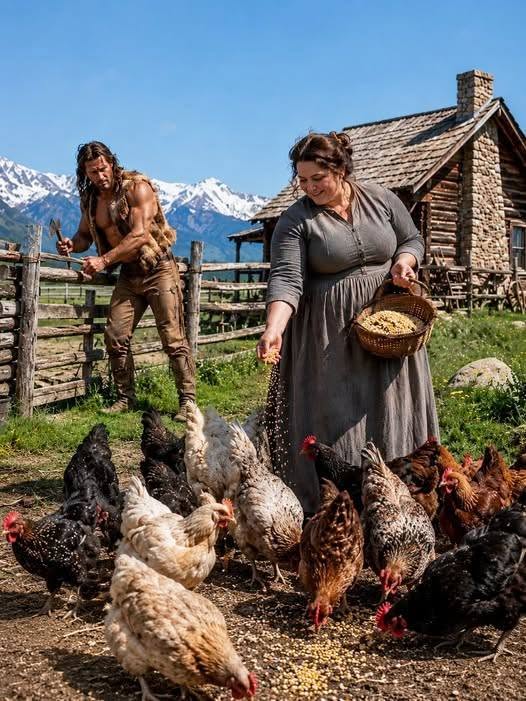
It was a deep, unpleasant laugh, the kind belonging to a man who had spent his entire life watching other people surrender before he ever had to raise his voice.
“Now, what exactly do you intend to do with that little book, Mrs. Tucker?” he asked. “Read me a bedtime story?”
The deputy beside him snickered. One of the armed men spat into the dirt.
Mattie did not blink.
“No,” she replied. “I intend to read you the account of how you stole this man’s ranch.”
The laughter stopped.
Griffin Tucker stood behind her on the porch, his hands curled into fists. He had faced stampeding cattle, blizzards that could freeze a man to death before dawn, and nights when hunger gnawed so fiercely that he could barely sleep.
But he had never faced Harrison Caldwell with anything resembling confidence.
Caldwell owned the bank, controlled the biggest cattle-buying operation in the county, and had friends in the sheriff’s office. He could ruin a man with a signature and have that man’s neighbors thank him for doing it.
“Careful, woman,” Caldwell warned. “Accusing a respectable businessman of theft is a serious matter.”
Mattie turned one page.
“On March third, you purchased forty-seven head of cattle from Mr. Tucker. Your receipt says forty-seven. Your weigh station recorded fifty-eight.”
Caldwell’s smile faltered.
“On April seventeenth, you charged him interest at eighteen percent. The territorial law governing your original loan permits no more than ten percent under the terms of the agreement you signed.”
“That is a lie.”
“Wonderful,” Mattie said calmly. “Then you won’t object to having the original documents examined by a judge.”
She turned another page.
“And on June ninth, you charged Mr. Tucker for three hundred sacks of feed that were never delivered. I have the invoices, the railroad shipping records, and the signatures of two men who say they were paid to falsify the delivery receipts.”
For the first time since riding into the yard, Caldwell looked genuinely uncomfortable.
Griffin stared at the back of Mattie’s head.
Three hundred sacks.
He remembered that invoice. He had argued with Caldwell about it for weeks before finally accepting the charge because he lacked the knowledge to challenge the bank’s books.
He had believed his own carelessness had ruined him.
Mattie had discovered the truth in less than a week.
Caldwell dismounted, his boots striking the ground with deliberate force.
“You have no idea who you’re dealing with,” he said.
Mattie closed the ledger halfway.
“Oh, I know precisely who I’m dealing with. A man who has mistaken other people’s desperation for his own intelligence.”
The deputy shifted uneasily.
Caldwell’s face darkened.
“Mr. Tucker has defaulted on his loan. I possess a signed mortgage agreement, and I am here to take possession of the property.”
“Then present the original agreement.”
“I have the document.”
“The original, Mr. Caldwell. Not the copy you altered.”
His eyes narrowed.
Griffin felt the world tilt beneath him.
“Altered?” he whispered.
Mattie finally glanced over her shoulder.
“Your father borrowed twelve hundred dollars,” she explained. “The original agreement required repayment of the principal plus lawful interest. Caldwell’s office recorded the balance as more than three thousand dollars, then added fees for inspections, feed deliveries, and cattle losses that never occurred.”
Griffin swallowed hard.
“My father told me the debt was paid down to less than a thousand before he died.”
“And your father was right.”
Caldwell stepped forward.
“That’s enough!”
Mattie raised one gloved hand.
“No. We have not yet discussed the most interesting part.”
She opened the ledger to a page marked with a red ribbon.
“Your foreclosure notice claims Mr. Tucker missed his final payment on September fifteenth. But the bank’s own receipt shows that he paid two hundred dollars on September fourteenth. Your clerk accepted the money and signed the receipt.”
She held it up.
“Which means the foreclosure notice was issued before the legal grace period expired.”
Caldwell stared at the paper.
“That payment was insufficient.”
“Perhaps. But you cannot pretend it was never made. And you cannot seize the property on the date stated in a notice that misrepresents the account.”
For several seconds, nobody spoke.
Then Griffin heard something he had not heard in years.
A laugh.
Not Caldwell’s.
His own.
It escaped him unexpectedly, rough and disbelieving, as though some forgotten part of himself had finally awakened.
Caldwell turned on him.
“You find this amusing, Tucker?”
“No,” Griffin replied, stepping beside Mattie. “I find it interesting that the woman I hired to feed my chickens knows more about your business than you do.”
Mattie’s mouth twitched.
Caldwell’s hand moved toward his saddle.
The deputy immediately straightened.
“Mr. Caldwell,” the deputy said quietly, “I think we ought to take this matter through the proper channels.”
Caldwell looked at him as if he had just committed treason.
“Are you refusing to carry out a lawful order?”
“I haven’t seen a court order authorizing seizure of the property.”
Caldwell’s jaw тιԍнтened.
Mattie nodded approvingly.
“An excellent observation, Deputy.”
He flushed slightly.
Caldwell climbed back into his saddle.
“This isn’t over,” he announced. “You have bought yourself a few days, nothing more. Winter is coming. Your cattle are starving. Your well is nearly dry. And no bank in this territory will lend you another cent.”
He pointed at Griffin.
“When the first snow buries this place, you’ll come crawling to me.”
Then he turned toward Mattie.
“And you, Mrs. Tucker, will learn that a woman cannot run a ranch with a book and a sharp tongue.”
Mattie smiled.
“Then I suppose I shall have to use both.”
Caldwell rode away with his men, leaving a cloud of dust hanging over the Broken Spur.
Griffin stood motionless until the last hoofbeat faded.
Then he turned to his wife.
“How much of that was true?”
“Every word.”
“No, I mean…” He rubbed his face. “How did you know where to look? How did you understand those contracts? How did you know the law?”
Mattie tucked the ledger beneath her arm.
“Because I was raised by a man who believed numbers never lie.”
“Your father?”
“My father owned a small mercantile business in Missouri. He taught me bookkeeping when I was twelve. By seventeen, I was keeping accounts for three neighboring businesses. By twenty-two, I was helping farmers challenge dishonest lenders.”
She paused.
“Until my father’s business collapsed.”
Griffin looked at her more carefully.
“What happened?”
“An investor manipulated his accounts, took the property, and left my family with nothing. My father died believing he had failed us.”
Her voice remained steady, but Griffin noticed how тιԍнтly she held the ledger.
“I promised myself I would never again watch an honest family lose everything simply because they couldn’t read the papers placed in front of them.”
Griffin lowered his eyes.
“And you answered my advertisement because you thought you could save me?”
“No.”
Her answer came so quickly that he looked up.
“I answered your advertisement because you offered a roof, food, and an opportunity to begin again. I thought I could contribute something useful. I did not know you would be so determined to underestimate me.”
Griffin winced.
“I was wrong.”
“Yes,” Mattie replied. “You were.”
She walked past him toward the cabin.
“And if you wish to remain married to me, Mr. Tucker, I suggest you stop confusing my willingness to work with a willingness to be ordered around.”
For the first time in his adult life, Griffin Tucker found himself without a single argument.
By sunrise the following morning, Mattie had taken command of the Broken Spur.
Not because Griffin had granted her authority.
Because she had simply begun doing what needed to be done.
She rose before dawn, inspected the feed stores, examined the water troughs, and walked the fence line with a notebook in hand. By breakfast, she had compiled a list of everything that was wrong with the ranch.
The list was four pages long.
Griffin stared at it over his coffee.
“Four pages?”
“Five, if you count the items I haven’t verified.”
“You’ve only been here eight days.”
“And yet the chickens are still eating moldy grain, the north pasture is being wasted, and you have enough usable timber behind the barn to repair half your fences.”
He looked toward the barn.
“That timber is rotten.”
“Some of it is. Some of it isn’t. You haven’t sorted it.”
“I’ve had other things to worry about.”
“Like going bankrupt?”
Griffin slowly lowered his cup.
Mattie gave him a look over the rim of her own.
“I am not trying to insult you, Griffin. I am trying to keep us alive.”
It was the first time she had called him by his given name.
Somehow, that made the rebuke harder to dismiss.
He leaned back.
“All right. What do you propose?”
Mattie turned the list around.
“First, we stop wasting money. Second, we stop selling cattle at whatever price Caldwell offers. Third, we repair the well and fence the creek’s lower basin. Fourth, we find a way to earn cash before winter.”
“And how exactly do we accomplish all that with six dollars in the lockbox?”
“Seven dollars and forty cents.”
Griffin blinked.
“What?”
“I found a coin purse behind your desk. You had forgotten about it.”
He stared at her.
“Are you telling me our financial recovery depends on a purse I left behind a desk?”
“At present, yes.”
Despite himself, Griffin laughed.
It was a strange sound between them, unfamiliar but not unpleasant.
Mattie allowed herself a small smile.
“Good. You still have a sense of humor. We may yet save you.”
“Save me?”
“The ranch, Griffin. Don’t become sentimental.”
But when she turned away, he caught himself watching her.
For the first time since his father died, the Broken Spur did not feel like a grave he was being forced to tend.
It felt like a place where something might still grow.
Mattie’s first victory came from the chickens.
Griffin had expected her to spend her days feeding them and gathering eggs. Instead, she examined the birds, separated the sick ones, cleaned the coop, and changed their feed.
She mixed cracked corn with the remaining good grain, added kitchen scraps in measured quanтιтies, and began collecting clean water from a spring beyond the eastern fence.
Within days, the hens became more active.
Within two weeks, their egg production nearly doubled.
But Mattie’s real discovery came when she visited the nearest settlement to sell a basket of eggs.
The general store owner, a wiry man named Samuel Pike, examined the eggs and whistled.
“Fresh as anything I’ve seen this month. How many can you bring me?”
“Forty dozen a week,” Mattie answered.
Griffin nearly dropped the crate he was carrying.
“Forty dozen?” he whispered. “We don’t have that many.”
“Not yet.”
Samuel raised an eyebrow.
“You promising me eggs you haven’t laid?”
“No. I’m offering a supply agreement based on our current production and a reasonable increase as the flock recovers. You may begin with twelve dozen a week. If we fail to deliver, you pay only for what arrives.”
Samuel considered her for a moment.
“And what do you want in return?”
“A fair price. Cash payment. No deductions for imaginary transport costs.”
The shopkeeper laughed.
“I like you, Mrs. Tucker.”
“Then you’ll like my husband too, once he learns to stop looking as if every business conversation is a hanging.”
Griffin opened his mouth.
Samuel laughed harder.
They signed the agreement before noon.
On the ride home, Griffin kept glancing at the paper in his coat pocket.
“You negotiated a contract over eggs.”
“I negotiated a contract over a reliable product that people need.”
“It’s still eggs.”
“Every empire begins with something somebody needs.”
He shook his head.
“You make everything sound simple.”
“No. I make it sound possible. There is a difference.”
That evening, Mattie used part of the payment to purchase clean feed, nails, lamp oil, and seed.
She recorded every cent in her ledger.
Griffin watched her work by lamplight.
“Don’t you ever get tired?” he asked.
“Of course.”
“Then why keep going?”
Mattie looked up.
“Because tiredness is temporary. Losing everything needlessly is not.”
He sat opposite her.
“My father worked himself to death trying to keep this ranch. He believed that if he just worked harder, things would turn around.”
“And did they?”
“No.”
“Then perhaps your father was not wrong to work hard. Perhaps he was wrong to believe hard work was enough.”
Griffin stared at the calluses on his hands.
For years, he had measured himself by how much punishment he could endure. He had believed that a good rancher never complained, never rested, and never admitted he needed help.
Mattie was teaching him that survival required more than stubbornness.
It required thought.
And sometimes, it required trusting someone else.
The next battle began with the cattle.
Griffin had been selling them to Caldwell’s operation for years, accepting whatever price the buyer offered because he had no other market and no money to transport the animals farther afield.
Mattie changed that arrangement in a single afternoon.
She spent two days studying the cattle records, then walked the pastures with Griffin and identified which animals were healthy enough to sell, which needed treatment, and which should be kept for breeding.
“You cannot sell all your strongest cows,” she told him.
“I have to pay the debt.”
“If you sell the breeding stock, what will you sell next year?”
He rubbed his jaw.
“More cattle.”
“From where?”
He had no answer.
Mattie pointed toward the western pasture.
“Your father built this ranch to reproduce its own wealth. Caldwell has convinced you to consume it.”
Griffin looked across the dry land.
She was right.
Every year, he had sold the best animals to cover the previous year’s losses. Every year, his herd had become smaller and weaker. He had mistaken the shrinking of his operation for bad luck when it was actually a pattern.
“What do we do?” he asked.
“Find another buyer.”
“There isn’t one close enough.”
“Then we look farther away.”
The next morning, Mattie rode into town with Griffin and visited a freight agent who handled shipments toward Cheyenne and the growing markets beyond.
The agent, a young man named Elias Reed, listened skeptically as she described their available stock.
“You want to ship cattle east?”
“Not the whole herd,” Mattie replied. “A carefully selected group of healthy steers. We want a written estimate covering transport, fees, and delivery.”
“You know shipping costs money.”
“I am aware.”
“And you may lose animals on the journey.”
“I am aware of that too. That is why we are comparing the costs before making a decision.”
Elias studied her.
“Most ranchers who come in here simply ask what I’ll pay them.”
“Most ranchers are not in a position to lose money twice on the same cattle.”
He smiled.
“Fair point.”
By the end of the meeting, Elias had agreed to help them arrange a small shipment at a price Griffin could afford if they sold enough eggs and a few surplus animals.
It was not a fortune.
It was not even a guarantee.
But it was a market Caldwell did not control.
On the ride home, Griffin was unusually quiet.
Finally, he said, “You know what frightens me?”
“What?”
“That you might actually succeed.”
Mattie looked at him.
“Why would that frighten you?”
“Because if you do, I’ll have to admit I spent years believing I was a failure when I was really just too stubborn to ask the right questions.”
For a moment, Mattie said nothing.
Then she eased her horse closer to his.
“Griffin, being wrong is not the same as being worthless.”
He looked at her, startled by the gentleness in her voice.
“My father lost his business because he trusted the wrong man. He spent the rest of his life blaming himself. I will not make that mistake again, and I will not allow you to make it either.”
He swallowed.
“I don’t know how to thank you.”
“Start by repairing the north fence.”
He laughed.
“Yes, ma’am.”
“And stop calling me ma’am when you want to avoid an argument.”
“Yes, Mattie.”
This time, she smiled all the way home.
By the end of the month, the Broken Spur had begun to change.
The chickens were healthy. The egg contract brought in steady cash. The well had been repaired with salvaged materials, and Griffin had cleared a channel to guide what little water remained toward the lower pasture.
Mattie introduced a strict rationing system for the cattle and reorganized the feed storage. She also persuaded Griffin to plant hardy forage in a protected patch of ground, using seed purchased with their first profits.
The improvements were modest, but they mattered.
For the first time in years, the ranch was not losing money every single week.
Then Caldwell struck back.
A notice arrived by courier on a bitterly cold morning.
The bank had frozen Griffin’s remaining account pending investigation of the disputed debt. Their small shipment contract had also been challenged after Caldwell’s company informed the freight agent that the cattle were subject to a lien.
Griffin read the notice twice.
Then he crushed it in his fist.
“He’s going to make sure we can’t sell a single animal.”
Mattie took the paper from him and smoothed it on the table.
“He is trying to force us into accepting his terms.”
“He’ll succeed.”
“No.”
“Mattie, you don’t understand. He can make a dozen phone calls and close every door in this county.”
“Then we stop knocking on his doors.”
She walked to the shelf where she kept her ledger and withdrew a folded sheet of paper.
“What is that?” Griffin asked.
“A list of everyone who has done business with Caldwell in the last five years.”
He stared at her.
“How did you get that?”
“Receipts, shipping manifests, old notices, and a little conversation at the general store.”
She laid the sheet beside the bank notice.
“Look at the names. Ranchers. Farmers. A blacksmith. Two freight agents. A widow whose property was sold after her husband died.”
Griffin read the list.
He recognized nearly every name.
Some had lost their farms. Others had disappeared from the county. A few were still working for Caldwell, trapped by debts they could never repay.
“You think they’ve all been cheated?”
“I think we should ask them.”
“And if they refuse to help?”
“Then we will know where we stand.”
Griffin shook his head.
“No one challenges Caldwell. Not openly.”
Mattie closed the ledger.
“Then perhaps someone needs to be first.”
The following Sunday, Mattie invited twelve people to the Broken Spur.
They came reluctantly, some on horseback and others in wagons. A few stood near the door as if expecting Caldwell to appear with a sheriff at any moment.
Among them was Abigail Turner, a widowed rancher whose land had been seized the previous winter. There was also Thomas Bell, a cattleman with a limp, and Samuel Pike, the general store owner who had bought their eggs.
Mattie placed her ledger on the table.
“I will not ask you to trust me simply because I say Mr. Caldwell has cheated you,” she began. “I will ask you to examine the evidence.”
She read the figures aloud.
She showed them the altered interest calculations, the inconsistent cattle weights, and the duplicate fees. She explained how a single dishonest entry could become three more charges, each one building upon the last until a manageable loan became an impossible debt.
Abigail’s hands began to tremble.
“My husband borrowed eight hundred dollars,” she whispered. “Caldwell said the debt had grown to nearly three thousand before he died.”
Mattie turned toward her.
“Do you still have the original agreement?”
Abigail nodded slowly.
“It’s in a box at my sister’s house.”
“Bring it to me. We will compare it with the bank’s records.”
Thomas Bell leaned forward.
“What happens if we’re right?”
“Then we take our evidence to a judge.”
“And if the judge is Caldwell’s friend?”
“Then we take the case beyond this county.”
A murmur swept through the room.
Samuel Pike crossed his arms.
“You speak as though justice is something a person can simply order from a catalog.”
“No,” Mattie answered. “I speak as someone who knows justice is expensive, difficult, and sometimes slow. But silence is expensive too. And we have already paid too much for it.”
For a long moment, nobody moved.
Then Abigail stepped forward and placed a folded document on the table.
“My husband’s agreement,” she said. “I’ll bring the rest tomorrow.”
Thomas followed.
Then another rancher.
And another.
By sunset, Mattie had gathered seven original contracts and the names of eleven additional families willing to testify.
Griffin watched from the doorway, amazed.
He had spent years believing every man in the county stood alone against Caldwell.
Now he understood that Caldwell’s greatest weapon had never been his money.
It had been the belief that everyone else was too frightened to speak.
That night, after the last visitor departed, Griffin found Mattie sitting beside the stove, rubbing her aching hands.
He placed a cup of H๏τ tea before her.
“You did something today that I couldn’t have done in a lifetime.”
She looked up.
“I gave people a table and asked them to bring their papers.”
“You gave them courage.”
“No,” she said softly. “They already had courage. They were simply waiting to discover they weren’t alone.”
Griffin pulled out the chair beside her.
“Mattie, I owe you an apology.”
“You’ve already given me several.”
“This one is different.”
She studied him, then nodded for him to continue.
“When you stepped off that train, I looked at you and saw everything I thought I couldn’t afford. I thought about the work you might not be able to do. I thought about the money I had spent bringing you here. I never once wondered what you might know, what you might see, or what you might be capable of.”
His voice grew rough.
“I treated you like another burden on a dying ranch.”
Mattie looked down at her tea.
“And now?”
“Now I think the ranch might have died without you.”
She was quiet for a long time.
Then she reached across the table and placed her hand over his.
“Griffin, I did not come here to be worshipped. I came here to build a life. But I cannot build it alone, and I will not do it with a man who thinks I must earn the right to speak.”
“I understand.”
“Do you?”
He met her eyes.
“I am trying to.”
It was not a grand declaration of love.
It was not a promise that every day would be easy.
But it was honest.
And for Mattie Cole, honesty was a better foundation than any beautiful speech.
Outside, the Wyoming wind swept across the prairie, rattling the old shutters.
Inside, for the first time, the Broken Spur felt like home.
Neither of them noticed the rider watching from the ridge.
He had been sent by Harrison Caldwell.
And he had heard enough to understand that the woman with the velvet ledger was becoming a threat far more dangerous than anyone had expected.
By morning, Caldwell would know it too.
And he would not wait for a judge to decide what happened next.
End of Part 2