PART 2: WHEN THEY CAME HOME, I WAS GONE
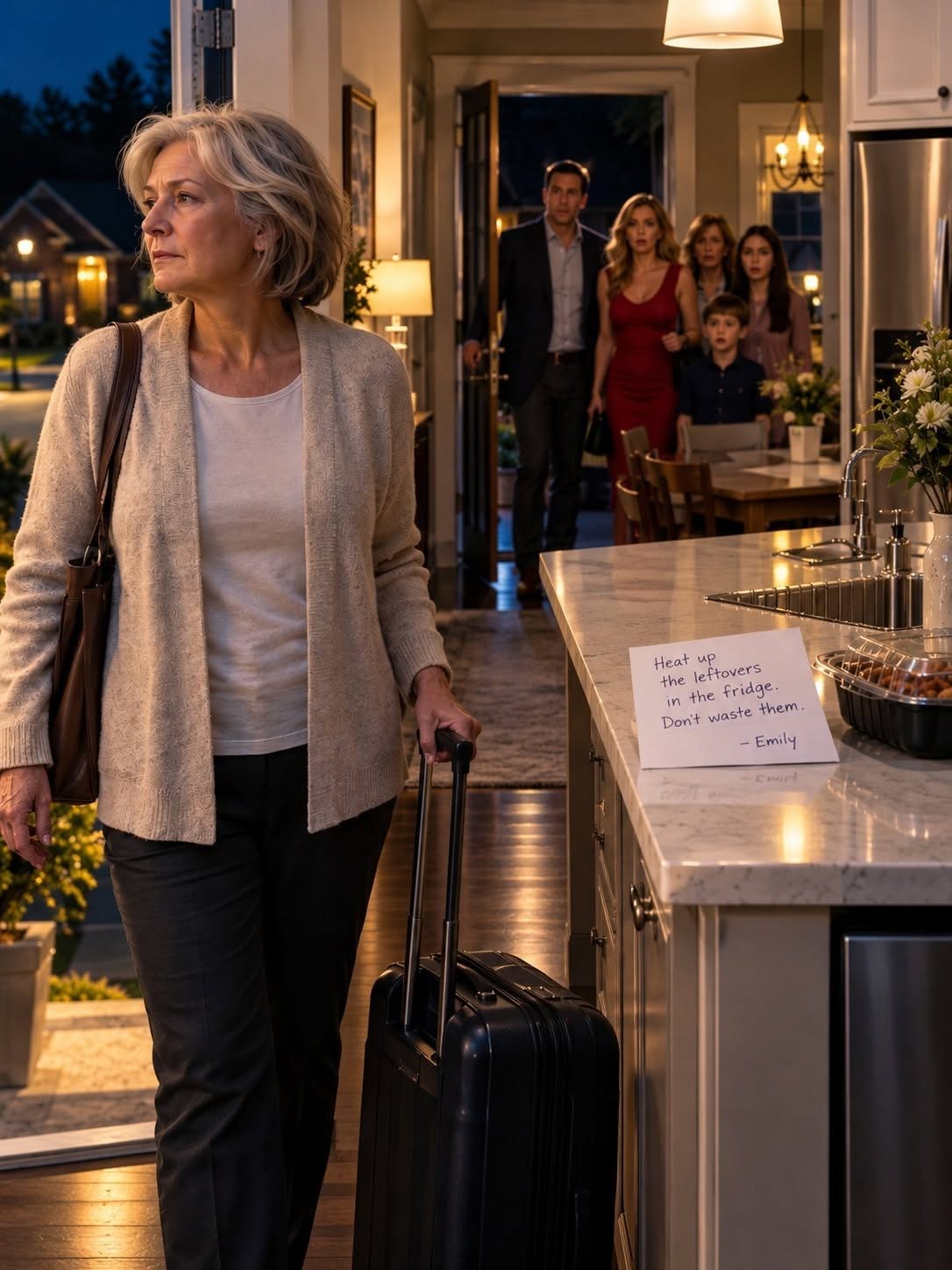
The woman at the front desk barely looked up when I asked for a room.
“Just one night?”
“For now,” I replied.
She handed me a key card.
I thanked her, dragged my suitcase down the corridor, and stepped into a room that smelled faintly of detergent and old carpet. The curtains were faded. The bedside lamp flickered when I turned it on. Somewhere outside, a truck rumbled along the highway.
It was not the sort of place I would have chosen for myself.
But for the first time in years, nobody was waiting for me to cook dinner, fold laundry, babysit the children, or clean up after them.
Nobody was calling my name from another room.
Nobody was treating my presence as an unpaid service.
I sat on the edge of the bed and opened the small envelope I’d carried out of the house.
Inside were my identification documents, a copy of my late husband’s death certificate, several bank statements, and a folded piece of paper bearing the name of an attorney I had consulted three months earlier.
I had kept that envelope hidden because I wasn’t ready to make a decision.
Tonight, I finally was.
My name is Betty Collins. I am sixty-seven years old, a widow, and until that evening, I had been living with my son Daniel, his wife Emily, and their two children in a house I had helped them keep afloat.
They called it a family arrangement.
I called it love.
I had sold my own little house after my husband, Robert, died. Daniel had insisted that moving in with him would make things easier.
“You shouldn’t be alone, Mom,” he’d said, wrapping his arms around me. “We’ll take care of each other.”
I believed him.
I used part of the money from my house sale to help Daniel and Emily refinance their mortgage. I paid for groceries, school supplies, utility bills, and countless things that never appeared in any family budget.
In return, I was given a bedroom at the end of the hallway.
At first, I told myself I was fortunate.
Then the requests started.
Emily needed someone to collect the children from school because her meetings ran late. Daniel needed his shirts ironed because he had early presentations. The kitchen had to be spotless before Emily’s friends came over. The grandchildren needed dinner, homework supervision, and clean uniforms.
I did everything because I loved them.
And because every time I considered saying no, I heard Robert’s voice in my head.
Family takes care of family.
I had spent so long interpreting that sentence as an obligation that I had forgotten it was supposed to work both ways.
At 10:43 p.m., my phone began vibrating.
Daniel.
I watched it ring until it stopped.
A few seconds later, a message appeared.
Daniel: Mom, where are you? Emily says you haven’t answered her.
I put the phone facedown.
Then it rang again.
This time, Emily.
I let it ring.
Her message arrived almost immediately.
Emily: Betty, this isn’t funny. The kids are tired, and we need you to get their things ready for school tomorrow.
I stared at the screen.
Not Are you okay?
Not Did something happen?
Not even Why did you leave?
She was still ᴀssigning me work.
I turned off notifications and took a shower.
When I returned, I noticed something I hadn’t expected.
My hands were shaking.
Not because I was afraid of Daniel or Emily.
Because I had finally done something for myself, and a part of me still felt guilty.
I sat quietly until the trembling pᴀssed.
Then I opened my laptop.
Three months earlier, I had contacted an attorney named Margaret Ellis after Daniel casually mentioned that he and Emily wanted to make some changes to the house.
They had suggested that I sign a few documents so the family could “simplify its finances.”
I had asked to read them first.
Emily had laughed.
“Oh, Betty, they’re just standard papers. You don’t need to make everything complicated.”
Something about her tone bothered me.
So I took the documents to Margaret.
She spent an hour reviewing them before looking up at me.
“Mrs. Collins, I want to ask you something. Do you understand what financial contributions you’ve made to this household?”
“I helped them with the mortgage,” I said. “And I pay for most of the groceries.”
“How much did you contribute toward the refinance?”
I told her.
Margaret wrote the number down.
“And was there a written agreement specifying whether that money was a gift or a loan?”
I looked at my hands.
“No.”
She nodded thoughtfully.
“Then we need to be careful about what you sign going forward. Depending on the documents and the circumstances, your contribution may not give you an ownership interest in the house. We should review the records before drawing any conclusions.”
She had explained my options, including how to document my contributions and protect whatever funds remained in my name.
She had also encouraged me not to sign anything I didn’t understand.
I had thanked her and gone home.
I wasn’t ready to confront my son.
Now, sitting alone in a motel room, I called her office’s after-hours number and left a message.
I told her I had left Daniel’s house voluntarily and wanted to arrange a meeting as soon as possible.
Then I finally slept.
For nearly seven hours, nobody woke me.
Nobody needed anything.
And when I opened my eyes the next morning, sunlight was spilling across the curtains, and I realized that the world had continued without me making breakfast.
It was a small discovery.
But it changed something inside me.
At 7:12 a.m., Daniel called again.
I answered.
“Mom! Where are you?”
His voice was sharp with frustration.
“I’m safe.”
“That’s not an answer. We came home last night, and your room was empty. Your suitcase is gone. What happened?”
“I left.”
“Yes, we figured that out. Why?”
I looked out the motel window at the parking lot.
“Because I no longer want to live somewhere I’m treated as though I don’t belong.”
He went silent.
Then he laughed awkwardly.
“Mom, come on. What is this about? Emily had a big night yesterday. She got promoted. We were celebrating.”
“I know.”
“You know?”
“I saw the pictures.”
Another silence.
“Well, it wasn’t personal,” he said finally. “Emily wanted to celebrate with her colleagues and her family. There were only so many seats.”
“Her family had seats. Her colleagues had seats. Your children had seats. I was the only person who wasn’t invited.”
“She didn’t mean it like that.”
“Then how did she mean it, Daniel?”
He sighed.
“Mom, please don’t turn this into a big emotional thing. We were out for a few hours. You could have watched television or ordered something.”
I closed my eyes.
There it was.
The familiar dismissal.
The suggestion that my hurt was the problem, rather than the behavior that caused it.
“Daniel, I spent yesterday cleaning your house, ironing your shirt, and preparing everything for the family. Then your wife told me to stay behind while everyone went out to celebrate her success. Hours later, she instructed me to eat leftovers.”
“She was probably busy.”
“Busy enough not to remember that I was a person?”
“That’s not fair.”
I took a slow breath.
“Do you know what the worst part was?”
He didn’t answer.
“It wasn’t that I missed the dinner. It was that I wasn’t surprised.”
His voice softened slightly.
“Mom…”
“For years, I’ve told myself that if I did enough, helped enough, and asked for little enough, eventually I would feel like part of this family. Last night, I finally understood that you had grown accustomed to my sacrifices.”
“That’s not true.”
“Then tell me the last time you asked what I wanted to do. Not what the children needed. Not what Emily needed. Not what the house needed. What I wanted.”
He remained silent.
I waited.
Finally, he said, “I don’t know.”
That answer hurt.
But at least it was honest.
“I love you, Daniel,” I said. “That hasn’t changed. But I am not coming back today.”
His voice hardened again.
“So you’re just going to abandon us?”
I looked down at the suitcase beside the bed.
“No. I’m going to stop abandoning myself.”
I ended the call.
For several minutes, I sat completely still.
Then I cried.
Not the kind of crying that comes from wanting someone to chase after you.
I cried because I had spent years hoping my son would notice how tired I was, how lonely I’d become, how much of myself I’d given away.
And now I had finally accepted that I couldn’t make him notice.
He had to choose to see me.
At 8:30 a.m., Emily called.
I answered because I wanted to hear what she would say when Daniel wasn’t there to soften the conversation.
“Betty, where are you?”
“I’m safe, Emily.”
“Well, you certainly could have left a note.”
“I left something on the kitchen counter.”
“What are you talking about?”
“You’ll find it.”
She exhaled sharply.
“This is incredibly inconvenient. Daniel is upset, the kids are asking questions, and I have a full day of meetings. Whatever you think happened last night, we need to talk about it like adults.”
“I agree.”
“Good. So when are you coming home?”
“I’m not.”
Silence.
Then a short, disbelieving laugh.
“Excuse me?”
“I won’t be returning to live there.”
“You can’t be serious.”
“I am.”
“Betty, you have nowhere to go!”
I looked around the motel room.
“I have somewhere to sleep.”
“For how long? A week? Two? What are you going to do when you run out of money?”
I almost smiled.
For years, Emily had ᴀssumed she knew exactly how much money I had, how much I spent, and how dependent I was on their household.
She had never bothered to ask.
“That’s something I’ll work out,” I said.
“You’re being selfish.”
“No, Emily. I’m being responsible for myself.”
She lowered her voice.
“Is this because we went to dinner without you?”
“It’s because of everything that dinner represented.”
“You’re making me sound like some terrible person. I have worked incredibly hard for this promotion. My mother was there. My sister was there. Daniel and the children were there. It was a special occasion.”
“And I am glad you were promoted. I would have congratulated you if you had told me.”
“You live in our house!”
The words came out so quickly that neither of us spoke for a moment.
Then I asked quietly, “Is that what you think?”
She hesitated.
“Well, yes. Obviously.”
“I helped pay for that house, Emily.”
“And we let you live there!”
I stared at the wall.
There it was.
The truth she’d been keeping behind every polite smile.
In her mind, my financial contribution had been forgotten. My labor was expected. My presence was tolerated because it was useful.
And the roof over my head had become a favor she could revoke whenever I stopped behaving the way she wanted.
“I understand now,” I said.
“Understand what?”
“That you never thought we were building a home together. You thought you were allowing me to occupy space in yours.”
She scoffed.
“Oh, for goodness’ sake. Don’t be dramatic.”
I ended the call.
Then I blocked her number temporarily, not because I wanted to punish her, but because I needed a few hours in which I wasn’t required to defend my feelings.
I dressed, packed my laptop, and drove to the bank.
I needed to understand exactly where I stood financially before making any further decisions.
And I had a feeling that what I learned there would change the way my family looked at me forever.
The bank manager greeted me in a small office.
“Mrs. Collins, how can I help you?”
“I’d like to review my accounts and make sure my contact information is current.”
He verified my idenтιтy and printed the statements I requested.
I reviewed them carefully.
My pension deposits were intact. My personal savings were still in my name. The proceeds I had retained from selling my house were held in an account I controlled.
But the statements also reminded me how much I had been contributing to Daniel’s household.
Regular transfers for groceries.
Payments toward utilities.
School expenses.
Mortgage-related payments.
Thousands of dollars over the years, much of it without any written record of what the money was intended to be.
I felt sick looking at the totals.
Not because I regretted helping my grandchildren.
I didn’t.
I regretted making myself financially invisible while everyone else treated my help as an unlimited resource.
The bank manager asked whether I wanted to change any account settings.
I updated my contact information and strengthened my account security. I also arranged for future statements to be sent directly to me.
When I left, I called Margaret Ellis again.
She answered personally.
“Betty, I received your message. Are you all right?”
“Yes,” I said. “And I’m ready to talk.”
“Good. Come by this afternoon. Bring whatever records you have concerning the house and your financial contributions.”
“I will.”
“And Betty?”
“Yes?”
“Don’t sign anything from your son or daughter-in-law until we’ve reviewed it.”
I thought of the papers Emily had once pushed across the kitchen counter.
“I won’t.”
For the first time since Robert died, I felt something stronger than grief.
I felt prepared.
At 1:00 p.m., I sat across from Margaret in her office.
She reviewed my bank statements, the mortgage-related records I had kept, and the copies of the documents Daniel and Emily had asked me to sign.
She was quiet for a long time.
Then she placed the papers on her desk.
“Betty, I want you to understand something. Your family may have benefited from your contributions, but we need to distinguish between money you gave them, money you may have loaned them, and any rights established by written agreements. We shouldn’t ᴀssume you own part of the house simply because you helped pay for it.”
“I understand.”
“Good. We’ll organize the evidence, determine what claims may be available, and communicate with them appropriately if necessary.”
I nodded.
Then she picked up one particular document.
“Did Daniel explain this to you?”
“No. Emily said it was standard paperwork.”
Margaret looked at me.
“This document appears to concern your future financial contributions to the household. It also contains language that could affect how certain previous payments are characterized.”
I leaned forward.
“What does that mean?”
“It may be an attempt to document those contributions as gifts rather than loans. Whether it would be enforceable depends on the full circumstances and applicable law. But I would not recommend signing it without a thorough review.”
My mouth went dry.
“Why would they want me to sign that?”
“I can’t tell you their motives. We can only examine what the document says and what the surrounding evidence shows.”
I thought back to the afternoon Emily had placed the papers in front of me.
She had been unusually impatient.
Daniel had insisted that the paperwork would make everything easier.
Neither had wanted me to take the documents to anyone else.
I had ᴀssumed they simply wanted to simplify their finances.
Now I wasn’t so sure.
Margaret put the document aside.
“Let’s focus on protecting your position first. You don’t need to confront them today.”
I nodded.
But as I gathered my things, my phone lit up with a message from Daniel.
Mom, Emily found the envelope you left. We need to talk about what you’ve done. Please come home before this gets out of hand.
I stared at the words.
Then another message appeared.
You can’t just walk away from your responsibilities. The kids need you.
I slowly put the phone down.
For the first time, I noticed what he hadn’t said.
He hadn’t asked whether I had somewhere safe to stay.
He hadn’t asked whether I had enough money.
He hadn’t asked whether I was hurting.
He had simply reminded me of my responsibilities to them.
Margaret watched my expression change.
“Is everything all right?”
I turned the phone toward her.
She read the messages and returned it.
“Betty, you are allowed to love your grandchildren without being responsible for running their parents’ household.”
I swallowed hard.
“I know.”
And for the first time, I believed it.
At 5:46 p.m., Daniel and Emily returned home from work.
They had spent the entire day trying to reach me. Daniel had left several voicemails. Emily had sent messages that began with anger and ended with demands for an explanation.
Neither knew where I was staying.
Neither knew I had met with an attorney.
And neither had yet understood what I had left on the kitchen counter.
They entered the house expecting to find the usual evening chaos: backpacks scattered near the stairs, dishes waiting in the sink, the children asking what was for dinner, and me moving between the kitchen and laundry room.
Instead, the house was unnaturally quiet.
Daniel called out, “Mom?”
No answer.
Emily dropped her handbag on the counter.
“Betty?”
Nothing.
Then Daniel noticed the envelope.
It was placed precisely in the center of the kitchen island, beside the folded dish towel Emily had left there that morning.
His name was written on the front.
Emily’s was beneath it.
Daniel picked it up.
Inside were three things.
The first was a short letter.
The second was a printed list of the recurring expenses I had been paying.
The third was a copy of the document they had asked me to sign, with a note from Margaret attached.
Daniel read the letter aloud.
Daniel and Emily,
I love you both, and I love the children. Nothing that happened yesterday changes that.
But I will no longer live in a house where I am expected to work, contribute money, and remain silent whenever I am excluded or disrespected.
I am taking time to arrange my living situation and review my finances. I will not be returning to the house as a resident.
Please do not interpret my decision as permission to treat me as an enemy. I am not trying to hurt you. I am simply choosing not to continue a living arrangement that has made me unhappy.
I have listed the recurring expenses I have been covering so there is no confusion about what will need to be handled going forward.
I will communicate with you about the children, and I hope we can maintain a loving relationship. But from this point forward, any discussion of my financial contributions or the documents you asked me to sign will go through my attorney.
I wish you both well.
Betty.
Daniel lowered the paper.
Emily snatched the expense list from his hand.
Her eyes moved down the page.
Groceries.
Electricity.
Water.
Internet.
School supplies.
Children’s clothing.
Household essentials.
Recurring payments and occasional transfers toward the mortgage.
At the bottom, I had written one sentence.
These are the expenses I have personally covered. Please arrange your own budget going forward.
Emily’s face changed.
“She can’t do this.”
Daniel looked at her.
“Do what?”
“Just leave us with everything!”
He stared at the list again.
Then he looked around the kitchen.
For the first time, he seemed to notice how much of the household had depended on me.
The children were still at an after-school activity. There was no dinner prepared. The laundry basket was overflowing. The refrigerator contained groceries, but nobody had planned a meal.
Emily pressed her hands against the counter.
“We need to call her.”
Daniel pulled out his phone.
He called.
Straight to voicemail.
He tried again.
The same result.
Then Emily noticed the attorney’s letter.
She opened it, expecting perhaps a complaint or a threat.
Instead, it explained that I had sought legal advice concerning the proposed document and that I would not sign anything until the relevant financial records had been reviewed.
Emily went pale.
“She went to a lawyer?”
Daniel looked at her.
“You told me the document was just a formality.”
“It was!”
“Then why does it need a lawyer?”
“Because your mother makes everything complicated!”
He stared at her for a long moment.
Then he asked the question neither of them had wanted to consider.
“Emily, what exactly were we asking her to sign?”
She opened her mouth.
No answer came.
And in the silence that followed, Daniel finally began to understand that I hadn’t left because of one dinner.
I had left because of years of being treated as though my love meant I could never say no.
That night, for the first time in a long time, my son had to make his own dinner.
He had to check the children’s school bags.
He had to figure out which bills were due.
And he had to confront the possibility that the person he had ᴀssumed would always be waiting in the kitchen had finally decided to live somewhere else.
Meanwhile, I sat in a modest furnished apartment Margaret had helped me locate, eating a simple dinner at a small table beside the window.
My phone was silent.
The room was quiet.
And I was no longer waiting for permission to belong.
I knew Daniel might eventually apologize. I knew Emily might eventually realize how much I had done.
But I had learned something important.
An apology could open a door.
It could not erase the years I had spent standing outside my own life.
And if my family wanted me back, they would have to understand that I wasn’t returning as the woman who cooked, cleaned, paid, and accepted whatever scraps of affection were left over.
I was returning, if I ever chose to return at all, as Betty Collins.
A mother.
A grandmother.
A woman who had spent years loving her family.
And a woman who had finally remembered that she deserved to be loved, too.