PART 2: THE CHRISTMAS MY FAMILY WILL NEVER FORGET
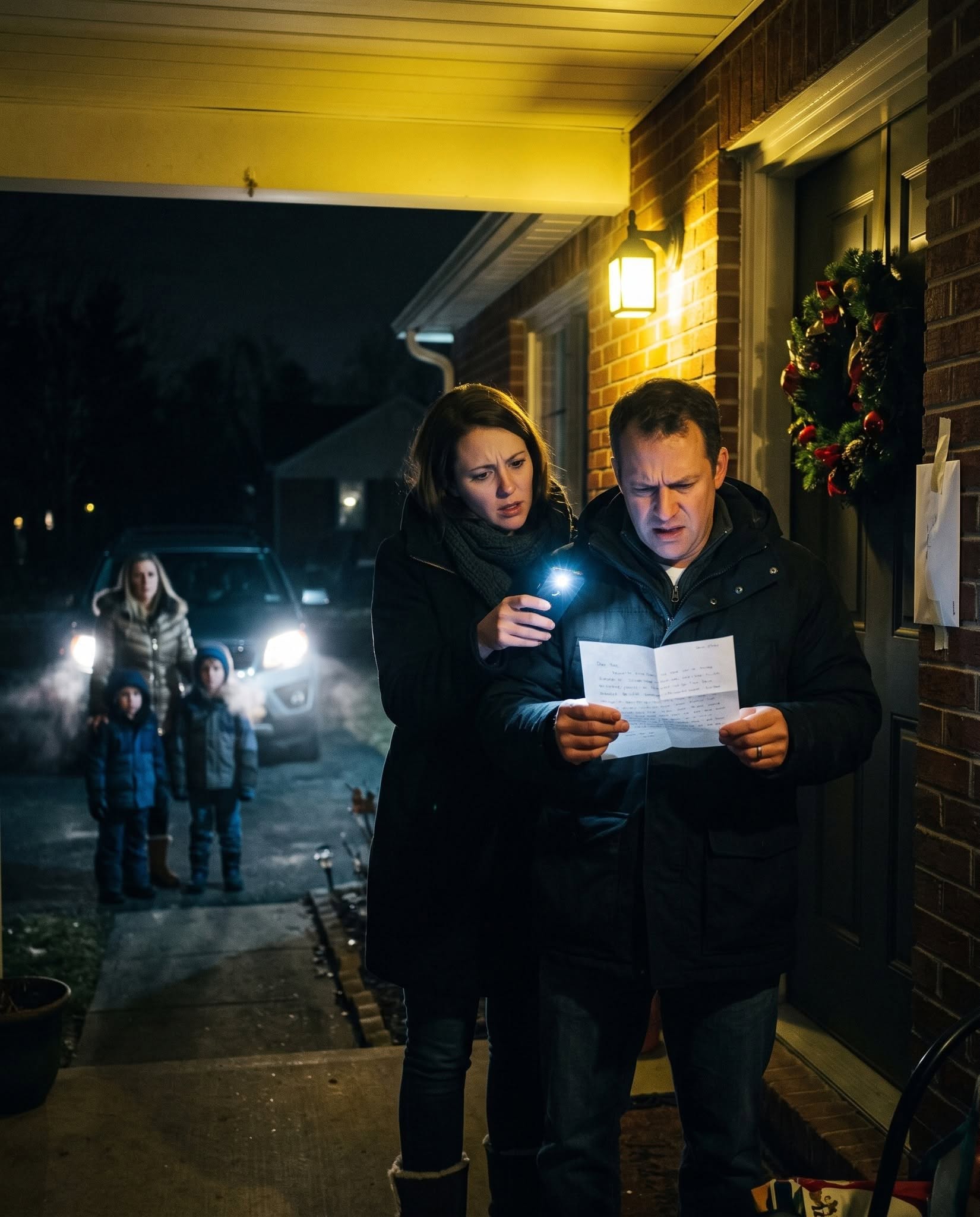
Then he lowered it and looked toward the garden shed.
“Mom actually left the presents,” he murmured.
Rebecca folded her arms against the cold. “That doesn’t change anything. She knew fourteen people were coming. She can’t just disappear on Christmas Eve.”
“Maybe she told us she wasn’t hosting,” Michael replied.
Rebecca stared at him. “She didn’t mean it.”
“Why wouldn’t she mean it?”
“Because she’s Mom!”
The words hung in the air.
For the first time, Michael seemed to hear what his sister had said.
Because she was Mom.
Because I had always cooked, always cleaned, always made room for one more guest. Because I had spent years putting everyone else’s comfort before my own, my children had convinced themselves that I was incapable of saying no.
Lauren snatched the letter from Michael’s hand.
“This is emotional blackmail,” she announced. “She’s punishing the entire family because we made a few comments about dinner.”
Michael turned toward his wife.
“A few comments?”
“Oh, don’t start.”
“You told her last year that her decorations looked outdated. Rebecca complained about the menu. I sent her a grocery list five days ago after she specifically told me she wasn’t hosting.”
Lauren’s cheeks flushed.
“I thought she’d change her mind.”
“Exactly,” Michael said quietly. “You thought she’d change her mind because that’s what she always does.”
Behind them, one of the grandchildren began to cry.
“Dad, my hands are freezing. Can we go inside?”
Michael looked at the dark windows of the house.
For thirty-eight years, that house had been the center of our family. He had learned to ride a bicycle in the driveway, opened Christmas presents beside the fireplace, and watched his father carve wooden ornaments at the dining-room table.
Now he stood outside it, unable to enter.
And for the first time, he understood that the locked door wasn’t the real problem.
The real problem was that I had finally stopped opening it whenever someone demanded that I do so.
“Let’s get the boxes,” he said.
They walked around the side of the house toward the garden shed.
Inside were five neatly labeled boxes containing the grandchildren’s gifts. Beside them sat two smaller containers holding Frank’s wooden Christmas ornaments, divided equally between Michael and Rebecca.
Michael lifted one ornament from the box.
It was a little wooden horse his father had carved when Michael was seven.
On the back, Frank had written the date in pencil.
Michael ran his thumb over the faded inscription.
“Dad made this for me,” he whispered.
Rebecca’s expression softened as she picked up a small wooden star.
“He made this one for me.”
Neither of them spoke for a moment.
Then Lauren broke the silence.
“Fine. We have the presents. Now what? We still need somewhere to have dinner.”
Michael looked at her.
“We find somewhere open, or we go home and make something ourselves.”
“On Christmas Eve? With fourteen people?”
“Yes.”
She stared at him as though he had suggested climbing a mountain.
“Michael, your mother always handles this.”
He closed the box.
“Not this year.”
And with those four words, our family’s Christmas tradition finally began to change.
Not because I had destroyed it.
Because I had stopped carrying it alone.
PART 3: FOURTEEN MISSED CALLS
Martha and I were sitting beside the fireplace at the inn when my phone began vibrating again.
I had already received eleven missed calls. Now the number had climbed to fourteen.
I looked at Michael’s name on the screen.
Martha raised an eyebrow.
“Are you going to answer?”
I took a sip of tea.
“Not yet.”
She smiled gently.
“Good.”
Outside, a light snow had begun falling over the Virginia countryside. The inn’s dining room glowed with candlelight, and the smell of roasted chicken drifted from the kitchen.
For the first time in years, I had spent Christmas Eve without standing over a H๏τ stove until my back ached.
I hadn’t peeled twenty pounds of potatoes.
I hadn’t worried whether Rebecca would complain that the gravy was too thick.
I hadn’t checked the clock every five minutes because Michael’s family was running late.
I had simply sat down, ordered dinner, and allowed someone else to bring me a warm plate.
It felt almost scandalous.
My phone rang again.
This time, I answered.
“Hello, Michael.”
“Mom!” His voice was strained. “Where are you?”
“I’m safe, sweetheart. I told you that in the letter.”
“I know, but—” He stopped. “I didn’t realize you were actually going to leave.”
I looked at Martha.
She silently mouthed, Of course he didn’t.
“Michael, I told you five days ago that I wasn’t hosting Christmas.”
“I thought you were upset.”
“I was upset. I was also serious.”
He exhaled.
“Everyone’s angry.”
I looked out the window at the snow.
“I’m sorry they’re uncomfortable.”
“Mom, that’s not what I mean. Lauren says you’ve embarrᴀssed us in front of the whole family.”
“Did she read the letter?”
“Yes.”
“Then she knows why I left.”
He was quiet.
Finally, he said, “I didn’t realize you felt that way.”
The words landed heavily between us.
I had spent years trying to make my feelings impossible to overlook. I had mentioned how tired I was. I had asked for help. I had suggested smaller gatherings.
Every time, someone had found a reason to dismiss me.
“I told you,” I replied softly. “You just didn’t believe me.”
Michael didn’t argue.
In the background, I heard Rebecca asking whether he had found somewhere to eat. A grandchild complained about being hungry.
“Mom,” he said, “can we come see you tomorrow?”
“Tomorrow I’m spending the day with Martha. We have plans.”
“Then when?”
“When I’m ready to arrange a visit.”
He sounded wounded.
“Are you really going to keep us away from you?”
I closed my eyes.
“No, Michael. I’m asking you to stop treating my home as though it belongs to everyone except me.”
Silence.
Then he whispered, “I’m sorry.”
It was the first time that evening he had said those words.
I wanted to believe they meant something.
But an apology was only the beginning.
“Thank you,” I said. “We can talk more when everyone has had time to think.”
Before ending the call, Michael asked one final question.
“Did you really leave because of what Lauren said three years ago?”
“No,” I replied. “I left because of everything that happened afterward.”
I hung up and placed my phone in my handbag.
Martha reached over and squeezed my hand.
“How do you feel?”
I thought about the house, the ornaments, and the empty dining table.
Then I smiled.
“Like I finally have permission to enjoy my own Christmas.”
PART 4: THE CHRISTMAS DINNER THEY HAD TO MAKE THEMSELVES
Back at my house, Michael had managed to convince everyone to gather at his place.
It wasn’t ideal.
His kitchen was smaller than mine, his dining table seated only six, and his refrigerator contained little more than milk, leftovers, and a jar of mustard.
Rebecca stared at the counters.
“What are we supposed to cook?”
Michael opened the refrigerator.
“I don’t know. We could order pizza.”
“On Christmas Eve?” Lauren exclaimed.
“What would you suggest?”
She looked at him incredulously.
“You’re the one who insisted everyone come here!”
“I didn’t insist. I thought Mom would host.”
Rebecca threw her hands up.
“This is ridiculous. We should have known she’d do something like this.”
Michael turned toward his sister.
“She told us she wasn’t hosting.”
Rebecca fell silent.
He continued, his voice quieter now.
“We all knew. We just ᴀssumed she wouldn’t follow through.”
For once, nobody had an immediate answer.
The grandchildren began opening their presents. They were delighted to discover that I had wrapped everything carefully, with their names written in my familiar handwriting.
One of them found a small card tucked beneath a ribbon.
It read:
Dear sweetheart,
I hope you always remember that Christmas is not about how much we receive, but how much love we give. Be kind to the people who care for you, especially when they are tired.
Love, Grandma Diane.
The child read it aloud.
Rebecca looked down at her plate.
Lauren busied herself with the wrapping paper.
Michael went into the kitchen and began searching the cupboards.
He found flour, eggs, sugar, and a handwritten recipe card tucked into the back of a drawer. It was one of the recipes I had given him when he moved into his first apartment.
His father had written a note on the bottom.
Don’t forget to call your mother. She worries when you don’t.
Michael sat down on a kitchen stool.
He could suddenly picture me standing in the kitchen at home, wearing Frank’s old apron, checking the oven while answering three different questions at once.
He remembered the way I always served everyone else before sitting down.
He remembered how often I had said, “I’ll eat after everyone is settled.”
And he realized he could not remember the last time anyone had insisted that I sit down first.
“Michael?” Rebecca called. “Are you going to make something?”
He looked at the recipe.
“Yes.”
“What?”
“Frank’s apple cake.”
Rebecca’s face softened.
“Dad’s favorite.”
“Mom used to make it every Christmas.”
Lauren crossed her arms.
“Are you seriously going to bake a cake now?”
Michael looked at his wife.
“Yes. Because we have flour, apples, and eggs. And because I’m tired of acting as though Christmas happens by itself.”
Nobody spoke.
He began measuring ingredients.
Rebecca eventually joined him, peeling apples at the counter. One of the grandchildren carried over a mixing bowl. Even Lauren, after a long silence, began washing dishes.
It wasn’t a perfect Christmas dinner.
The potatoes were lumpy. The chicken was overcooked. The apple cake came out slightly crooked.
But for the first time in years, the family had to participate in creating the holiday they claimed to cherish.
And while Michael mixed the batter, he finally understood the lesson I had tried to teach him without words.
Tradition is not something one person owes everyone else. It’s something a family builds together.
PART 5: THE VISIT I DIDN’T EXPECT
I returned home two days after Christmas.
The house was exactly as I had left it. The wooden ornaments Frank had kept for himself still hung on the small tree in the living room, and his blue mug sat beside the fireplace.
I made a cup of tea and stood by the window, watching the bare branches sway in the winter wind.
For the first time in years, I wasn’t exhausted.
I was also a little sad.
Setting boundaries didn’t erase love. It didn’t remove the memories of Christmas mornings when Michael and Rebecca were children, racing downstairs in their pajamas.
I still missed those days.
But I was beginning to understand that missing the past didn’t mean I had to accept the present.
On the afternoon of December 27, someone knocked on my door.
I checked the peephole.
Michael stood on the porch alone, holding a paper bag.
I opened the door but didn’t immediately step aside.
“Hello, Michael.”
“Hi, Mom.”
He looked nervous.
“I brought something.”
I glanced at the bag.
“What is it?”
“Apple cake.”
I almost smiled.
“Your father’s recipe?”
He nodded.
“I made it myself. Rebecca helped with the apples, but I did the mixing.”
“Was it edible?”
He laughed nervously.
“Mostly.”
I stepped aside.
“Come in.”
He entered slowly, looking around the living room as though he were seeing it for the first time.
Then he placed the cake on the kitchen counter.
“I owe you an apology,” he said.
I didn’t answer immediately.
He took a deep breath.
“I read your letter again last night. I realized I was angry because you didn’t do what I expected, not because you had done anything wrong.”
I leaned against the counter.
“Go on.”
“I kept telling myself you liked hosting. That it made you happy to have everyone here. But I never really asked you.”
“No,” I said. “You didn’t.”
“And when you said you weren’t hosting, I ᴀssumed you’d change your mind because you always have.”
He looked down at his hands.
“I treated your kindness like an obligation.”
The words surprised me.
Not because they were complicated, but because they were honest.
“Yes,” I replied. “You did.”
He nodded.
“I am sorry, Mom.”
I studied his face.
For years, I had imagined hearing those words. I had thought I would feel triumphant, perhaps even vindicated.
Instead, I felt tired and relieved.
“Thank you for apologizing.”
He looked up.
“Can we make things right?”
“We can start.”
His shoulders relaxed.
“Does that mean Christmas will be back at your house next year?”
I stared at him.
Then I laughed.
Not bitterly. Not angrily.
Just because he had managed to turn an apology into a request for next year’s dinner in less than thirty seconds.
Michael’s face reddened.
“Sorry. That was a terrible thing to ask.”
“It was.”
We both laughed a little.
Then I grew serious.
“Michael, I love you. I love Rebecca. I love the grandchildren. I want to see you. But I will not spend another Christmas cooking for fourteen people while everyone else treats me like the hired help.”
He nodded.
“I understand.”
“If we celebrate here again, everyone will help. The menu will be agreed upon in advance. People will bring dishes. Everyone will clean up. And if I decide I want to spend Christmas somewhere else, I won’t have to defend that decision.”
“That’s fair.”
“And one more thing.”
He waited.
“I need you to ask me how I’m doing sometimes when you don’t need something.”
His eyes filled.
“I should have done that years ago.”
“Yes,” I said gently. “You should have.”
He reached for my hand.
I let him hold it.
It wasn’t forgiveness for everything that had happened. It wasn’t a promise that our relationship would suddenly become perfect.
It was simply a beginning.
And beginnings, I had learned, were sometimes enough.
PART 6: FOURTEEN CALLS AND ONE IMPORTANT LESSON
In January, Rebecca came to visit.
She brought groceries, a small bouquet of flowers, and a handwritten note.
“I know flowers don’t fix anything,” she said, placing them on the table. “But I wanted to bring something that wasn’t a request.”
I smiled.
“That’s a good start.”
She sat beside me and looked at the pH๏τographs on the mantel.
“I’ve been thinking about Dad,” she said. “And about how you kept Christmas going after he died.”
I nodded.
“I missed him.”
“I know. I think I was so used to you making everything feel normal that I never stopped to think about what it cost you.”
She looked down.
“I’m sorry I complained about the food. I’m sorry I sent you that picture of the table. I thought I was helping, but I was making you feel as though nothing you did was good enough.”
I reached for her hand.
“Thank you for saying that.”
She wiped her eyes.
“Do you think Dad would have been disappointed in us?”
I considered the question.
“Your father loved you both. He wouldn’t have stopped loving you because you made mistakes. But I think he would have wanted you to recognize those mistakes and do better.”
Rebecca nodded.
“That sounds like him.”
She stayed for lunch, and afterward we looked through the old Christmas pH๏τographs.
We found one of Michael at six years old, wearing a paper crown and holding a wooden horse. Rebecca was standing beside him in a red dress, missing one front tooth.
Frank stood behind them, his arms wrapped around both children.
I remembered the day vividly.
The turkey had been too dry, the gravy had spilled, and one of the ornaments had broken before dinner.
Yet nobody had cared.
We had laughed until our stomachs hurt.
Because back then, Christmas had never been about a perfect table.
It had been about being together.
Before Rebecca left, she hugged me тιԍнтly.
“Next Christmas, can I cook the main dish?”
I smiled.
“You can cook whatever you want.”
“And I’ll clean up.”
“I’ll hold you to that.”
She laughed.
“I deserve that.”
After she left, I stood in the quiet kitchen and looked at the flowers she had brought.
The house felt different.
Not because the furniture had changed or because the Christmas decorations were gone.
Because I had stopped believing that loving my family required me to disappear inside their expectations.
And that was a change worth keeping.
EPILOGUE: THE CHRISTMAS I FINALLY ENJOYED
The following December, Michael called me in early November.
“Mom, we’re planning Christmas,” he said. “Would you like to host, or would you rather come to our house?”
I smiled into the phone.
“Tell me what you’re thinking.”
“We thought we’d divide everything. Rebecca will handle the side dishes. Lauren volunteered to make dessert. I’ll take care of the turkey. And the grandchildren want to decorate your tree.”
I glanced at Frank’s wooden ornaments, carefully stored in their box.
“That sounds lovely.”
“Would you like to have everyone at your house?”
I considered the question.
A year earlier, I might have said yes automatically.
This time, I thought about my energy, my preferences, and what would make the day enjoyable for me.
“Yes,” I said. “But I have one condition.”
“What’s that?”
“I’m not spending the entire day in the kitchen.”
He laughed.
“Deal.”
On Christmas Eve, my house filled with the sound of family arriving.
But this time, Michael carried the groceries inside. Rebecca helped prepare the vegetables. Lauren set the table without criticizing the decorations.
The grandchildren hung Frank’s wooden ornaments on the tree, carefully placing the little horse near the bottom so the youngest could reach it.
At dinner, everyone sat down together.
I looked around the table and saw something I hadn’t seen in years.
People helping.
People listening.
People asking questions that had nothing to do with what I could provide for them.
Michael raised his glᴀss.
“To Mom,” he said.
Everyone looked at me.
“For reminding us that Christmas is supposed to be about family. And for teaching us that family means showing up for one another, not just expecting one person to do everything.”
My eyes filled with tears.
I looked at Frank’s blue mug beside the fireplace and imagined him smiling.
Then I lifted my glᴀss.
“To doing better,” I said.
We ate, laughed, and exchanged presents.
After dinner, Michael and Rebecca cleared the table while Lauren washed dishes. I sat beside the fireplace with a cup of tea, listening to my grandchildren argue cheerfully over a board game.
For the first time in years, I wasn’t counting the minutes until everyone left.
I was enjoying the fact that they were there.
Later that night, after the house had grown quiet, I walked to the front door and looked at the place where I had taped the envelope the year before.
I remembered Michael’s fourteen calls.
I remembered the cold porch, the dark windows, and the shock on my family’s faces when they realized I had meant what I said.
I had worried that setting a boundary would cost me the people I loved.
Instead, it had forced us to confront the way we had been treating one another.
Not everyone had changed overnight. Some conversations had been uncomfortable. Some apologies had taken time.
But I had finally stopped confusing being needed with being loved.
And my family had begun learning the difference, too.
I turned off the porch light and walked back into the living room.
Frank’s blue mug sat beside my chair.
I picked it up, smiled, and whispered, “We did it, Frank.”
Then I settled beneath a warm blanket and listened to the quiet house.
At sixty-nine, I had discovered something I wished I had learned decades earlier:
You can love your family with your whole heart without giving them unlimited access to your time, your energy, or your peace.
And sometimes, the most loving thing you can do is close the front door, leave a letter, and give everyone the chance to learn what it means to open it with respect.