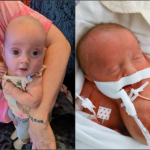
He Weighed 255 Pounds at Seven. His Parents Had Insurance. Prosecutors Say That Is the Point.

Just before nine in the morning on November 4, 2025, Jessica O’Brien called 911 from a rented house on Dania Street in Flint Township, Michigan, and said her son was not breathing. Paramedics found seven-year-old Casper O’Brien in distress, unable to move, in a makeshift bed that investigators said four members of the family slept in together. He was taken to Hurley Medical Center. He died a short time later. The autopsy, prosecutors later said, listed dilated cardiomyopathy, a disease of the heart muscle that can end in heart failure, as the cause, with morbid obesity as a contributing factor. He weighed 255 pounds.
For seven months the death sat inside an investigation. On June 24, 2026, Genesee County prosecutors stood up in district court and charged both parents, Damien O’Brien, 40, and Jessica O’Brien, 41, with second-degree murder, torture, and three counts of second-degree child abuse. The abuse counts reach past Casper to his five-year-old sister, whom officers said they found running through the house naked, dirty, with knotted hair, and whom doctors later described as morbidly obese at about 130 pounds, with poor hygiene and a significant cough. Prosecutor David Leyton called the file very sad, and then he used the words he clearly did not want to soften: abuse, neglect, and torture. “I don’t want to charge parents with neglect or murder,” he told reporters. “I didn’t have any choice.” Both parents were held without bond. A probable-cause conference was set for early July. Their attorney, Elias J. Fanous, could not be reached for comment in the first wave of reporting.

The prosecution theory is not that a heavy child is a crime. It is that a child who could not move, who lived on a diet investigators were told consisted mainly of potato chips and fries because of texture issues, who was taken to a doctor once despite the family having health insurance, and who died of a heart-muscle disease in which obesity was a contributing factor, was failed for years inside a house police described as deplorable. Charging documents cited by local stations allege the parents did not care for an immobile son, did not address the obesity, and did not keep a safe or clean home. Leyton said the children had never attended school and had never come to the attention of Child Protective Services. When officers arrived that Tuesday, paramedics already filled the usable space. One account said police could not readily get inside because of it. The house, Leyton said, held “everything you can imagine.”
That gap — a child this sick, in a township outside Flint, unknown to the systems built to find him — is the part of the case that does not fit a single bad morning. A seven-year-old who weighs 255 pounds is not invisible in a pediatric office. He is invisible if he is never in one. Prosecutors have stressed the insurance on purpose. The defense, when it is fully heard, will almost certainly argue the difference between a terrible medical outcome and a murder, between a cardiomyopathy that can strike a heart and a parental failure a jury can call torture under Michigan law. Second-degree murder in this state can mean up to life. Torture is charged as its own count, not as a flourish. None of that has been tested in front of a jury. As of the June filings, this was an arraignment, not a verdict.
The sister’s condition is what keeps the case from being argued as a single tragedy with a single cause of death. Prosecutors say a five-year-old in the same house was also in medical trouble, also unschooled, also unknown to protective services, and was naked when police walked in. If a jury accepts that picture, the November 4 call stops looking like the day a disease won and starts looking like the day a pattern became impossible to hide. If a jury does not, the parents are two people who lost a son and were then charged with killing him. Both of those sentences can be true as descriptions of the stakes. Only one of them, eventually, can be the verdict.
Flint Township is not a place that lacks hospitals, schools, or insurance networks. Hurley is minutes away. The prosecutor’s public line has been that proximity did not matter because the adults did not use it. Neighbors, in the early reporting, were not the ones who brought the police. A 911 call about a child who had already stopped breathing did. That is the fact Leyton keeps returning to, and it is also the fact a defense lawyer will say cannot be reverse-engineered into years of criminal intent. MLive reported that the boy was found in a bed shared by four people. WNEM, citing the affidavit, reported the chip-and-fries diet and the sister’s weight. USA Today and CBS Detroit carried the autopsy language and the no-bond hold. The record, this early, is a pile of those documents and a prosecutor who says he charged murder because he believed neglect had been allowed to become fatal.

What the public does not yet have is a trial narrative from the parents. Fanous had not answered reporters in the first forty-eight hours after the charges. Bond was not an option at the arraignment. A probable-cause conference is a low gate: the state has to show there is reason to keep going, not prove the case beyond a reasonable doubt. The higher gate is later, and it will turn on medical testimony as much as on pH๏τographs of the house. Dilated cardiomyopathy is a real diagnosis. Morbid obesity as a contributing factor is a real autopsy finding. The legal question is whether parents who had insurance, who took their son to a physician once, and who called 911 on the morning he died, committed murder and torture by the way they lived with him before that morning. Genesee County has said yes, in the language of a complaint. A jury has not said anything yet.