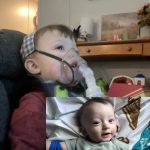
Luke’s Brave Heart Journey: The Little Boy Fighting Hypoplastic Left Heart Syndrome While Waiting for a Life-Saving Transplant
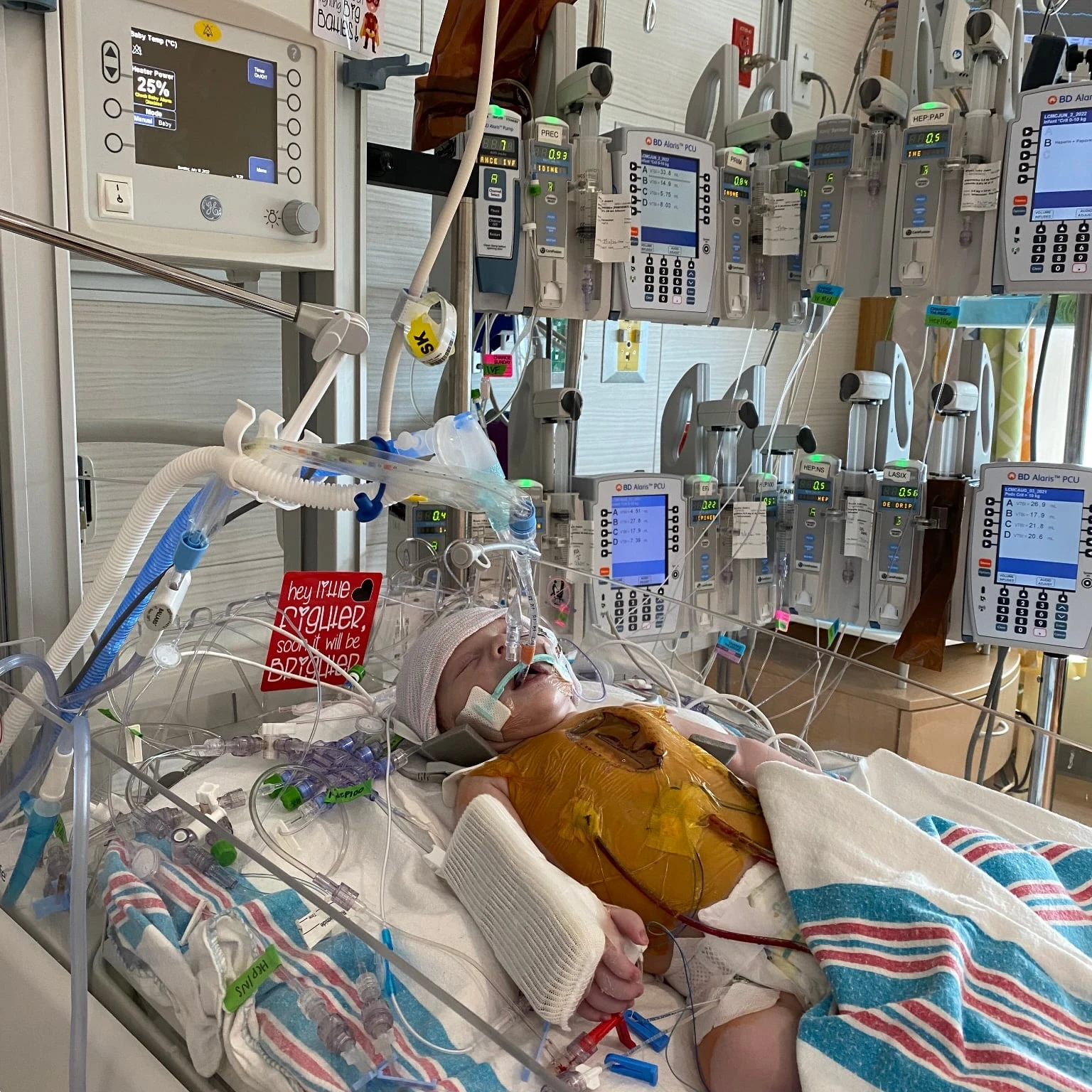
Luke has spent nearly his entire life fighting to survive.
Before he ever opened his eyes to the world, doctors already knew his heart was dangerously underdeveloped. What began as a routine 21-week anatomy scan during pregnancy quickly became every parent’s nightmare—a diagnosis of Hypoplastic Left Heart Syndrome, one of the most severe congenital heart defects a child can face.
From that moment forward, Luke’s life became a story of surgeries, setbacks, hospital stays, and unimaginable endurance.
Yet through every painful procedure and terrifying complication, one thing has remained constant:
Luke refuses to stop fighting.
A Diagnosis Before Birth
During pregnancy, Luke’s parents learned that the entire left side of his heart had not developed properly.
The diagnosis immediately changed everything about the months leading to his birth. Instead of preparing a nursery in peace, the family began meeting with specialists, fetal cardiologists, and surgical teams. Every appointment carried the weight of uncertainty as they prepared for the complex medical journey waiting ahead.
Luke was born at Touro Infirmary in New Orleans.
From his very first breath, doctors worked urgently to stabilize him. Medications were started immediately to keep a critical blood vessel called the PDA open, allowing blood to continue circulating through his fragile body.
Even the first days of life became a battle.
His breathing was unstable. His heart rate frequently climbed dangerously high. Feeding him safely became difficult because of the constant risk of necrotizing enterocolitis, a serious intestinal condition that can threaten infants with heart disease.
Instead of ordinary bonding moments, Luke’s parents watched milk slowly move through feeding tubes while machines surrounded their baby.
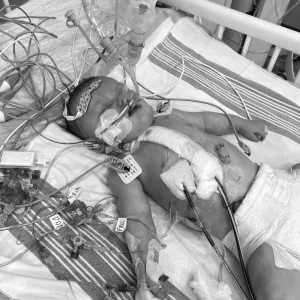
Open-Heart Surgery at Just Seven Days Old
At only one week old, Luke underwent the Norwood procedure, one of the most complex surgeries performed on newborns with Hypoplastic Left Heart Syndrome.
For his family, the operation represented hope—but also overwhelming fear.
Unfortunately, recovery did not go smoothly.
Luke’s chest remained open for seven days after surgery because his body was too unstable for closure. Then more complications followed. His lungs collapsed. Chylous effusions developed. Infections spread. His vocal cords became paralyzed. Feeding issues continued, and medication withdrawals caused additional suffering.
Every small improvement seemed to be followed by another setback.
Still, Luke kept surviving.
Before he could finally leave the hospital, doctors also had to place a G-tube and perform a Nissen fundoplication procedure to help him feed safely.
By the time Luke finally went home, his parents had already endured months of fear, exhaustion, and emotional trauma.
Living Between Hospital Visits and Hope
Once home, Luke entered what heart families call the “interstage period,” an extremely fragile phase between major surgeries.
His family monitored oxygen levels, nutrition, heart rates, and weight every single day. Weekly cardiology visits—both virtual and in person—became essential lifelines.
Every reading mattered.
Every feeding mattered.
Every breath mattered.
At around four and a half months old, doctors realized Luke was beginning to outgrow his Norwood circulation. A cardiac catheterization confirmed he needed another major surgery: the Glenn procedure.
Once again, his family prepared for another terrifying operation.
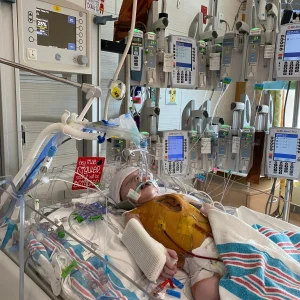
Another Surgery, More Complications
The Glenn surgery was expected to require roughly two weeks of recovery.
Instead, Luke remained hospitalized for six exhausting weeks.
His recovery became complicated by collapsed lungs, pneumothorax, low oxygen levels, and severe medication withdrawals. Every day felt uncertain. Every setback carried fresh fear.
Yet Luke endured it all.
Just before Christmas, he was finally discharged home again—small, medically fragile, but alive.
His family held тιԍнтly to every small sign of progress.
At home, Luke slowly began thriving in his own way. Although he remained dependent on his G-tube and his vocal cord paralysis lasted nearly a year, he started experiencing pieces of normal childhood.
Medical daycare became part of his routine.
And despite everything he had endured, Luke’s personality continued shining through.
A Happy Child Despite Endless Challenges
One of the most remarkable parts of Luke’s story is that illness has never stolen his spirit.
Doctors, nurses, and respiratory therapists consistently describe him as joyful, playful, and incredibly determined. Even after repeated hospitalizations, ambulance rides, helicopter transfers, catheter procedures, and painful treatments, Luke still greets people with curiosity and smiles.
His resilience deeply impacts everyone who meets him.
Even during difficult admissions, he continues finding ways to laugh, engage, and play. His spirit reminds medical staff that children often possess extraordinary courage adults struggle to understand.
Luke teaches people that strength is not measured by age.
Heart Failure and the Need for a Transplant
As Luke approached his first birthday, signs of worsening heart failure began appearing.
Medications helped temporarily slow the progression, but his condition continued deteriorating. Frequent respiratory infections led to repeated hospital admissions, including multiple emergency transports and two helicopter flights.
Then came devastating news.
By early 2025, Luke’s heart failure had progressed into decompensated congestive heart failure. Severe tricuspid valve leakage made future reconstructive surgeries impossible.
Without a heart transplant, Luke would not survive.
For his parents, hearing those words felt unimaginable.
But once again, they refused to give up.
Waiting for the Call That Could Save His Life
In June 2025, Luke underwent transplant evaluation at Texas Children’s Hospital.
By August, he was officially approved and listed for a heart transplant.
Complications involving his kidneys added even more concern, but his family continued holding onto hope. Then, on October 2, 2025, Luke was admitted permanently to the hospital and started on a milrinone infusion to support his failing heart.
His transplant status was elevated to 1A, indicating urgent need.
But the call for a donor heart still had not come.
As of April 30, 2026, Luke had spent nearly seven straight months inside the hospital waiting for the organ that could save his life.
A Family Fueled by Hope
Luke will turn four years old in June.
His birthday arrives surrounded by medical uncertainty, but also by extraordinary love. His parents and six-year-old sister continue standing beside him every day, refusing to let fear overpower hope.
For this family, hope is no longer abstract.
It exists in tiny victories:
A stable oxygen reading.
A successful feeding.
A moment of laughter.
A peaceful night.
And through everything, Luke continues reminding everyone around him that joy can still exist even in the middle of overwhelming hardship.
More Than a Diagnosis
Luke is not simply a heart patient.
He is a little boy with courage far beyond his years.
A child whose laughter still echoes through hospital hallways despite years of pain and procedures. A fighter whose resilience inspires families navigating congenital heart disease across the country.
His story shines a light on the realities of pediatric heart disease, the importance of organ donation, and the incredible endurance required from families living inside medical uncertainty.
Most of all, Luke reminds the world that even the smallest hearts can carry extraordinary strength.
And while he waits for the call that could finally bring him home, he continues doing what he has done since birth:
Fighting bravely, one heartbeat at a time.