GET ON BOAT NOW: A close friend claims Nolan Wells ignored his repeated pleas just before disappearing
For the first time since the death of 18-year-old Nolan Xavier Wells, one of the young men who was with him on a Fourth of July boat trip to Mississippi’s Horn Island has publicly described what he believes were the teenager’s final hours and moments on the barrier island. Warren Hudson, who has described himself as Wells’ best friend, said in recent interviews that multiple people urged Wells to board their departing boat as it began taking on water, but the Ocean Springs High School graduate and college football player insisted on staying behind with people he had just met.
Hudson’s account, delivered primarily on conservative commentator Brandon Tatum’s podcast “The Officer Tatum” and in comments to the New York Post, has added new detail to a case that has drawn national attention, fueled intense online speculation, and left Wells’ family questioning the official narrative that their son simply chose to remain on the island and later drowned. Authorities have said they have found no evidence of foul play, but the investigation remains open, an independent autopsy commissioned by the family ruled the cause and manner of death undetermined, and Wells’ parents, represented by civil rights attorney Ben Crump, continue to press for answers.
Nolan Wells, a well-liked athlete known to friends and family as “Nono,” graduated from Ocean Springs High School in 2025 and was preparing to play wide receiver at Southwest Mississippi Community College. On the evening of July 3, 2026, he cooked baked salmon for his parents, Christine Wonsley and Elmore Wonsley, before leaving to spend the night at a friend’s house ahead of the holiday. The next morning he joined a group of friends for what was intended to be a celebratory boat trip to Horn Island, an undeveloped barrier island roughly eight to ten miles off the Mississippi Gulf Coast that forms part of the Gulf Islands National Seashore. The island has no facilities, no drinking water, and no permanent staff; it is accessible only by private boat and draws heavy crowds on major summer holidays.
According to GPS data released in the investigation, the boat carrying Wells and several friends left a private dock around 9:56 a.m. on July 4 and arrived at Horn Island about 11:14 a.m. Hudson later described the scene as packed. He estimated thousands of people were on or around the island that day, with boats lining the shoreline for miles. “I think there were boats all the way around the entire island,” Hudson said. “Every area of Horn Island is covered, 100 percent.” Groups mingled, music played, and alcohol flowed as the day progressed. Hudson said their own circle “grew and grew,” with people drinking and celebrating Independence Day in the heat.
Hudson told Tatum that Wells appeared to be in good spirits and was enjoying himself. The last time Hudson said he saw his friend was around 3 p.m. near the northwest tip of the island. According to Hudson, Wells was “cradling a girl in his arms” — identified in some accounts as Katie — and was laughing and shaking his head when Hudson joked with him. That was the final visual contact Hudson claimed to have had with Wells.
Later that afternoon the boat that had brought Wells and several others to the island began experiencing problems. It started taking on water — Hudson estimated about six inches — after the bilge pump failed. A distress call captured in investigative records reflected the urgency: the vessel’s operator reported they were at the west tip of Horn Island, the bilge pump had stopped working, and they were “sinking.” Hudson described the situation as an emergency. “We were in emergency,” he said. “The boat, we’re trying to save the boat.”
According to Hudson, friends repeatedly urged Wells to get aboard before the boat was towed away around 4:30 p.m. One panicking friend, Hudson claimed, yelled, “Nolan, get the F on the boat.” Hudson said his buddy asked Wells multiple times: “Nolan, get on the boat, get on the boat, we’re leaving. If you’re coming, you gotta come now.” Wells’ response, according to Hudson, was that he was staying on the island and would ride back later with someone else. Hudson insisted that Wells was not abandoned. “It’s not like we didn’t ask Nolan or we just left Nolan. Nolan decided to stay on the island with the girl that he was with. And the girl is a witness to that, too.” He added that other people in the larger group that day also arrived on one boat and returned on another, and that no one who had come with their party was left behind against their will.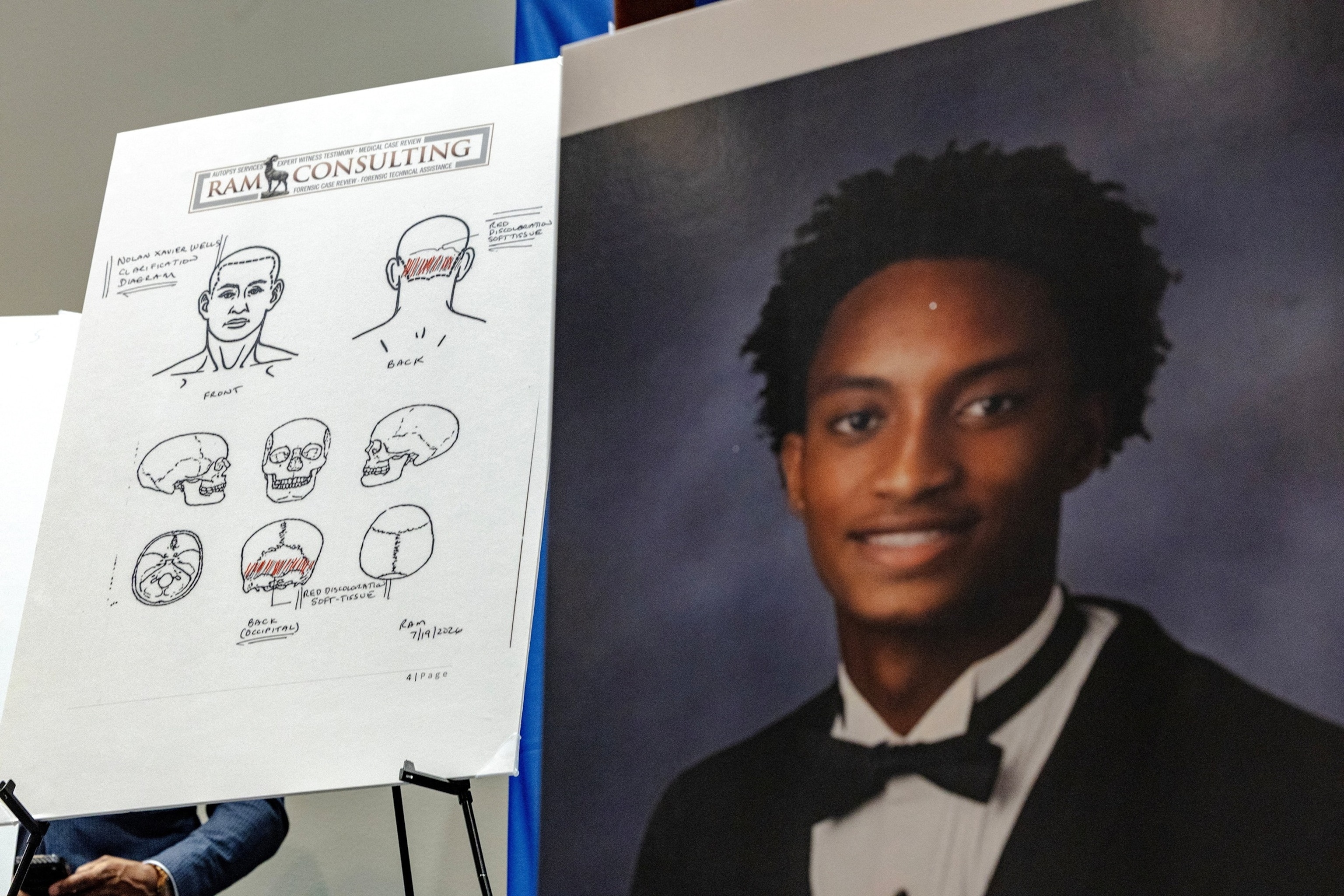
Hudson’s mother, Jackson County Chancery Court Judge Ashlee Cole, had earlier released a statement consistent with this timeline. She said her son last saw Wells around 3 p.m., that the group left about 4:30 p.m. because of the bilge-pump problem and the boat taking on water, and that “Nolan made a decision to stay on the island and return inland later with another group of friends.” Cole noted that Warren had cooperated fully with the Jackson County Sheriff’s Office.
The boat returned to its original dock around 5:44 p.m., according to GPS records. Wells did not return with it. His cellphone and, according to some reports, his keys remained on the boat. Hudson later explained that it was common for people on Horn Island to leave phones aboard because the water could be waist- to neck-deep, murky after rain, and risky for electronics. When Wells still had not been heard from that evening, Hudson said he obtained Christine Wonsley’s number from another friend, called her around 11 p.m., and learned she also had not heard from her son. Hudson then contacted the U.S. Coast Guard to report a missing person near Horn Island. Wonsley separately contacted the Jackson County Sheriff’s Department around midnight.
A multi-agency search involving the Jackson County Sheriff’s Department, Harrison County Sheriff’s Department, U.S. Coast Guard, National Park Service, Mississippi Department of Marine Resources, United Cajun Navy and other volunteers combed the island and surrounding waters. On the morning of July 6, a National Park Service ranger discovered a body in the water near the western tip of Horn Island, close to where Wells had last been seen. Jackson County Coroner Bruce Lynd Jr. confirmed the identification through dental records on July 7. Initial statements from authorities indicated they believed Wells had drowned and that there were no immediate signs of foul play, though the investigation continued.
Wells’ family has never accepted the simplest version of events. They have said they find it difficult to believe their athletic, strong-swimming son would willingly separate from his friends, leave his phone behind, and later drown in conditions he knew well. Attorney Ben Crump, retained by the family, has highlighted what he calls “glaring contradictions” in witness accounts, including questions about an alleged altercation or yelling on the boat, the handling of Wells’ phone (the family reported that messages and media appeared to have been deleted when they recovered it), and why Wells’ body was not located until July 6 if he had entered the water on July 4. Crump has also referenced bystander video that he said showed Wells arguing with someone about his phone.
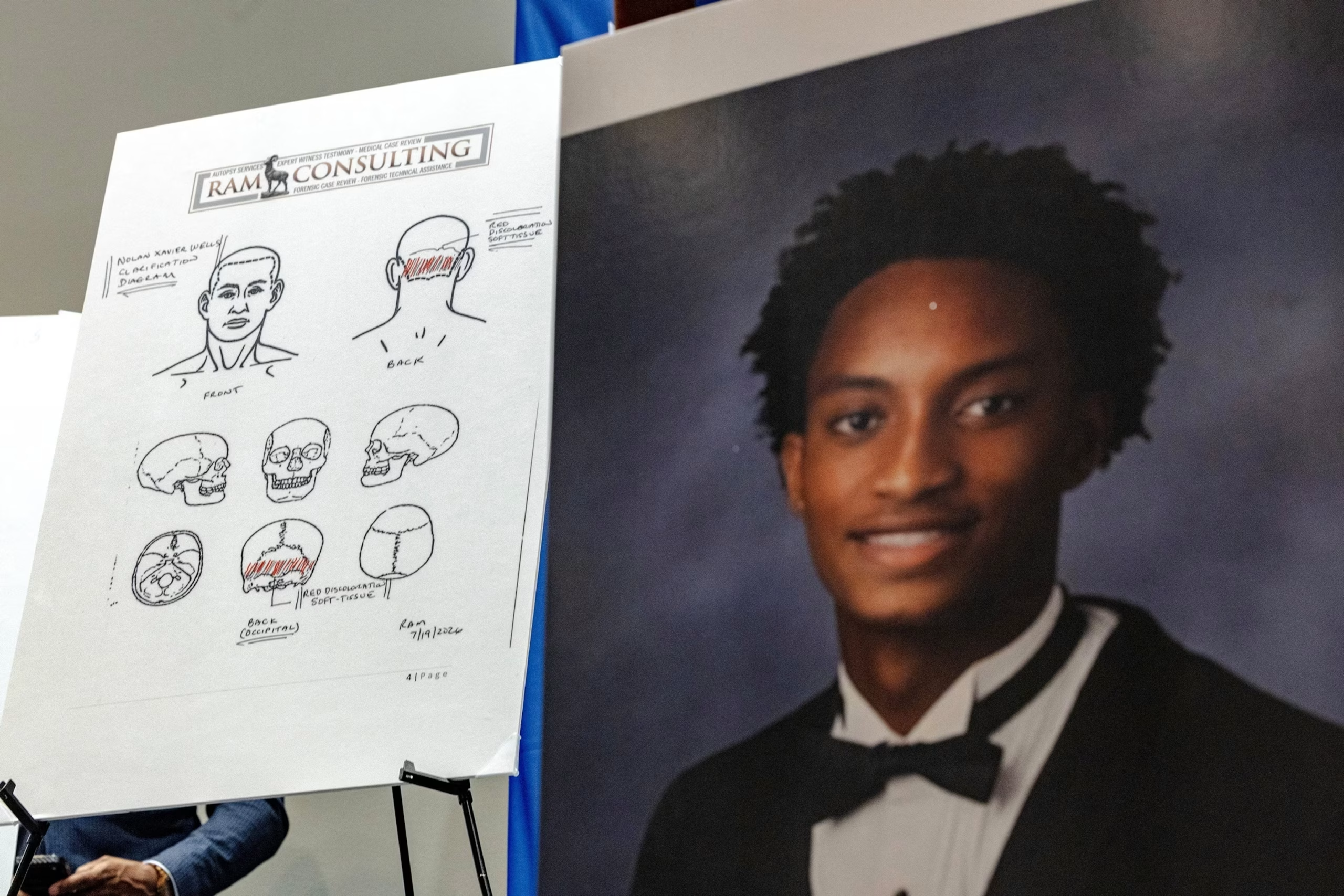
An independent autopsy commissioned by the family and performed by forensic pathologist Dr. Roger A. Mitchell Jr. (with funding support that included Colin Kaepernick) concluded that the cause and manner of death were “undetermined pending further investigation.” Mitchell noted a red discoloration in the deep soft tissue at the back of Wells’ skull that was difficult to interpret amid decomposition, the absence of certain structures (including parts of the throat retained by the state medical examiner, which Mitchell described as common practice), and the inability to determine whether Wells was conscious when he entered the water. Mitchell stated he could not rule out the possibility that non-accidental factors contributed to or caused the death. The official state autopsy results and toxicology findings have not been publicly released as of late July 2026.
Hudson has pushed back against online rumors and speculation that have targeted him and the other young people on the trip. In comments to the New York Post he called the accusations “hurtful” and “terrible,” saying, “It’s a sick world we’re living in… Nolan was my best friend. There’s no facts out, just a lot of rumors.” He has maintained that the group was focused on saving the boat in an emergency and that Wells made a clear choice to stay. Hudson also described the water around Horn Island as having rapid depth changes and a strong current, conditions local officials have acknowledged can be dangerous.
The Jackson County Sheriff’s Office, led by Sheriff John Ledbetter, has conducted dozens of interviews, collected pH๏τos and videos from the island that day, and continues to investigate. Officials have urged anyone who was on or near the northwest tip of Horn Island on July 4 to come forward with relevant material, particularly anything depicting altercations or showing Wells. The case is expected to be presented to a grand jury once the investigative file is complete. Mississippi Department of Public Safety leadership has stated there is currently “no indication” that race played a role, though the optics of a Black teenager traveling with predominantly white friends and not returning with them have fueled public discussion given Mississippi’s history.
Wells was laid to rest in mid-July at a well-attended funeral in his hometown. His mother asked mourners to keep Nolan’s memory alive. In public statements she has described her son as a special soul who always encouraged and uplifted others, and she has continued to seek a thorough, transparent investigation.
Hudson’s recent public statements represent the most detailed firsthand account yet from someone who was present in the final hours. They paint a picture of a crowded, festive, alcohol-fueled holiday on a remote island, a mechanical emergency that forced a rapid departure, repeated verbal pleas for Wells to board the boat, and a decision by the 18-year-old to remain with new acquaintances. Whether that decision, the conditions of the water and current, or other factors still under investigation led to his death remains unresolved. Wells’ family continues to question the completeness of the narrative that he simply chose to stay and later drowned. As the official investigation proceeds and additional forensic results are awaited, the gap between Hudson’s account and the family’s doubts remains one of the central tensions in a case that has gripped the Gulf Coast and beyond.
The story of Nolan Wells is, at its core, the story of an 18-year-old who set out on a bright summer holiday with friends and never came home. Warren Hudson’s claim that he and others begged Wells to “get on the boat” now stands as a key piece of the public record. Whether it fully explains the tragedy, or whether further evidence will alter the picture, is a question that investigators, a grand jury, and ultimately the family still seek to answer.