The Science of Human Tails: A Rare and Fascinating Evolutionary Echo
The Science of Human Tails: A Rare and Fascinating Evolutionary Echo
Every human being on Earth started life with a tail.
During the first few weeks of embryonic development, all human embryos grow a small, tail-like structure that closely resembles those found in other mammals. By the eighth week of pregnancy, however, a process called apoptosis (programmed cell death) typically kicks in, causing this structure to shrink and dissolve into what we eventually know as the tailbone, or coccyx.
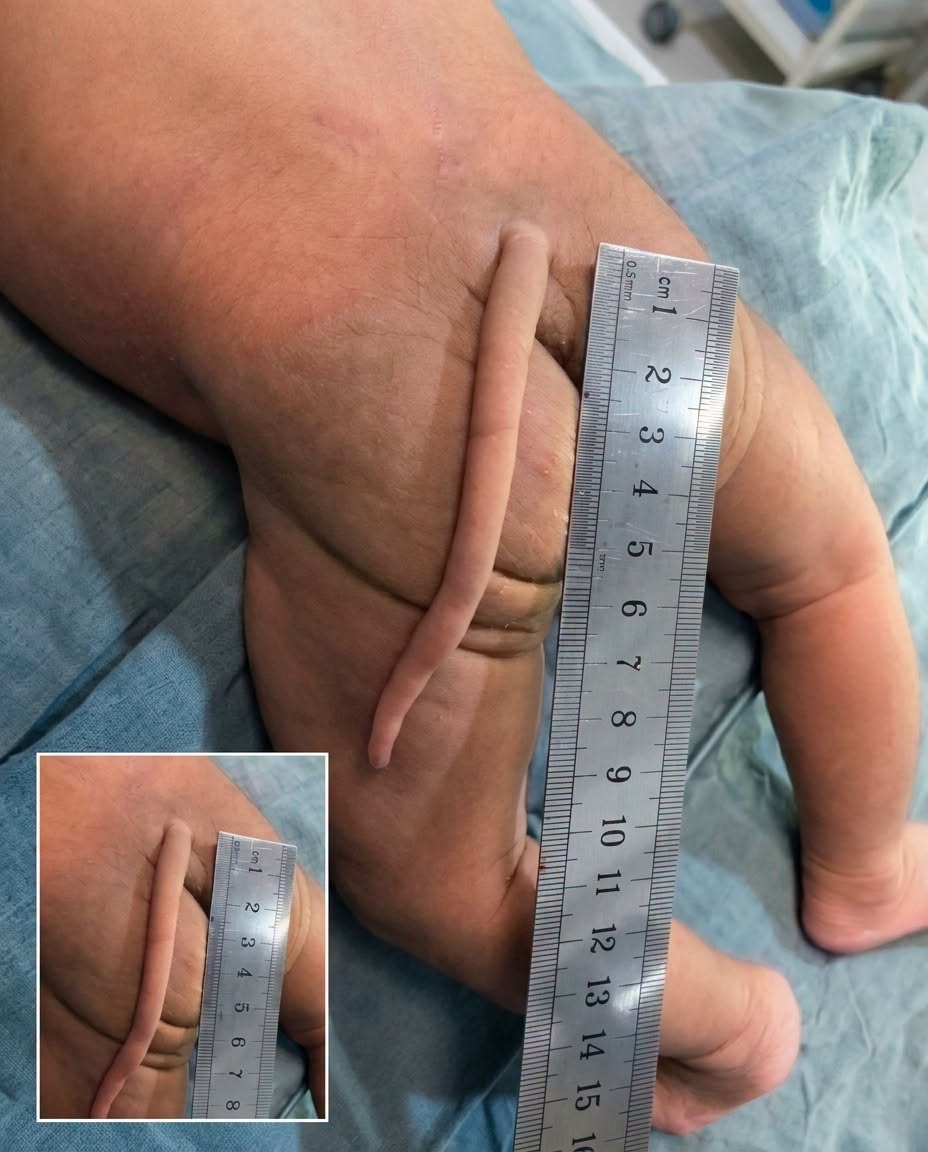
But nature occasionally takes an unexpected detour. In incredibly rare instances, a baby is born with what science calls a vestigial tail—a living, striking echo of our evolutionary past.
What Exactly Is a Human Tail?
A true vestigial human tail emerges directly from the most distal (outermost) remnant of the embryonic tail. It typically grows in the sacrococcygeal region—right at the base of the spine, near the tailbone.
While it looks like a miniature animal tail, its internal anatomy is distinctly human. A typical vestigial tail is covered in normal skin and contains a complex mix of:
-
Adipose tissue (fat cells)
-
Connective tissue and blood vessels
-
Striated muscle fibers and nerves
Because these structures contain muscle fibers and nerve pathways, many of these tails can actually move, twitch, and contract involuntarily or in response to emotional stimuli, much like a muscle spasm. Statistically, this rare genetic alteration presents itself twice as often in males as it does in females.
True Tails vs. Pseudo-Tails
In medical literature, it is crucial to separate a true vestigial tail from a pseudo-tail.
The Medical Distinction: A true vestigial tail is an isolated, benign genetic retention containing only fat, muscle, and tissue. A pseudo-tail, on the other hand, is often an extension of a spinal abnormality, such as spina bifida or a lipoma attached to the spinal cord, and may contain actual bone or spinal fluid.
Because true vestigial tails lack vertebrae (bones) or a connection to the central nervous system, they are generally harmless anomalies rather than painful or dangerous conditions.
How is it Treated?
For the vast majority of families, the solution is straightforward and entirely cosmetic.
Because true human tails are composed primarily of soft adipose and muscle tissue without spinal cord involvement, they can be surgically removed shortly after birth. The extraction is typically uncomplicated, leaving behind a minor scar and zero residual side effects. The child goes on to live a perfectly normal, typical life.
However, medical history shows that not everyone opts for surgery. There are recorded cases of adults who have chosen to keep their vestigial tails into maturity, treating them as a unique, highly personal biological signature.
A Window Into Our Past
The human tail remains one of the most fascinating topics in modern biotechnology and anatomy. It serves as a living reminder that our DNA still holds the silent blueprints of our ancient ancestors.
It is an early, beautiful, and harmless step back into evolutionary history—showing us that even in a world of precision medicine, nature still knows how to surprise us. 🧬
Had you ever heard of a true human vestigial tail before? Do you find these rare evolutionary throwbacks as fascinating as we do? Let’s get a conversation going in the comments below!