The Short Life and Rushed Death of George Stinney Jr.: When Speed Replaced Justice
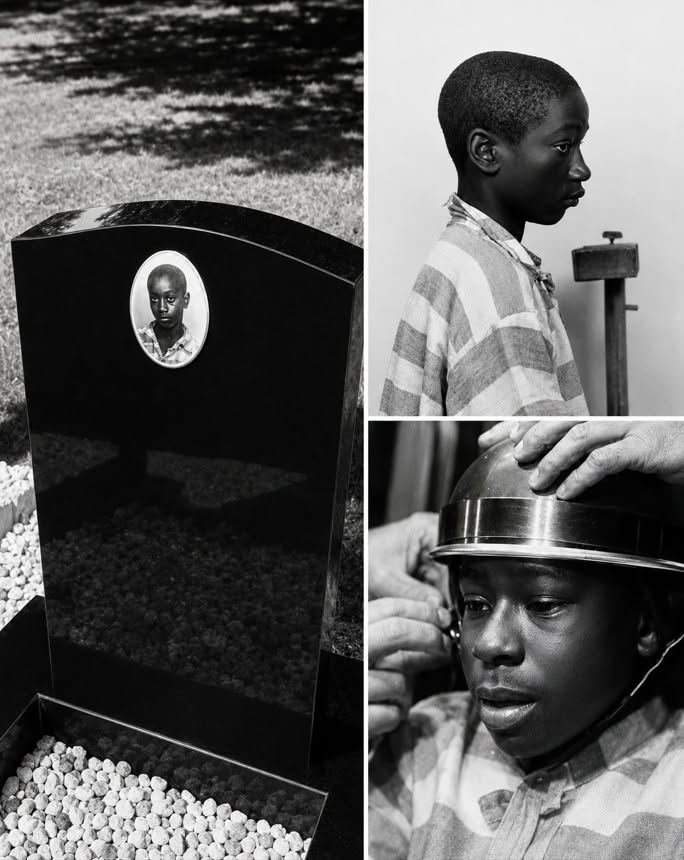
The Short Life and Rushed Death of George Stinney Jr.: When Speed Replaced Justice
How do you execute a child when there is no physical evidence tying him to a crime?
In 1944, the State of South Carolina did exactly that.
At just fourteen years old, George Stinney Jr. became the youngest person executed in the United States during the twentieth century. His story remains one of the most agonizing examples in American history of how fear, racial prejudice, and a broken legal system can destroy a life before the truth ever has a chance to be heard.
A Town Shaken by Tragedy
In March 1944, the small mill town of Alcolu, South Carolina, was upended by the horrific murder of two young white girls: eleven-year-old Betty June Binnicker and seven-year-old Mary Emma Thames. After disappearing on their bicycles, their bodies were discovered the following day in a ditch.
The community demanded immediate answers. Law enforcement demanded a suspect.
Before long, their attention turned to a Black teenager who lived nearby, simply because he had crossed paths with the girls the day before and spoken to them. That teenager was George Stinney Jr.
He was a child. He was fourteen.
A Defense That Didn’t Defend
The legal process that followed moved with a terrifying, breathless speed.
Upon his arrest, George was immediately separated from his family and held in a facility miles away. Fearing for their lives amidst violent threats, George’s parents and siblings were forced to flee the area overnight. George was left entirely alone to face the machinery of the state.
When the case went to trial, the lack of due process was staggering:
-
Zero Physical Evidence: There were no fingerprints, no eyewitnesses, and no forensic proof linking George to the murders.
-
The “Confession”: The prosecution’s entire case rested on an alleged confession that was never recorded, never signed, and heavily disputed.
-
No Defense: George’s court-appointed attorney, a local politician, called few to no witnesses and mounted virtually no defense.
On April 24, 1944, in a courtroom packed with white spectators and before an entirely white jury, the trial took only a few hours. The jury deliberated for a mere 10 minutes before returning a guilty verdict.
The sentence was death.
June 16, 1944: Too Young to Live, Old Enough to Die
Less than three months after his arrest, George Stinney Jr. was led into the execution chamber at the South Carolina State Penitentiary.
George’s frail, 95-pound frame was so small that the executioners faced practical difficulties. Guard accounts from the time note that books—often reported to be a Bible or a telephone directory—had to be used as a booster seat to lift him high enough to fit the heavy execution gear.
A child was executed by the state, and the book was closed. Or so they thought.
The 70-Year Fight for a Flawed Verdict
For decades, George’s family refused to let his story die in that chamber. Historians, civil rights advocates, and legal scholars slowly peeled back the layers of the investigation, exposing the glaring inequalities and total absence of consтιтutional protections.
Finally, seventy years later, a South Carolina court took an extraordinary step.
In 2014, Judge Carmen Mullen officially vacated George Stinney Jr.’s conviction. The court ruled that he had been denied a fair trial, noting that his progression from arrest to execution was a violation of his fundamental consтιтutional rights.
“Justice had failed. But some wrongs cannot be undone. A court order could overturn a conviction, but it could not restore a childhood.”
The Questions That Remain
Today, George Stinney Jr.’s case stands as a stark, haunting reminder of the dangers of rushed justice, systemic racial bias, and an uncritical rush to judgment. It forces us to confront uncomfortable, heavy questions that still echo across generations:
-
How could a legal system value speed over human life?
-
How could a conviction rest on evidence so fragile?
-
How many opportunities for true justice were lost simply because of the color of a child’s skin?
George Stinney Jr. died in 1944. His conviction was wiped away in 2014. But the debate over what happened in that small South Carolina town—and what it reveals about the history of criminal justice—continues to this day. 🕯️
George Stinney Jr.’s story is a heavy chapter in history, but one that must never be forgotten. How do you feel we can best honor the legacies of those failed by the justice system in the past? Let’s discuss respectfully in the comments below.