Mary Schweitzer’s Dinosaur Soft Tissue Discovery Ignites Global Holy War Between Faith and Evolution.lh

Mary Schweitzer’s Dinosaur Soft Tissue Discovery Ignites Global Holy War Between Faith and Evolution
In 2005, paleontologist Mary Schweitzer stunned the scientific world when she reported flexible, branching blood-vessel-like structures and possible red blood cells inside the 68-million-year-old femur of a Tyrannosaurus rex from Montana’s Hell Creek Formation. Published in Science, the find was hailed as one of the most extraordinary examples of soft-tissue preservation ever recorded.
Creationist groups immediately seized on the discovery, declaring it “proof” that the bone could not be 68 million years old and that the Earth must be young. Online campaigns, documentaries, and viral posts framed the preserved vessels as irrefutable evidence against evolution and deep time, sparking heated online debates and renewed attacks on radiometric dating.
Scientists, however, offered a very different explanation. Subsequent research showed that iron from the dinosaur’s own blood acted as a natural fixative, cross-linking proteins in a manner similar to formaldehyde and dramatically slowing decay. Rapid burial in fine sediment and partial mineral replacement further stabilized the tissue. Similar soft-tissue preservation has now been documented in many other Mesozoic and even older fossils, confirming it is a rare but repeatable taphonomic phenomenon, not evidence of recent burial.
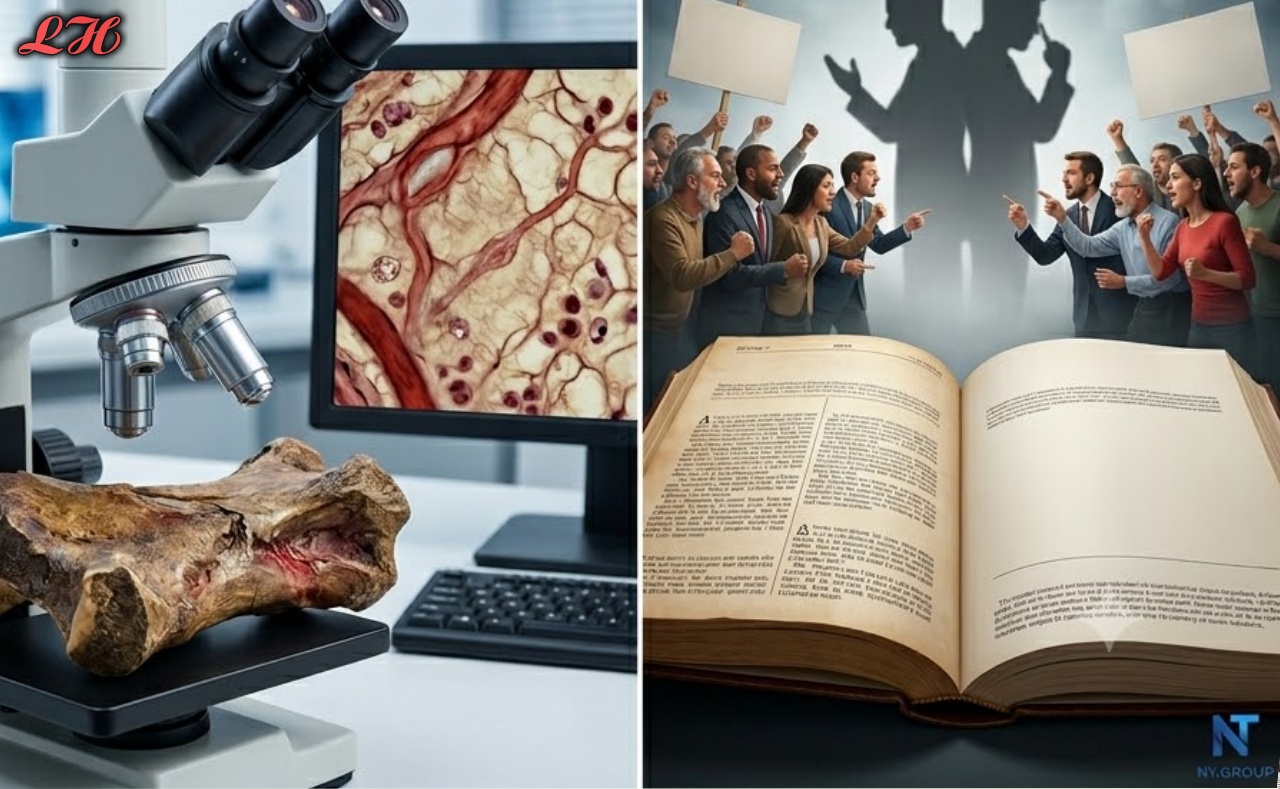
No peer-reviewed study has concluded that the vessels prove a young Earth. Multiple independent dating methods — radiometric, biostratigraphic, and geochemical — consistently place the Hell Creek Formation in the Late Cretaceous. The structures are chemically altered and mineralised, not fresh modern tissue.
Far from igniting a holy war within science, Schweitzer’s discovery has expanded our understanding of fossilisation and opened new avenues for molecular palaeontology. The real story is not a clash between faith and evolution, but a testament to how exceptional preservation can survive deep time — a finding that strengthens, rather than threatens, our understanding of Earth’s 4.5-billion-year history.