Ancient Hand Fossil from Kenya Reignites Debate Over Early Tool Use in Human Evolution
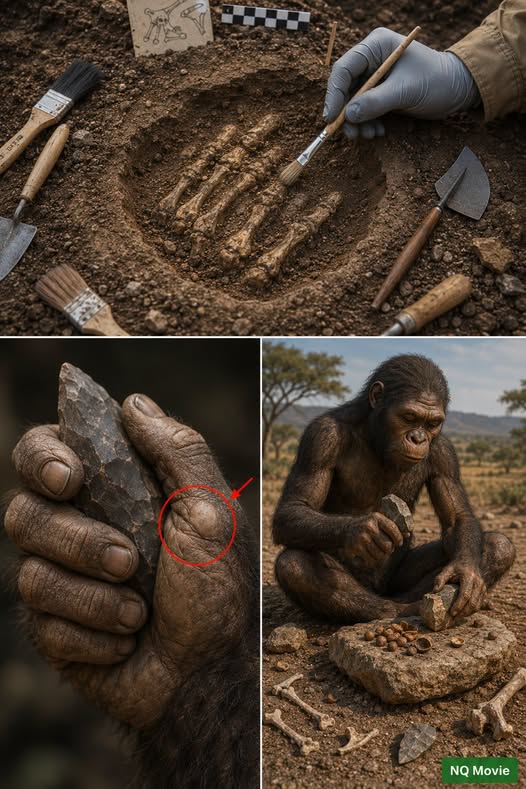
A 1.52-million-year-old hand fossil discovered in Kenya is prompting renewed discussion among paleoanthropologists about who the earliest toolmakers in human evolution may have been. Initially attributed to Paranthropus boisei, the specimen is being examined for what it may reveal about the physical capabilities and behavioral potential of non-Homo hominin species during the Early Pleistocene.
The fossilized hand shows a combination of robust bone structure and features that some researchers interpret as compatible with a degree of fine motor control. This mix of strength and possible dexterity has led to questions about whether species outside the Homo lineage could have manipulated objects with enough precision to engage in early forms of stone tool use.
For decades, the dominant scientific view has ᴀssociated more advanced tool production with early members of the genus Homo, such as Homo habilis and later Homo erectus. These species have been widely considered central to the development of systematic toolmaking traditions, based on both fossil evidence and archaeological stone tool ᴀssemblages found across Africa.
However, the new interpretation of the Kenyan hand fossil adds to a growing body of research suggesting that the story may be more complex. If Paranthropus boisei or closely related species possessed greater manual dexterity than previously ᴀssumed, it could indicate that tool use was not exclusive to a single evolutionary branch but may have been a broader behavioral trait among multiple hominin groups.
Researchers caution that the evidence remains incomplete. Hand morphology alone cannot definitively prove toolmaking behavior, as anatomical capability does not necessarily equate to habitual or sophisticated tool production. Direct ᴀssociation between skeletal remains and stone tools at archaeological sites is required to strengthen such claims.
Nevertheless, the discovery contributes to an evolving perspective in paleoanthropology: early human evolution was likely not a simple division between “toolmakers” and “non-toolmakers,” but rather a spectrum of behavioral abilities shared across different species. Environmental pressures, overlapping habitats, and possible interaction between hominin groups may have encouraged multiple evolutionary experiments in tool-related behavior.
If further analysis supports these interpretations, it could expand the range of species considered capable of contributing to early technological development. This would further blur the traditional boundaries drawn between the genus Homo and other contemporaneous hominins.
Ongoing research, including comparative anatomy and contextual archaeological studies, will be essential to determine how this fossil fits into the broader picture of human evolution. For now, it stands as another reminder that the origins of tool use—and by extension human technological behavior—may have been more widespread and complex than previously ᴀssumed.