❄️ PART 3 — THE SECRET THE MOUNTAIN HAD KEPT FOR THIRTY YEARS
❄️ PART 3 — THE SECRET THE MOUNTAIN HAD KEPT FOR THIRTY YEARS
Eleanor followed Reverend Whitmore to the church the next morning.
The building was crowded.
Families who had once laughed at her cave now sat shoulder to shoulder beneath the cold rafters. Some had brought children. Others carried blankets and small bundles of possessions.
Walter and Agnes Marsh were there too.
Walter looked stronger than he had several days earlier, but Agnes avoided Eleanor’s eyes.
At the front of the room stood Margaret Holt.
Beside her was a stranger wearing a dark coat and carrying a leather surveyor’s case.
Margaret spoke before Eleanor had even removed her gloves.
“We have a serious problem.”
Eleanor waited.
Margaret gestured toward the stranger.
“This is Mr. Gideon Price. He represents a group of property investors from Harrisburg.”
Price opened his case.
“Mrs. Marsh, the land where your cave stands has been incorrectly recorded.”
Eleanor stared at him.
“My name is Eleanor Marsh. And I have a deed.”
“An incomplete deed,” he replied.
Margaret stepped forward.
“The cave was part of the old Marsh estate. Walter gave you temporary permission to occupy it, but that arrangement was never intended to become permanent.”
Eleanor looked toward her father-in-law.
“Is that true?”
Walter shifted uncomfortably.
“I signed the papers they gave me.”
“What papers?”
Price produced a document.
“This agreement states that the five acres were transferred for temporary use only, pending a proper survey.”
Eleanor examined the page.
The signature resembled Walter’s.
But something was wrong.
The date was written in a different ink, and the description of the property included a boundary that Eleanor had never seen before.
“Where is the original deed?” she asked.
Price closed the folder.
“This document is sufficient for our purposes.”
“No,” Eleanor replied. “It isn’t.”
Margaret’s expression sharpened.
“You should be grateful that anyone is discussing this with you at all.”
Eleanor looked around the church.
“Three months ago, you told everyone I was foolish for choosing the cave. Now that it has survived the storm, you suddenly want it back.”
Margaret flushed.
“Don’t make accusations you cannot prove.”
“I haven’t accused anyone. I’ve asked to see the original papers.”
Price stepped forward.
“The matter will be handled by the county.”
Eleanor turned toward Reverend Whitmore.
“Then I would like the county clerk to examine both documents.”
The reverend nodded slowly.
“That seems reasonable.”
Margaret looked furious.
But Price gathered his papers and announced that the survey would proceed once the roads were pᴀssable.
Eleanor returned to the cave with more questions than answers.
That evening, she took Silas’s old map from its hiding place.
The faded lines showed three pᴀssages beneath the limestone hillside.
One was marked for air.
Another for water.
The third had a symbol Eleanor could not understand.
Beside it were the words:
RECORDS — WEST CHAMBER.
She had never explored that pᴀssage.
Silas had warned her that some parts of the cave were unstable and should not be entered without proper knowledge.
But now she wondered whether the answer to the property dispute lay inside.
She waited until Caleb arrived the following morning.
He had been helping the other families and had promised to bring additional tools.
“There’s something I need you to see,” Eleanor said.
She showed him the map.
Caleb examined it carefully.
“Do you think there’s really another chamber?”
“I don’t know.”
“Then we should ask someone who understands caves.”
Eleanor nodded.
They visited an experienced local stoneworker named Thomas Greer, who examined the drawing and agreed to inspect the accessible areas with them.
He warned them not to enter any unstable pᴀssage or remove supporting stones.
When they reached the western chamber, Thomas studied the rock formations for nearly an hour.
“There is a cavity behind this section,” he finally said. “But we won’t open it until we’re certain the surrounding stone is secure.”
Eleanor looked at the map.
“Could it be the records room?”
“Possibly.”
Thomas examined the old markings again.
“Whoever made this map understood the mountain well.”
They arranged for a careful inspection after the weather improved.
But before they could leave, Eleanor noticed something beneath a loose stone near the chamber entrance.
A small metal container.
Thomas helped her lift it out.
Inside was a bundle of papers wrapped in oilcloth.
The oldest document carried a date from 1826.
It was a deed.
Eleanor read the first paragraph.
Then she read it again.
The land surrounding the cave had originally been granted to a family named William and Sarah Whitmore.
The document described a public winter refuge built into the limestone hillside, intended to shelter travelers during severe storms.
The cave, its water source, and the surrounding land were not to be sold separately.
They were to remain available to the families of the valley.
Eleanor looked up.
“Reverend Whitmore?”
Thomas nodded.
“Perhaps the reverend’s family has known about this for generations.”
But there was another page.
It was a later agreement, signed by several local landowners.
One signature belonged to Eleanor’s late father-in-law.
Walter Marsh.
The agreement stated that the original refuge had been closed after a dispute over ownership. But it also confirmed that the cave and spring were protected by the original grant.
Eleanor felt her hands tremble.
Walter had known.
He had given her the cave while knowing that its history might make it far more valuable than the rest of his property.
And Margaret Holt had apparently known too.
The final document was a letter.
Its handwriting was unfamiliar.
To whoever discovers these records,
The refuge was never intended to belong to one family. It was built because winter does not choose between rich and poor.
If the cave remains standing, keep its entrance open to those who need shelter.
If anyone attempts to claim it for private profit, the original agreement must be presented before the county.
Eleanor lowered the letter.
For a long time, nobody spoke.
Then Caleb noticed a second sheet tucked behind it.
It was a handwritten list of names.
Among them were William Whitmore, Walter Marsh, and a name Eleanor recognized from the surveyor’s document.
Gideon Price.
But the date beside his name was 1831.
The surveyor currently claiming the cave was not the first man with that name to be involved.
Thomas examined the page.
“This could be a relative.”
Eleanor shook her head.
“Perhaps. But why would the same family appear in both documents?”
They returned to the church with copies of the records.
Walter was waiting outside.
When he saw the papers in Eleanor’s hands, his face changed.
“Where did you find those?”
“In the western chamber.”
He looked toward the ground.
“Your father knew about the agreement,” Eleanor continued. “Why didn’t you tell me?”
Walter’s shoulders sagged.
“Because I was afraid.”
“Of what?”
“Losing the land. The spring. Everything.”
Eleanor stared at him.
“You told me the cave was worthless.”
“I thought the old agreement had been destroyed.”
“And Margaret?”
Walter hesitated.
“She knew about the spring. She has been trying to purchase the surrounding property for years.”
Eleanor looked toward the church.
“Why?”
Walter’s answer came quietly.
“Because the spring never freezes. And beneath the cave is a natural water channel that feeds several farms in this valley.”
Suddenly, the stranger’s interest in her land made sense.
The cave was not worthless.
It was the key to a water source that could change the future of the entire settlement.
But there was one final detail.
Walter reached into his coat and produced a folded letter.
“Margaret gave me this before the storm. She said it was proof that the old agreement had been canceled.”
Eleanor unfolded it.
The letter bore the seal of a county office.
But the signature at the bottom did not belong to any official she recognized.
Instead, it was signed by Gideon Price.
And beneath his name was a handwritten instruction:
Remove the old records before the spring inspection.
Eleanor looked up.
“Walter, when did you receive this?”
“Three weeks before the blizzard.”
Her stomach тιԍнтened.
Three weeks before the storm, someone had already planned to remove the records.
And if Margaret and Price were willing to erase the history of the cave, what else were they hiding?
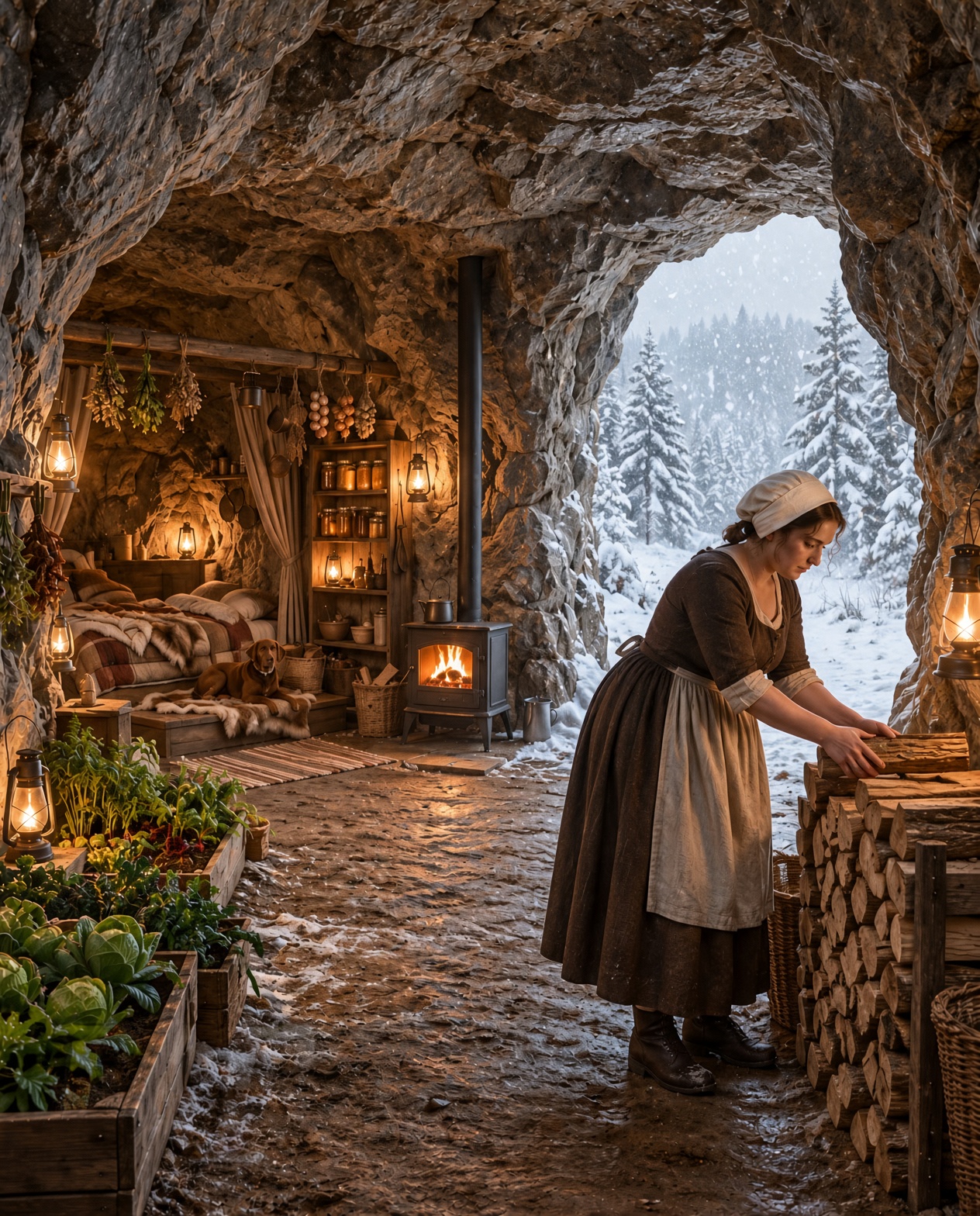
That evening, Eleanor returned to her shelter.
She stood at the entrance, watching the last sunlight fade over the snow-covered valley.
She had once believed the cave was simply a place to survive.
Now she understood that it had been built to protect far more than one widow.
It belonged to a promise made generations earlier.
A promise that no traveler should ever be turned away from shelter during winter.
But as she entered, she noticed something disturbing.
The wooden barrier had been disturbed.
Ash was growling near the western chamber.
And in the fresh snow outside the entrance were the tracks of two horses.
Someone had been there while she was away.
Eleanor lifted her lantern and approached the old records.
The container was still in place.
The documents were untouched.
But a new note had been left on top.
It contained only seven words:
Give us the spring, or lose the cave.
And beneath those words was Margaret Holt’s unmistakable signature.
Eleanor folded the note carefully.
She was no longer simply protecting her home.
She was protecting a refuge that belonged to everyone.
And she had just discovered that the people trying to take it were willing to do almost anything to keep its true history buried.
TO BE CONTINUED IN PART 4…