The Unstoppable Baby and His Gorilla Guardian: A Hilarious Showdown in Baby’s Day Out
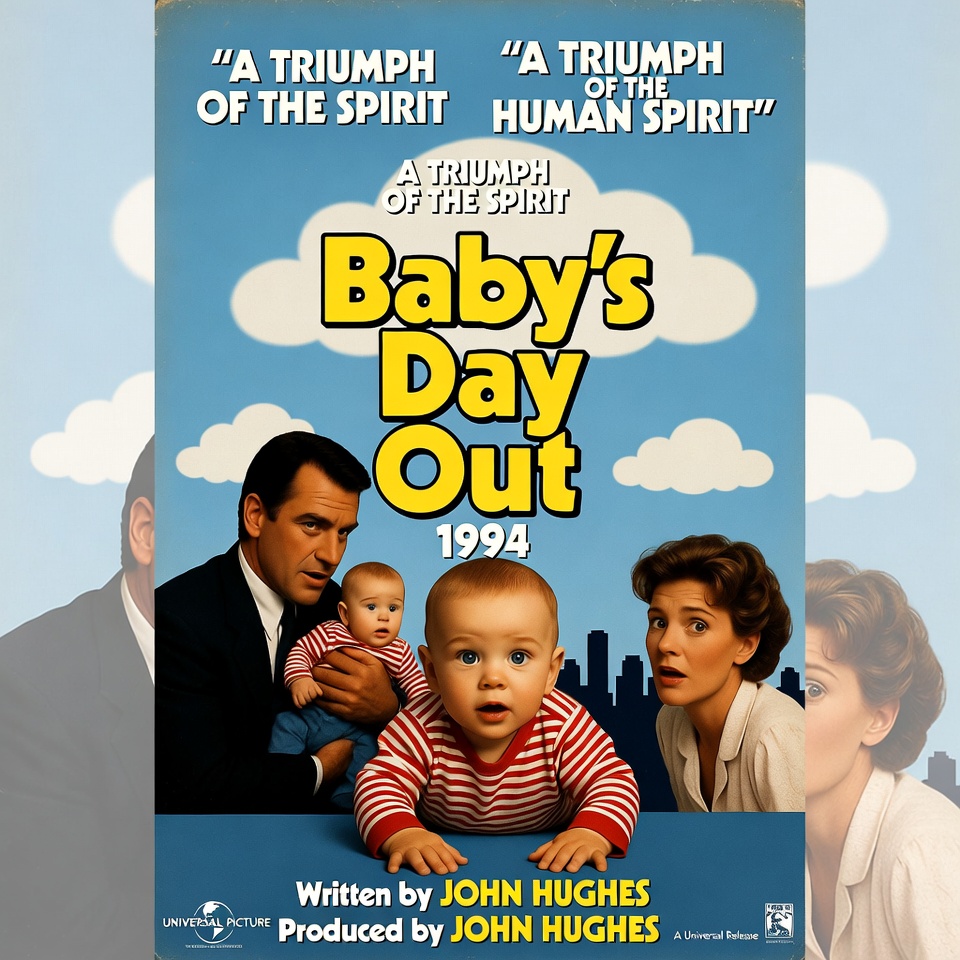
Baby’s Day Out is a delightful 1994 American family comedy that turns a simple kidnapping premise into an outrageous, slapstick-filled odyssey across the streets of Chicago. Directed by Patrick Read Johnson and produced by the legendary John Hughes, the film follows the misadventures of nine-month-old Bennington Austin “Bink” Cotwell IV, a wealthy infant whose innocent curiosity proves far more powerful than the schemes of three bumbling adult criminals.
The story begins in a luxurious mansion where Baby Bink lives with his loving but socially prominent parents, Laraine and Bennington Cotwell III. As the family prepares for Bink to appear in the local newspaper’s social pages, three dim-witted crooks—Eddie Mancuso (Joe Mantegna), Norby LeBlaw (Joe Pantoliano), and Veeko Riley (Brian Haley)—disguise themselves as baby photographers. They successfully abduct the infant and demand a $5 million ransom. What seems like an easy payday quickly unravels when the kidnappers prove utterly incompetent at handling their tiny hostage.
At their rundown hideout, Norby tries to quiet the baby by reading his favorite bedtime storybook, Baby’s Day Out. Bored by the repetitive tale, Norby falls asleep, giving Bink the perfect opportunity to crawl away unnoticed. From this moment, the film transforms into a madcap chase as the baby embarks on a solo adventure through the big city, blissfully unaware of the danger. Guided purely by the pages of his beloved book, Bink treats the urban landscape like a real-life storybook come alive.
The baby’s journey takes him through a series of increasingly absurd and perilous situations. He boards a public bus, wanders into a bustling department store where staff mistake him for a lost child from the daycare center, and even hitches a ride in a taxi. Each stop mirrors a scene from his storybook: a crowded store becomes a grand exploration, while the outside world offers endless wonders for his innocent eyes. Bink remains miraculously unscathed throughout—falling from heights, crawling through traffic, or navigating construction zones—earning him a reputation as cinema’s ultimate baby with “plot armor.”
Meanwhile, the three kidnappers suffer one humiliating disaster after another in their frantic attempts to recapture him. They step on nails, crash into obstacles, get attacked by animals, endure physical injuries, and face escalating frustration as their ransom plan crumbles. The contrast between the baby’s cheerful, fearless demeanor and the adults’ cartoonish suffering provides the film’s core comedic engine. Joe Mantegna leads the trio with sharp timing as the exasperated Eddie, while Pantoliano and Haley deliver perfect supporting slapstick as the even more hapless Norby and Veeko.
One of the film’s most memorable sequences occurs at the zoo, where Bink finds himself in the company of a gentle western lowland gorilla. The massive primate displays a surprisingly protective and paternal instinct toward the tiny intruder, creating a heartwarming yet hilarious moment amid the chaos. The kidnappers’ attempts to retrieve the baby from the enclosure only lead to further comedic failures, highlighting the film’s theme that innocence often triumphs over malice.
As the pursuit intensifies, both the police and the baby’s frantic parents join the city-wide search. Bink’s adventure culminates at a busy construction site, where the final confrontations push the slapstick humor to its peak. Throughout it all, the baby continues his day out with wide-eyed wonder, treating every obstacle like another page in his storybook. The adults, exhausted and defeated, eventually realize the futility of their efforts.
Beyond the broad physical comedy, Baby’s Day Out offers a gentle celebration of childhood innocence and the power of imagination. From Bink’s perspective, the dangerous city becomes a playground of discovery. The film subtly underscores the importance of family and the idea that even the smallest among us can outsmart the world through pure, unfiltered curiosity. John Hughes’ influence is evident in the blend of heartfelt family moments with over-the-top humor, much like his earlier hits such as Home Alone.
Upon its initial release, the movie received mixed reviews and modest box office returns, but it found a devoted audience on home video and cable television. Today, it stands as a nostalgic gem of 1990s family entertainment, praised for its practical effects, charming lead performance (delivered by twin babies Adam and Jacob Worton), and relentless comedic energy.
Baby’s Day Out reminds viewers that sometimes the best adventures are the unplanned ones. In an era dominated by CGI spectacles, its old-school slapstick and character-driven laughs feel refreshingly simple and joyful. Whether you’re watching it for the first time or revisiting a childhood favorite, the film delivers pure escapist fun centered on one unstoppable baby who turns an entire city upside down—one crawl at a time.