“Little Girls Brilliantly Trick Confederate Officers – Jaw-Dropping Bluff Scene”
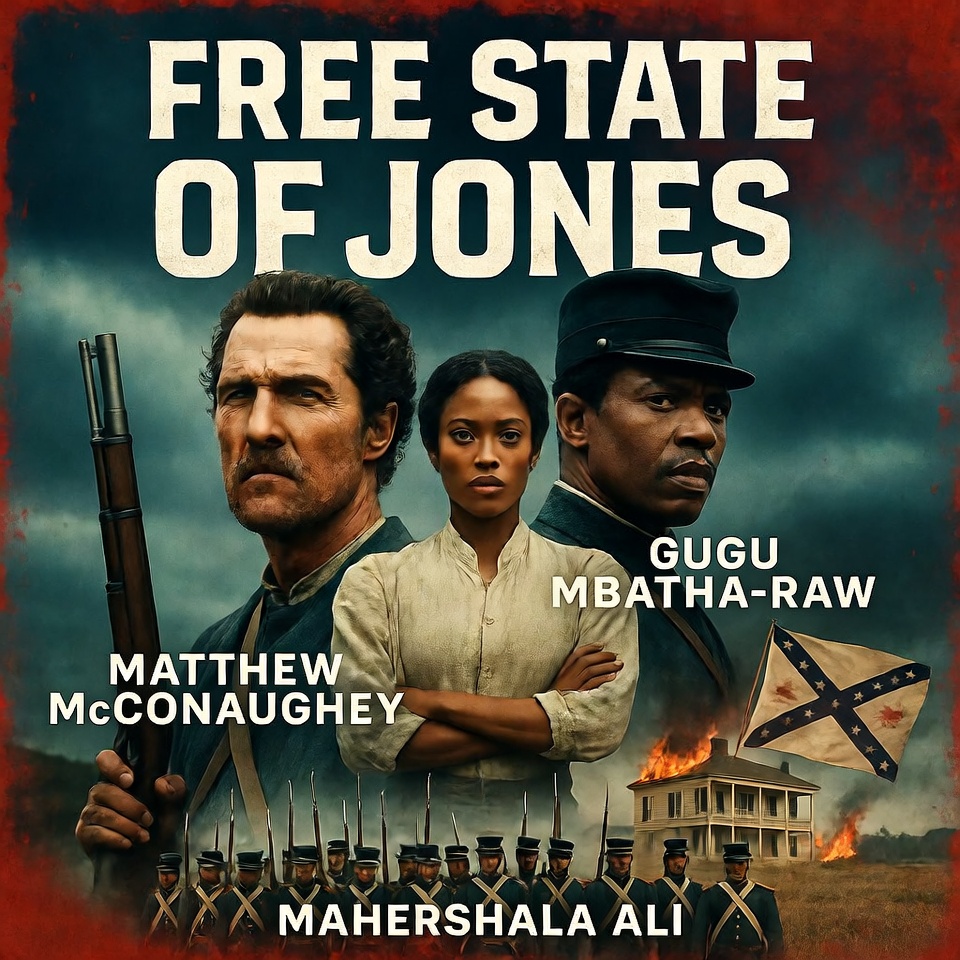
In the 2016 historical war drama Free State of Jones, directed by Gary Ross and starring Matthew McConaughey, one of the most tense and memorable sequences captures the raw ingenuity and quiet bravery of ordinary people resisting oppression during the American Civil War. A short clip circulating on YouTube perfectly encapsulates this spirit: three young girls, armed with rifles, successfully trick a group of approaching Confederate army officers into retreating without a single shot being fired. This scene, set against the backdrop of Jones County, Mississippi, highlights themes of resistance, family solidarity, and the human cost of a divided nation.
The film is based on the true story of Newton Knight (played by McConaughey), a farmer and Confederate soldier who deserted the army after witnessing the brutal realities of war and the unfair treatment of poor Southerners. Disillusioned by the Confederacy’s policies that favored wealthy plantation owners—particularly the “Twenty Negro Law” that exempted large slaveholders from military service—Knight returns home and eventually leads a rebellion. He establishes the “Free State of Jones,” a breakaway region in Mississippi where deserters, escaped slaves, and local families band together to fight against Confederate authority. The movie blends intense battle sequences with intimate moments of civilian life under siege, showing how the war tore apart communities while also forging unlikely alliances across racial and class lines.
In this particular scene, the tension builds as Confederate officers ride toward a modest home, suspecting it harbors deserters or Union sympathizers. From the officers’ perspective, the situation looks routine: a house that might yield information, supplies, or fugitives. But inside, a clever deception is already in motion. The father figure calmly instructs his three young daughters to take positions at the windows, each holding a rifle. To the approaching soldiers, it appears as though multiple armed defenders—perhaps eight or more—are guarding the property. The girls maintain composure, their small frames hidden just enough to sell the illusion of a heavily fortified position.
As the officers draw closer, dialogue crackles with suspicion and threat. One officer remarks on the “quite normal” yet unnervingly steady demeanor of the “three little girls.” Another questions why they aren’t “up north” with Union forces, while boasting about his role in tracking deserters and supplying troops. The father, staying out of sight but guiding his children, urges them to hold steady. The girls don’t flinch. Their calm presence, combined with the visible barrels of multiple guns, creates enough doubt and fear in the officers that they choose retreat over confrontation. “We’ll be back,” one warns, but the bluff has worked. Once the danger passes, the emotional release is palpable—one girl breaks into tears, revealing just how young and vulnerable they truly are. The father praises them softly: “Good job, girls,” acknowledging their extraordinary courage.
This moment is more than a simple trick; it symbolizes the broader resilience of families caught in the chaos of civil war. In Free State of Jones, women and children are not mere bystanders but active participants in survival. The Confederacy’s desperate conscription policies left many households without adult men, forcing even the youngest to shoulder immense responsibility. The scene underscores how resourcefulness—using limited means to project strength—became a form of resistance when direct combat was impossible. It also reflects the film’s nuanced portrayal of the South: not as a monolith of slaveholding elites, but as a region where poor whites, like Knight’s community, suffered under the same system that enslaved Black people and grew increasingly resentful of the planter class.
Matthew McConaughey delivers a grounded, intense performance as Knight, a man driven by moral conviction rather than political ideology. The supporting cast, including Gugu Mbatha-Raw as an escaped slave who forms a profound connection with Knight, adds emotional depth. Visually, the film employs gritty realism—mud-caked uniforms, dense swamps, and candlelit interiors—to immerse viewers in the harsh 1860s Mississippi landscape. The score, blending period folk elements with subtle tension, heightens the stakes in scenes like this one.
Beyond the immediate action, the clip resonates because it humanizes history. The American Civil War (1861–1865) claimed over 600,000 lives and left deep scars on the national psyche. Stories like the Free State of Jones rebellion remind us that the conflict wasn’t just grand battles at Gettysburg or Antietam; it was also fought in isolated farmhouses, where ordinary citizens navigated loyalty, survival, and justice. Knight’s real-life defiance, which included protecting freed Black communities and rejecting Confederate taxation, challenged the romanticized “Lost Cause” narrative long after the war ended.
Critically, Free State of Jones received mixed reviews upon release. Some praised its ambition in tackling race, class, and rebellion in one sweeping tale, while others noted its uneven pacing across a two-hour-plus runtime. Nevertheless, moments like the girls’ bluff stand out for their emotional authenticity. They illustrate how courage isn’t always about charging into battle with flags flying; sometimes, it’s about steady hands on a trigger, a calm voice under pressure, and the willingness to protect one’s home at all costs.
In today’s context, the scene continues to captivate audiences on platforms like YouTube because it speaks to universal themes: the power of deception in asymmetric conflicts, the strength found in family bonds, and the quiet heroism of those history often overlooks—especially women and children. It serves as a poignant reminder that even in the darkest chapters of human conflict, ingenuity and solidarity can turn the tide, if only for a moment.
The legacy of the Free State of Jones endures in American folklore and historical studies as a rare example of internal Southern dissent. Through films like this, we revisit not just the facts of war, but the personal stories that reveal our shared humanity. Whether viewed as a thrilling short clip or part of the full cinematic experience, this bluff scene leaves viewers with a sense of awe at the lengths people will go to defend freedom and family—values that transcend time and borders.