Breaking: How Baby Griffin Johnson Defied Deadly Heart Defects Through Expert Care and Unbreakable Family Determination
At just 22 weeks pregnant, Alison Johnson received the kind of news that stops time.
Doctors told her that her unborn son, Griffin, had multiple congenital heart defects—conditions so severe they could take his life within days of birth. In a quiet hospital room filled with clinical explanations and cautious voices, the future suddenly felt uncertain, fragile, and terrifying.
But Alison made a decision in that moment—she would fight for her son, no matter the odds.
That decision would become the foundation of a journey defined by resilience, cutting-edge medicine, and the extraordinary power of hope.
A Devastating Diagnosis Before Birth
Griffin was diagnosed with critical aortic stenosis, a condition that forces the heart to work dangerously hard to pump blood, along with a restrictive atrial septal defect that limited proper circulation. Together, these conditions created a life-threatening situation that required immediate and highly specialized care.
For Alison and her husband, the months leading up to Griffin’s birth were filled with planning, fear, and determination. They placed their trust in a multidisciplinary pediatric cardiac team at Holtz Children’s Hospital, where specialists coordinated every detail of Griffin’s care—even before he entered the world.
This early diagnosis, while devastating, became a crucial advantage. It allowed doctors to prepare a life-saving strategy the moment Griffin was born.
A Fight Begins Moments After Birth
On February 3, 2022, Griffin entered the world via C-section. Weighing nine pounds, he let out a strong cry—a small but powerful sign that he was ready to fight.
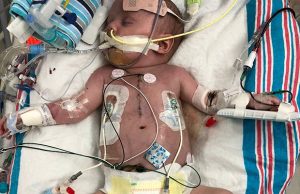
Within moments, he was intubated and rushed to the cardiac catheterization lab.
Doctors moved quickly.
Umbilical lines were placed. Machines took over vital functions. And Griffin underwent his first critical procedure: a balloon valvuloplasty to open his narrowed aortic valve and restore blood flow.
For his parents, there was no time to process emotions. Survival had already begun.
A High-Risk, High-Precision Treatment Plan
Griffin’s condition required a carefully staged approach—three major procedures over the course of his early life.
Just days after his birth, surgeons performed bilateral pulmonary artery banding to regulate blood flow to his lungs. Soon after, a stent was placed in his patent ductus arteriosus to maintain circulation.
This hybrid approach—where surgical and catheter-based techniques are used together—represented the forefront of pediatric cardiac care.
And Griffin responded.
Despite the odds, his tiny body adapted. He stabilized. He fought.
A Glimpse of Normal Life
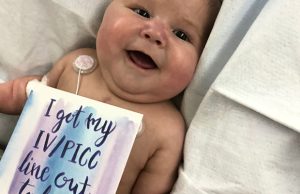
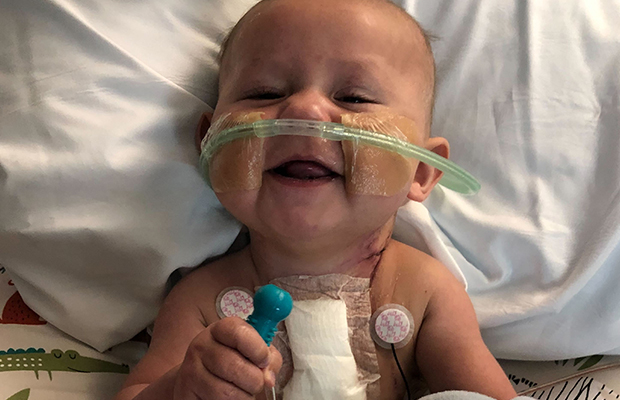
By May 2022, something remarkable happened—Griffin was strong enough to go home.
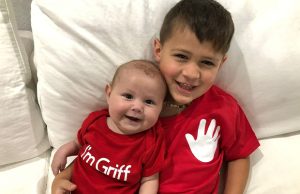
For the first time, he met his older brother. He experienced life outside hospital walls. His family celebrated moments that once felt impossible—quiet mornings, shared laughter, and the simple joy of being together.
Then came a milestone few thought he would reach:
His first birthday.
On February 3, 2023, Griffin turned one year old—a powerful symbol of survival against overwhelming odds.
The Most Complex Surgery Yet
But the journey was far from over.
Later that month, Griffin returned to the hospital for one of the most complex procedures in pediatric heart surgery: the Norwood/Glenn operation.
This surgery restructured his heart’s circulation system, removing previous bands and stents while creating a new pathway for blood flow. It was a critical step in managing his single-ventricle physiology.
The risks were immense.
The wait was agonizing.
But once again, Griffin pulled through.
After four long weeks in the hospital, he was discharged—stronger, more stable, and continuing to defy expectations.
Strength, Science, and Survival
Today, Griffin is home with his family, growing, developing, and preparing for the next step in his journey: the Fontan procedure, expected around age three.
His parents remain hopeful that this final surgery will allow him to live a healthy life without needing a heart transplant.
Behind Griffin’s survival is more than just advanced medicine.
It is the result of:
- Early prenatal diagnosis
- A highly coordinated multidisciplinary team
- Precise surgical interventions
- Continuous monitoring and follow-up care
- And above all, relentless parental advocacy
Doctors emphasize that cases like Griffin’s highlight the life-saving impact of collaboration. Surgeons, cardiologists, nurses, therapists, and support staff worked together seamlessly—each playing a vital role in his survival.
The Emotional Journey Behind the Medicine
While the medical milestones are extraordinary, the emotional journey tells an equally powerful story.
Alison describes the experience as both exhausting and transformative.
There were moments of fear so intense they felt unbearable. Nights spent waiting for updates. Days filled with uncertainty.
But there was also something else.
Hope.
Not the kind that guarantees outcomes—but the kind that keeps you going anyway.
The kind that grows stronger with every heartbeat, every small victory, every step forward.
A Story That Inspires Beyond the Hospital Walls
Griffin’s journey is more than a medical success story.
It is a testament to what is possible when expertise meets determination.
It shows how modern pediatric cardiology can transform even the most critical diagnoses into survivable conditions. It highlights the importance of early detection, specialized care, and family-centered support systems.
And most importantly, it reminds us of something deeply human:
That even the smallest hearts can carry the greatest strength.
Looking Ahead With Hope
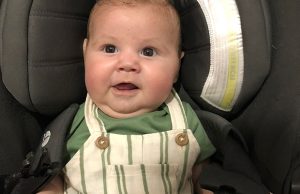
The Johnson family continues to focus on what matters most—Griffin’s growth, his happiness, and the life they are building together.
There are still challenges ahead. More procedures. More checkups. More uncertainty.
But there is also something they hold onto every day:
Griffin is here.
He is thriving.
And he is living proof that even in the face of life-threatening odds, hope—when paired with action—can change everything.
Griffin Johnson’s story is not just about survival. It’s about possibility.
And for families facing similar diagnoses, it stands as a powerful reminder:
You are not alone.And miracles, sometimes, are built one heartbeat at a time.