Rhett Ingold’s Remarkable NICU Journey: From Fragile Beginnings to a Christmas Miracle
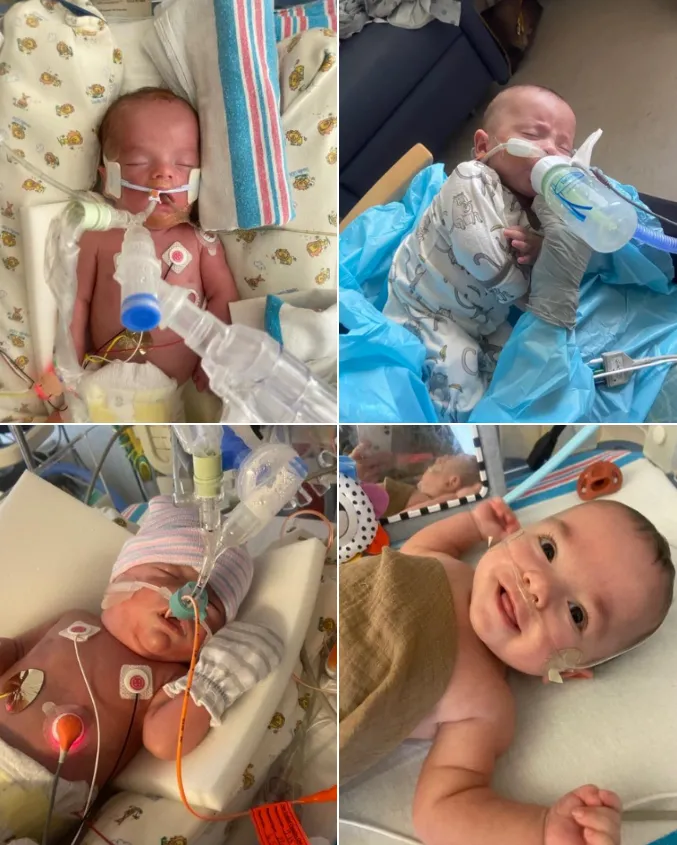
For Haley and Scott Ingold, the news of expecting their first child together in December 2022 brought immense joy and anticipation. With two daughters already filling their home with love, they looked forward to welcoming a baby boy into their family.
But what began as a hopeful pregnancy soon turned into a journey filled with uncertainty, fear, and extraordinary resilience.
A Pregnancy Marked by Concern
At Haley’s very first prenatal appointment, doctors noticed elevated blood pressure—an early warning sign that something might not be right.
She was referred to a specialist in maternal-fetal medicine, where further monitoring revealed that the baby, though stable, was measuring smaller than expected.
Despite the concerns, the family held onto hope.
A joyful gender reveal confirmed they were expecting a boy, and they named him Rhett. Excitement grew, even as the pregnancy required careful monitoring and frequent medical visits.
An Early and Urgent Arrival
By late May, at just 28 weeks of pregnancy, Haley’s condition worsened.
She was diagnosed with preeclampsia, a serious complication that can endanger both mother and baby. Doctors quickly determined that early delivery was the safest option.
On May 24, Rhett was born via emergency C-section—nearly ten weeks premature.
Weighing just over two pounds, he entered the world fighting for survival.
A Battle to Breathe
From the very beginning, Rhett faced severe respiratory challenges.
His lungs, not yet fully developed, required immediate support. Doctors placed him on a ventilator to help him breathe, later transitioning him to a CPAP machine as his condition slightly improved.
For his parents, each moment was filled with anxiety.
Every machine, every monitor, every change in his condition carried immense weight.
Just as things seemed to stabilize, Rhett developed an infection. Though initially treated successfully, his condition worsened again, requiring high-frequency oscillatory ventilation—a more advanced and intensive form of respiratory support.
The situation became critical.
A Transfer for Advanced Care
Recognizing the severity of his condition, doctors arranged an urgent transfer to the Level IV NICU at Children’s Hospital New Orleans.
There, a specialized team could provide the highest level of neonatal care, including the possibility of extracorporeal membrane oxygenation (ECMO)—a life-support treatment used in the most critical cases.
Haley and Scott arrived in New Orleans late at night, overwhelmed with fear but holding onto hope.
After careful evaluation, the medical team determined that ECMO was not yet necessary. Instead, they developed a detailed plan to support Rhett’s fragile lungs and guide his recovery step by step.

Slow but Steady Progress
Under the care of a dedicated team, Rhett began to show gradual improvement.
His journey was anything but linear—but it was moving forward.
He transitioned from the oscillator to a ventilator, then to CPAP, and eventually to a simple nasal cannula. Each step represented progress, each milestone a victory.
But breathing was only part of the challenge.
Due to prolonged intubation, Rhett developed feeding difficulties and oral aversion—making it hard for him to eat normally.
The care team introduced feeding slowly and carefully, combining breast milk with tube feeding to ensure he received the nutrition needed to grow stronger.
It was a delicate process requiring patience, consistency, and trust.
And once again, Rhett proved resilient.
The Strength of Family
Throughout the long NICU journey, Haley and Scott remained unwavering in their support.
Haley spent long days at the hospital, balancing her time between Rhett and her daughters at home. Scott visited whenever work allowed, ensuring their son always felt the presence of his parents.
Support from the Ronald McDonald House helped ease the burden, providing a place to stay close to the hospital during this challenging time.
But it wasn’t just about logistics—it was about love.
A constant, unbreakable presence that carried Rhett through his hardest days.
161 Days of Courage
Rhett’s NICU journey lasted 161 days—115 of them at Children’s Hospital New Orleans.
Over those months, he faced infections, setbacks, and countless challenges. But he also achieved incredible milestones.
From just two pounds at birth, he grew to over thirteen pounds.
From total respiratory support, he progressed to breathing with minimal assistance.
From fragile beginnings, he became stronger each day.
Every step forward was celebrated—not just by his parents, but by the entire medical team who had become like family.
A Team That Made a Difference
The NICU team did more than provide medical care.
They offered reassurance.
They communicated openly.
They showed compassion beyond measure.
Nurses and therapists went above and beyond—even checking in on Rhett during their days off. Their dedication created a support system that helped the Ingold family navigate one of the most difficult periods of their lives.
A Christmas to Remember
Today, Rhett is thriving.
His journey—from a critically ill preemie to a growing, healthy baby—is nothing short of extraordinary.
And for his family, celebrating their first Christmas together after leaving the NICU carries a meaning that words can hardly capture.
It is not just a holiday.
It is a miracle.
A celebration of life, resilience, and everything they have overcome together.
A Story of Hope
Rhett’s journey is a powerful reminder of what is possible when expert medical care meets unwavering family love.
It is a story of perseverance in the face of fear.
Of strength in the smallest of bodies.
And of hope that refuses to fade—even in the darkest moments.
Because sometimes, the greatest miracles come in the tiniest forms.