Medieval Tunnel Discovered Beneath Pagan Graves
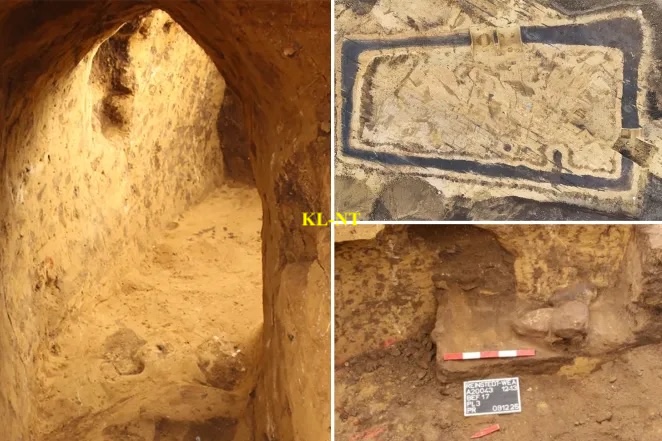
Archaeologists in Germany recently revealed a secret tunnel from the Middle Ages — a tunnel hidden within a much older burial site.
The findings were revealed in a Jan. 29 press release by the State Office for Heritage Management and Archaeology of Saxony-Anhalt (LDA Saxony-Anhalt).

The tunnel was found in the Middle Neolithic burial complex near Reinstedt, Germany. Officials estimate the burial complex was used by members of the Baalberge culture in the 4th millennium BC.
Excavators found it late last year ahead of wind turbine construction, officials said.
Some 5,000 years later, an erdstall — or underground tunnel system — was built into the loess, or compact wind-deposited silt, at the site.
The erdstall dates back to the late Middle Ages — and officials said that its purpose is unclear.


“Interpretations of erdstalls range from hiding places to spaces used for cultic activities,” the statement said.
Archaeologists initially believed the feature was a grave.
The ditch, described as “trapezoidal,” was part of a site that contained several “poorly preserved” burials that date to the Late Neolithic period of the 3rd millennium BC.
Seeing a stone slab at the northern end of the pit, archaeologists initially believed the feature was a grave — before realizing it was actually an underground tunnel.

Officials said the feature continued downward into the loess beneath the prehistoric site.
Excavators found late medieval pottery, numerous stones and small cavities in the loess fill — which made clear that the structure was an erdstall.
The underground passage contained a horseshoe and some traces of charcoal from a fire that “burned briefly,” officials said — as well as animal remains.

It appeared to be intentionally sealed, adding to the mystery of the site.
Officials said, “At the narrowest point of the entrance, an accumulation of larger stones stacked on top of one another was observed, which could indicate an intentional sealing of the entrance.”
Officials speculated the Neolithic ditch enclosure was likely still recognizable above ground during the late Middle Ages. It’s possible that the tunnel was built there because medieval Christians would have purposely avoided a pagan burial site.
The find is part of a series of recent archaeological discoveries reported across Germany.

Last summer, excavators found a mysterious Roman-era settlement site in North Rhine-Westphalia, with building remains and artifacts surviving nearly 2,000 years.
During another summer excavation, archaeologists unearthed a hoard of early medieval treasures — and a rare cross — on the banks of an inlet in northern Germany.