Ancient Roman Military Camps Discovered in Germany
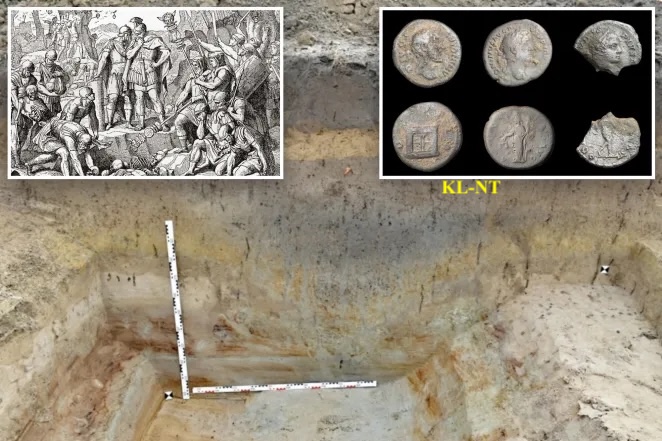
Archaeologists recently unearthed the remains of ancient Roman marching camps in Saxony-Anhalt — a first for one of Eastern Germany’s larger states.
The discovery was announced by the State Office for Heritage Management and Archaeology of Saxony-Anhalt (LDA Saxony-Anhalt) in January.
The camps were found at a site between the northern Harz Mountains and the Elbe River.
Pictures from the site show aerials of the field — as well as a cross-section of sediment layers exposed during archaeological work.

Radiocarbon analysis determined that the camps were likely established in the early third century A.D.
Officials say the site “documents Roman advances in the third century A.D.,” providing physical archaeological evidence that had previously been missing in the region.
“Until now, concrete evidence for these campaigns had been lacking in the territory of Saxony-Anhalt,” LDA Saxony-Anhalt said in a translated press release.
“In particular, the highly standardized marching camps that the Roman military constructed daily after reaching a marching destination were expected.”

Archaeologists used metal detectors to unearth over 1,500 artifacts, including nails, coins and fragments of fibulas, or brooches.
They also uncovered remnants of V-shaped defensive ditches, a hallmark of Roman military camps used to prevent enemy entry.
“These are the northeastern-most Roman camps in free Germania identified to date,” the release said.
“The discoveries represent an archaeological sensation, made possible largely through volunteer heritage conservators and modern remote-sensing technology.”


Rome made repeated attempts to push its frontier into what is now Germany, but never succeeded in fully conquering or holding the territory.
By the third century, however, Roman armies advanced further into Germanic territory.
“From the third century A.D. onward, major changes occurred in the Germanic region, with new tribal confederations posing a serious threat to the Roman Empire,” said the release.
“Written sources provide only a limited picture of Roman military campaigns in inner Germania, making archaeological discoveries particularly important.”

“Until now, Saxony-Anhalt lacked structural evidence of Roman troop movements toward the Elbe, especially marching camps.”
The latest discoveries join a list of other recent Roman-era finds in Germany.
Last summer, excavators found a mysterious Roman-era settlement site in North Rhine-Westphalia, complete with building remains and artifacts.