Archaeologists Discover House Linked to Isaac Newton
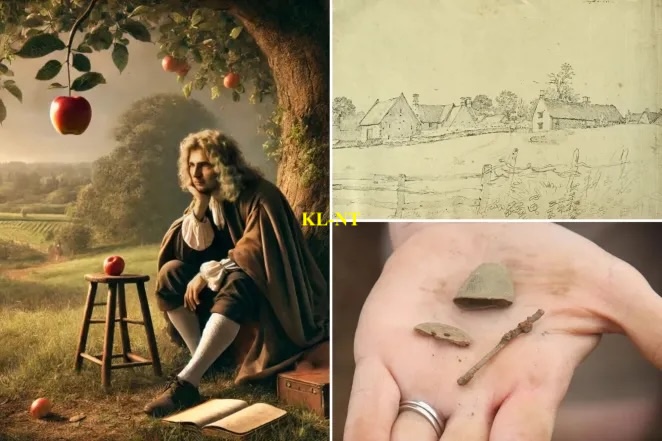
British archaeologists recently found the remnants of a 17th-century house where Isaac Newton’s mother lived – not far from the site of his famous apple tree.
The National Trust announced in a recent press release that it had found a trove of everyday objects from the site of his mother’s former house near Woolsthorpe Manor, an estate-turned-museum near Grantham, Lincolnshire.
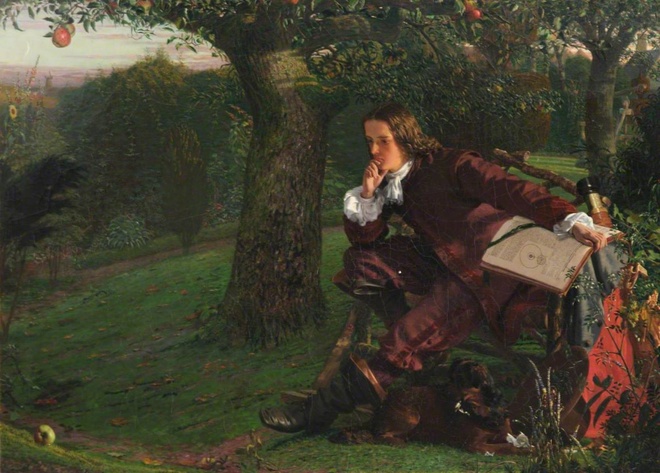
Isaac Newton was born and raised at Woolsthorpe Manor. In 1665, he left Cambridge University during the Great Plague, and legend holds that he developed his theory of gravity thanks to a tree on the property.
Though he and his mother lived on the same property, they didn’t live under the same roof. After his father died, Newton’s mother, Hannah Ayscough, left him to be raised by his grandparents when she married a vicar.
When her second husband died, Ayscough arranged for a house to be built next to Woolsthorpe Manor. She lived there with her children from her second marriage.


Archaeologists believe that Ayscough’s house was demolished after a fire destroyed it in the early 1800s – but its remains have only just been uncovered in new excavations.
“Searching for the exact location of the house, the archaeologists discovered rubble from its demolition – and intriguingly, some objects which might have been in the house when the Newton family was there,” the National Trust’s statement said.


The artifacts included thimbles, a needle remnant and buttons — in addition to animal bones that showed signs of butchering.
“We can really imagine Hannah and the family eating from items like the Staffordshire slipware.”
Staffordshire-type slipware – a style of 17th-century tableware – was also found, along with a Bellarmine jug and a “jetton,” or token used for gaming.


Though the famous apple tree on the property blew down in the early 19th century, another one was regrown at the same location in 1820, where it remains to this day.

“Isaac Newton didn’t actually live in the house, but it was very close to Woolsthorpe Manor where he lived,” said King.
“So, of course, it would be expected that he would have visited frequently and likely shared family meals there.”
There are no current plans for another dig of the area, though archaeologists haven’t ruled out other excavations, the official added. The artifacts will go on display at Woolsthorpe Manor next year.
The National Trust noted that the discovery was five years in the making, as the organization only acquired the field next to Woolsthorpe Manor in 2020.
“A sketch from 1797 by JC Barrow showed the house, and survey work over the past few years, conducted by South Witham Archaeology Group and the University of Leicester, unearthed more evidence to justify a proper dig,” the release added.
In a statement, National Trust archaeologist Rosalind Buck called the artifacts “a real window into the domestic life of the Newton family.”
“We can really imagine Hannah and the family eating from items like the Staffordshire slipware, or using jugs like the one with that magnificent, embossed face,” Buck said.
She added, “Were people potentially gaming with jetton pieces while domestic tasks such as sewing and repairing clothes were being done nearby?”