Ancient ‘Pleasure Boat’ Found Near Ruins Linked to Cleopatra
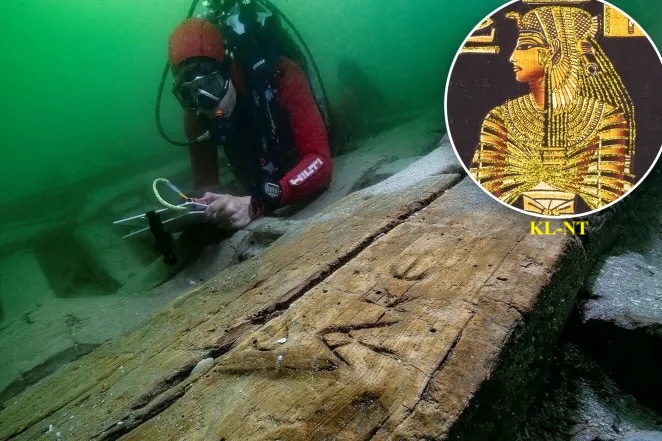
Archaeologists recently discovered the remnants of an ancient Egyptian “pleasure boat” near the ruins of Cleopatra VII’s lost palace in Alexandria’s royal harbor.
The discovery was announced by the European Institute for Underwater Archaeology (IEASM) earlier this month. The ruins were found in the great Portus Magnus of Alexandria, which is believed to hold the remnants of Cleopatra’s palace complex.
Directed by French archaeologist Franck Goddio, the excavation team uncovered an ancient vessel called a thalamegos.
Thalamegoi were luxurious barges used for a variety of activities in Ancient Egypt, including feasting, religious ceremonies, and leisure cruises.

The ship measures 115 feet long and 23 feet wide, with 92 feet of its structure preserved, the IEASM said.
“Its construction type was to obtain a maximum breadth for the ship to accommodate a central pavilion,” the organization noted.
“The particularity of the ship is the flat-bottomed hull with a hard chine at the bow and a rounded turn at the stern.”

The graffiti is still under study, the IEASM told Fox News Digital, but it still “reinforce[s] the hypothesis that the ship was built in Alexandria.”
The boat “would have had a luxuriously decorated cabin and seems to have been propelled only by oars,” the IEASM said.

In the press release, Goddio suggested the ship may have sunk during the destruction of the Temple of Isis in 50 A.D.
Cleopatra, respected in Egypt but vilified in Roman accounts, promoted the cult of Isis during her reign.
“We might also suggest a ritual use for this barge,” said Goddio. “It could have belonged to the sanctuary and [have been] part of the naval ceremony, [when the] procession celebrating Isis encountered a richly decorated vessel, the Navigium.”

“This vessel was performing a yearly ritual voyage of the goddess from the Portus Magnus of Alexandria to the sanctuary of Osiris at Canopus alongside the Canopic Channel.”
Officials stressed that research into the wreck is “still at an early stage.”
Even so, it offers a “fascinating journey into life, religion, luxury and pleasure on the waterways of early Roman Egypt.”

The discovery follows another Cleopatra-related find that was uncovered in 2025.
Egyptian archaeologists recently uncovered a hidden harbor at the Temple of Taposiris Magna, another temple connected to the ancient queen.