World’s Largest Medieval Cargo Ship Discovered Off European Coast
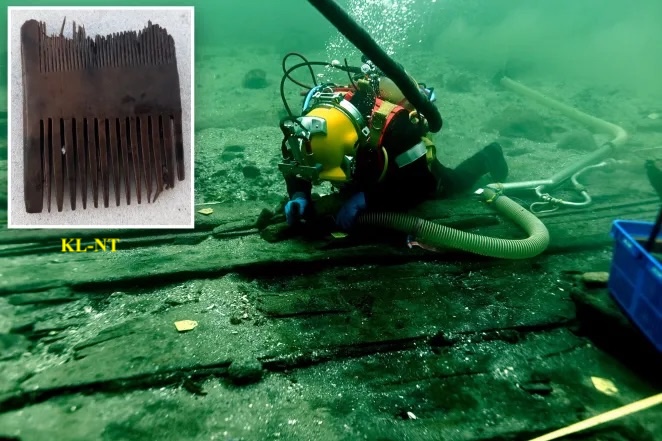
Danish archaeologists recently unveiled a major historical breakthrough. They found the remains of the world’s largest cog ship in the waters off Copenhagen after some 600 years.
The announcement, made by the Viking Ship Museum in Roskilde in late December, noted the ship had been found in the Øresund, a strait between Denmark and Sweden.
Divers found the cog — a type of medieval cargo ship — during seabed surveys ahead of construction on Copenhagen’s Lynetteholm development.
“From the very first dive, the maritime archaeologists sensed they had uncovered something extraordinary,” the Viking Ship Museum said in a statement.
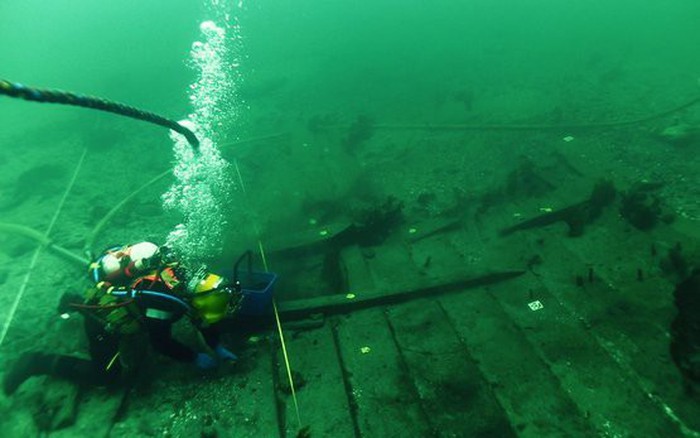
“And as they removed centuries of sand and silt, the outline of a remarkable find emerged. Not just any wreck, but the largest cog ever discovered — a ship that represents one of the most advanced vessel types of its time and the backbone of medieval trade.”
The ship, named Svælget 2, was built in 1410.
It measures roughly 92 feet long, 30 feet wide, and 20 feet high, with an estimated cargo capacity of around 330 tons.
Researchers dated the ship by conducting tree-ring analysis, which showed it was built with timber from Pomerania, in modern-day Poland, and the Netherlands.

The ship “represents the largest example of its type ever discovered anywhere in the world,” the museum said.
“The cog was an efficient ship type that could be sailed by a remarkably small crew, even when heavily loaded.”
“[The cog] was the super ship of the Middle Ages. . . . It transformed trade patterns. Where long-distance trade had previously been limited to luxury goods, everyday commodities could now be shipped across great distances.”

The ship survived the centuries thanks to the sand that protected it from the elements.
Archaeologists were especially surprised to discover the ship still had its rigging, or the system of ropes, cables, and fittings that supported its mast.
Divers also recovered numerous personal objects, including dishes, shoes, combs, and rosary beads that the sailors used every day.


Remarkably, archaeologists found the ship’s brick-built galley, where the crew cooked meals over an open hearth — a rare luxury during life at sea.
No trace of cargo has been found, but the museum said barrels of salt, bundles of cloth, and lumber were likely possibilities.

“Despite the missing cargo, there is no doubt that Svælget 2 was a merchant ship,” the museum added. “Archaeologists have found no signs of military use.”
It’s unknown how common cogs of this size were in Northern Europe at that time.
“We don’t know this with great certainty,” Otto Uldum, maritime archaeologist and the excavation leader, told Fox News Digital.
“There is a marked tendency that cogs were built increasingly larger through the use of this technology, [like from] 1200 to 1400,” said Uldum.
“Given the rarity of cogs dated this late, we think that most cogs entering the Baltic from the North Sea were around [82 feet] long, and that Svælget 2 marks an upper limit.”

Uldum was particularly struck by the recovery of the ship’s stern castle — the first archaeological proof that such raised structures, long depicted in medieval illustrations, actually existed.
He also described the cog’s preservation as “very rare,” adding that comparable finds in the Netherlands have been excavated in sheltered, reclaimed seabed areas rather than open waters.

“To find a cog lost at sea in this state of preservation is very rare — and the fact that it was underway on the high seas when it was lost puts it in the company of only a handful of other wrecks,” said Uldum.
The archaeologist said he hopes that further analysis of the ship’s artifacts, including the mammal and fish bones, will shed light on what the men ate on board.