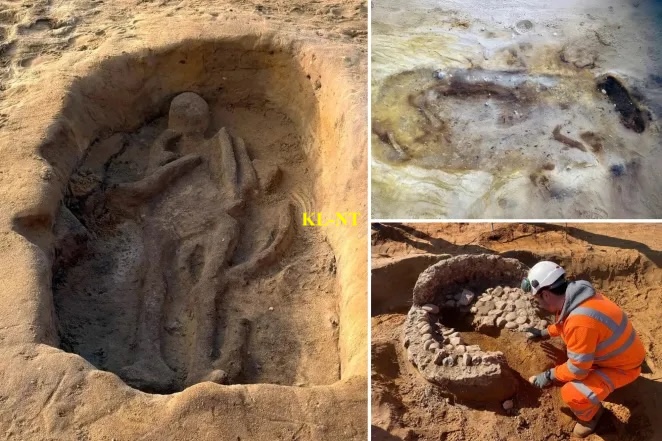
Excavators recently unearthed an Anglo-Saxon “princely” grave — containing two men, a horse and grave goods — during the construction of a nuclear power station in England.
The discovery was made at the Sizewell C site near Theberton, Suffolk.
It dates back to the 7th century A.D.
In a release, officials described the find as a “high-status grave containing two individuals buried alongside a fully harnessed horse, weapons and personal items.”

The grave goods included weaponry, shields, a bronze vessel and a silver-rimmed cup or horn — all artifacts that indicate the high status of those involved.
“These finds, dating to the 7th century, suggest the individuals were elite members of Anglo-Saxon society and reflect their complex burial traditions,” the statement added.
They also found 11 barrows, or burial mounds, containing both cremation and inhumation burials.
Eerily, the skeletons have become “sand bodies” due to the soil quality, Cotswold Archaeology post-excavation project manager Chris Fern told Fox News Digital.


“What we’re uncovering are ‘sand bodies’ rather than true skeletons — the acidic nature of Suffolk’s sandy soil erodes osseous material, leading to very poor bone survival,” he said.
While the discovery is significant, Fern said it’s relatively normal for a small amount of Anglo-Saxon burials that are found each year in England.
“Each cemetery [from] this period reflects the population of a small local community,” said Fern.
“In Suffolk, nearby cemeteries include those at Sutton Hoo, Snape and Rendlesham — and several are known from Ipswich.”
Researchers described the grave as “princely,” rather than belonging to a prince.
The term “indicates the high social status of the grave’s inhabitants,” Fern said.


He added that the most surprising takeaway from the excavation was that Theberton was a wealthier Anglo-Saxon community than previously believed.
“In addition, the horse burial is a rare burial rite in the period, and especially evocative, as it speaks of the special social relationship that still exists between humans and horses,” Fern noted.
The burial ground dates back to a significant time in English history, when regional kingdoms started to form and consolidate power.
“A more class-conscious society [emerged] generally, as well as alongside the gradual conversion of those kingdoms from paganism to Christianity,” the archaeologist added.
Local families would also show off their wealth in the burial rites, Fern said, as it “reflect[ed] local families in competition for social standing and leadership.”


“Burial was a form of powerful social and political theater,” he said.
“The elaborate burials were a form of display, [and] the event was almost a form of drama.”
The news comes over a year after archaeologists made a similarly significant discovery at the same site.
Excavators digging at Sizewell C found 321 silver coins last year, dating back between 1036 and 1044.
The treasure was found in “mint condition” in a lead and cloth package that researchers likened to a Cornish pasty.