Hezbollah Officially Enters the War, Launches Rockets Toward Israel for the First Time Since November 2024
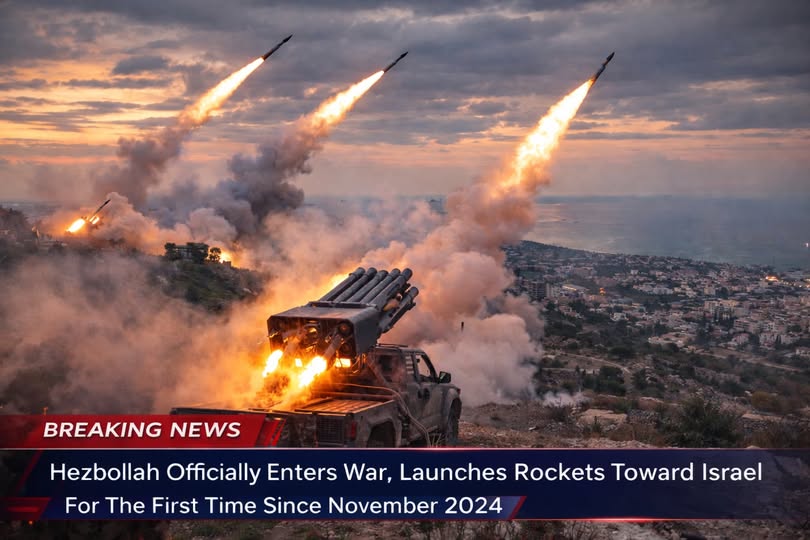
Hezbollah Officially Enters the War, Launches Rockets Toward Israel for the First Time Since November 2024
Beirut, Lebanon / Tel Aviv, Israel — In a major escalation of the ongoing conflict in the Middle East, Hezbollah has officially entered the war, launching rockets toward Israel for the first time since November 2024. The group’s decision to join the hostilities comes amid mounting tensions between Israel and Iran, as well as escalating military operations in both Lebanon and Syria.
Hezbollah, a militant group backed by Iran and operating from southern Lebanon, has long been a key adversary of Israel. However, this marks the first time in nearly two years that Hezbollah has directly launched an attack against Israeli territory.
Details of the Rocket Attack
The rocket barrage, which targeted northern Israel near the Lebanese border, was confirmed by the Israeli military. Sirens sounded across multiple Israeli towns, including Kiryat Shmona and Nahariya, as a wave of rockets fired by Hezbollah crossed the border. The Israeli Defense Forces (IDF) reported that many of the rockets were intercepted by the Iron Dome missile defense system, but at least one rocket struck a residential area, causing significant damage to buildings and injuring several civilians.
Hezbollah has confirmed responsibility for the attack, stating that it was carried out in retaliation for Israel’s ongoing military operations in southern Lebanon and Syria. The group’s spokesperson emphasized that this is only the beginning and vowed to intensify its efforts against Israel in the coming days.
“Hezbollah will not sit idly by while Israel continues its aggression against Lebanon and our allies,” said the spokesperson. “This is our first response, but it will not be the last. Israel’s actions will have consequences.”
Israel’s Response
In response to the rocket attack, Israel has launched airstrikes against Hezbollah positions in southern Lebanon, including weapons storage sites and rocket launchers. The Israeli military has vowed to take “decisive action” to prevent further Hezbollah rocket fire and to dismantle the group’s infrastructure along the border.
“We will respond with full force to any attack on Israeli soil,” Israeli Prime Minister Benjamin Netanyahu said in a statement. “Hezbollah has made a grave mistake by entering this war, and we will ensure they pay the price.”
The Israeli Air Force (IAF) has been heavily engaged in bombing Hezbollah targets in Lebanon, while Israeli ground forces have been placed on high alert along the northern border.
Hezbollah’s Role in the Conflict
Hezbollah’s entry into the conflict comes at a time when Israel is already embroiled in intense military operations against both Hezbollah in Lebanon and Iranian-backed forces in Syria. While Hezbollah had previously refrained from direct involvement in the conflict, it has now officially escalated its role, possibly at the behest of its Iranian backers.
For years, Hezbollah has been a key ally of Iran, receiving substantial military support and training. The group has developed a formidable arsenal of rockets and missiles, many of which are capable of reaching deep into Israeli territory. With the situation growing more volatile by the day, military experts fear that Hezbollah’s full-scale entry could significantly widen the scope of the war.
International Reactions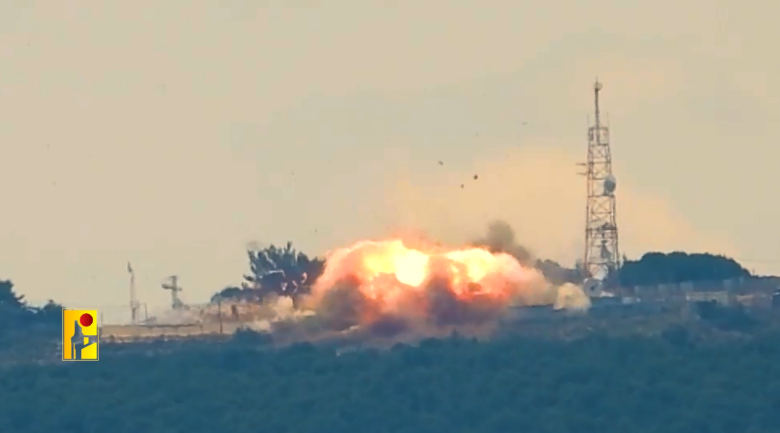
The international community has expressed grave concern over the widening conflict, with many world leaders calling for de-escalation and an immediate halt to hostilities. The United Nations has urged both Israel and Hezbollah to adhere to international law and avoid further violence that could jeopardize regional stability.
The United States, which has long supported Israel, reaffirmed its commitment to Israel’s right to self-defense. “Hezbollah’s actions are a direct provocation, and we stand with Israel in its efforts to protect its citizens and territory,” U.S. Secretary of State Mark Johnson said.
However, countries like Russia and China, which have close ties to Iran and its allies, have expressed concern about the growing instability in the region, calling for a diplomatic resolution to the conflict.
Looking Ahead
With Hezbollah now actively involved in the conflict, the situation in the Middle East is rapidly evolving. Israel’s northern border is on high alert, and the military is preparing for further rocket attacks and possible ground incursions. Hezbollah’s decision to officially enter the war increases the likelihood of a prolonged and expanded conflict, potentially drawing in other regional players.
The international community is closely monitoring the situation, hoping that both sides will seek a path toward de-escalation before the violence spirals further out of control. However, with Hezbollah’s rhetoric promising more attacks, the next few days could prove pivotal in determining the trajectory of the conflict.