Macron Warns US Strike on Iran Is “Dangerous” — Calls for Negotiation
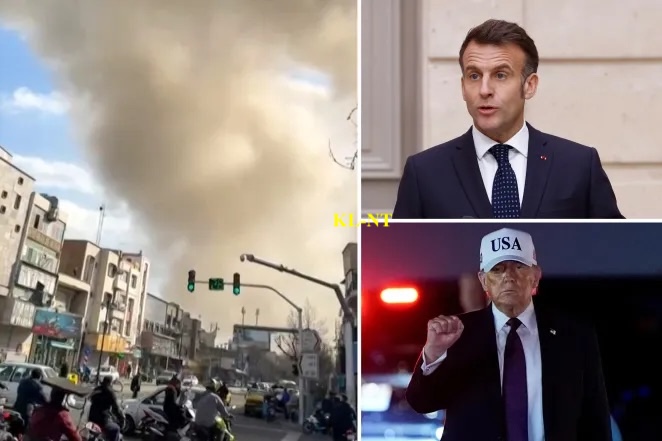
World leaders gave mixed reactions to Operation Epic Fury, with Gulf nations like Saudi Arabia firmly backing the joint US-Israel military action, most of Europe taking a cautious approach — and the UK sounding a contradictory note after days earlier denying use of their air bases to the US.

Less than a week after reportedly blocking Trump from using its military air bases for a possible attack on Iran, British Prime Minister Keir Starmer declared British planes “are in the sky” in the Middle East to protect the region.
“Our forces are active, and British planes are in the sky today as part of coordinated regional defensive operations to protect our people, our interests and our allies, as Britain has done before,” he said in a televised statement.
He called on all sides to return to the negotiation table and said it was up to Iran to take the first steps.
“It is vital that we prevent further escalation and return to a diplomatic process we want to see peace and security and the protection of civilian life. Iran can end this now, they should refrain from further strikes, give up their weapons programs and cease the appalling violence and repression against the Iranian people who deserve the right to determine their own future.”
Trump reportedly spoke with Starmer about the plans Tuesday night, and UK officials were worried that giving the US permission to use the RAF bases in England for a military attack could breach international law, according to the Times.

In a joint statement, the heads of France, Germany and the United Kingdom expressed unease and called for a return to “stability.”
“We call for a resumption of negotiations and urge the Iranian leadership to seek a negotiated solution. Ultimately, the Iranian people must be allowed to determine their future,” Starmer, French President Emmanuel Macron and German Chancellor Friedrich Merz said.
“We did not participate in these strikes, but are in close contact with our international partners, including the United States, Israel, and partners in the region. We reiterate our commitment to regional stability and to the protection of civilian life,” the leaders added.
Macron went a step further to issue his own statement, calling President Trump’s attack that eliminated Iran’s Supreme Leader Ayatollah Ali Khamenei, “dangerous.”
He also called for an urgent meeting of the United Nations Security Council.
The United States and Israel launched the joint attack that eliminated on Iran Saturday night.
Trump vowed to devastate the country’s military, eliminate its nuclear program and bring about a regime change. He encouraged Iran’s people to rise up and take back their country.
“It will be yours to take,” Trump said to them. “This will be probably your only chance for generations.”
Iran promptly retaliated, firing a barrage of missiles and drones at Israel, US bases and civilian areas in the region, including in Qatar, Kuwait, the United Arab Emirates and Bahrain.
The Gulf States banded together in the face of the attacks.
Saudi Arabia signaled its support for Trump, saying it stands ready to “place all its capabilities” at the disposal of its allies.
The Kingdom said it “condemns and denounces in strongest terms the blatant Iranian aggression and the flagrant violation of the sovereignty of the UAE, Bahrain, Qatar, Kuwait, and Jordan.
The United Arab Emirates’ Ministry of Defense said the nation “was subjected to a blatant attack involving Iranian ballistic missiles,” calling it “a dangerous escalation and a cowardly act that threatens the safety of civilians and undermines stability,
The King of Jordan also condemned Iran’s attacks on its territory,
The Ministry of Foreign Affairs said Jordan would continue to take “all available and necessary measures” to safeguard the safety of its citizens and protect the country’s security and sovereignty, as it sounded “absolute solidarity” with the affected Gulf states.
The prospect of instability in the Middle East is now a growing concern, world leaders said.

“We do not want to see further escalation into a wider regional conflict,” a UK government spokesperson said.
Other leaders echoed the same concerns.
“Ensuring nuclear safety and preventing any actions that could further escalate tensions or undermine the global non-proliferation regime is of critical importance,” European Union President Ursula von der Leyen said.
She called the attack “greatly concerning.”