Wealthy Wellness Enthusiasts Turn to Costly ‘Blood Cleansing’ Treatments
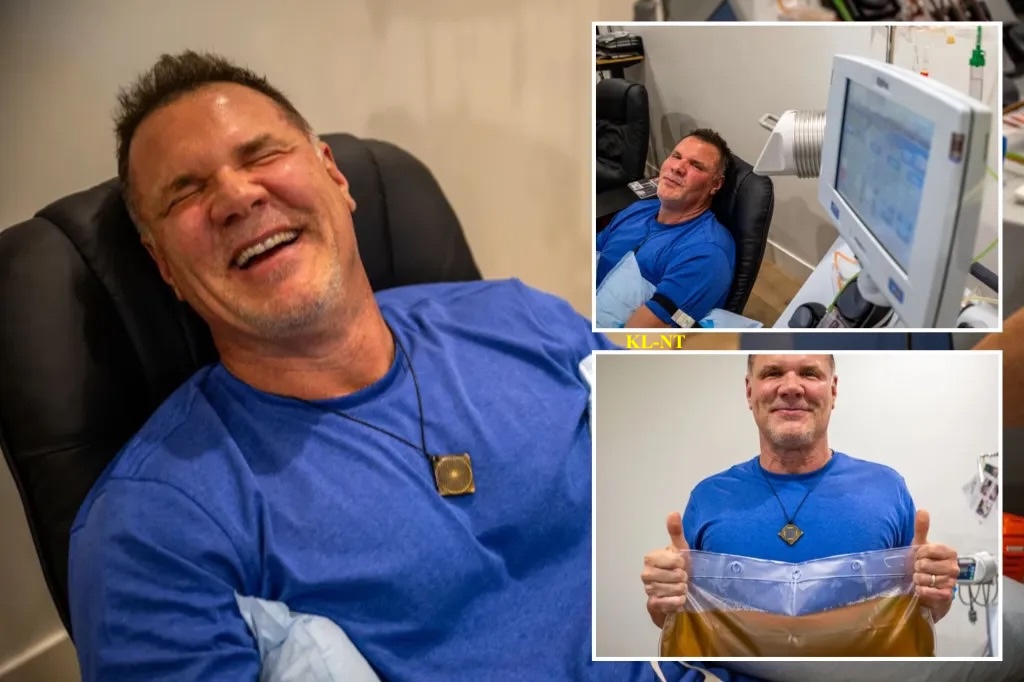
After his father died of a massive heart attack at the age of 66, Johnjay Van Es started doing literally everything he could to keep his ticker tickin’.
The congenial Phoenix radio host shed about 160 pounds, transforming himself from morbidly obese to impressively sleek, with just 12% body fat. He also embarked on an international biohacking journey, sourcing stem cells in Mexico and canned hydrogen water from Australia.
It takes a lot of wealth for Van Es’s good health. He estimated that he drops over $100,000 annually on everything from $25,000 natural killer cells to $3,000 unlimited red light therapy sessions.
“Oh, God, that’s sick,” Van Es, 57, told The Post as we counted the costs together. “I’ve never tallied it up.”

Van Es’s latest obsession is a controversial $7,500 blood “cleansing” technique called plasmapheresis, which involves removing plasma that may contain harmful substances like autoantibodies or toxins and replacing it with healthy fluid.
Plasmapheresis is a form of apheresis, which has long been used to treat autoimmune disorders, certain cancers, blood disorders like sickle cell disease, transplant rejection and high cholesterol.
But the anti-aging benefits for healthy people are unproven. That hasn’t stopped bold-faced names like Orlando Bloom and biohacker Bryan Johnson, both 48, from sending their blood through the spin cycle.
“If we want to use the term ‘biohacking’ or ‘blood purification for lifestyle purposes’ or for ‘detoxification,’ we have to realize that there are very few evidence-based trials,” Dr. Stefan Bornstein, director of the Medical Clinic and Policlinic III at the University Hospital Dresden in Germany, told The Post.
How does plasmapheresis work?
Most biohackers have done an IV drip for a wellness boost. That’s when a needle is inserted into the arm to infuse the blood with nutrients.
Plasmapheresis, also known as therapeutic plasma exchange (TPE), is a similar concept.

Two IV lines are typically used for TPE. One line slowly draws blood from the body to an apheresis machine that filters out the plasma.
“It looks like an old-school tape recorder, but with blood spinning around,” Van Es said of the equipment.
The second line returns the remaining blood components — red blood cells, white blood cells and platelets — along with a replacement substance, like protein-rich albumin, to the body.
When all is said and spun, patients are left with a large pouch of their original, yellow, sticky plasma.
Its toxicity is up for interpretation. Johnson — who follows a highly controlled and closely monitored regimen — boasted last year that his TPE operator called his “liquid gold” plasma “the cleanest he’s ever seen.” It was so pure that he “couldn’t bring himself to throw it away,” Johnson crowed.
Who could benefit from the procedure?
Johnson probably doesn’t need TPE, but others might find it helpful.

Bornstein — whose clinic in Germany performs 10,000 apheresis treatments annually — said it has the potential to remove age-related proteins, lower cholesterol and other lipids and reduce heavy metals and microplastics, ubiquitous plastic fragments believed to harm health.
“Most of these studies show positive effects and positive associations,” he said, “but [they] are not fully showing or are not a proof of a correlation in larger outcome studies at this point.”
Dr. Keith Smigiel, who oversees Van Es’s TPE, has found through patient testing that the procedure cuts cholesterol and purges mold and other environmental toxins.
His patients are often highly educated and affluent. Lately, he’s seen a lot of married, mid-30s, zombie-like Millennials struggling with fatigue and brain fog as they raise young kids.
Smigiel typically recommends longevity enthusiasts undergo a two- to three-hour session every six months.

The $7,500 treatment is proving so popular that he’s considering getting another apheresis machine for his Scottsdale clinic, ReGen Pain & Wellness.
“We’re just simply giving the body a chance to kind of heal itself by removing the toxic burdens out of the blood.”
What does it feel like?
Some biohacking tools are exciting and interactive — with TPE, you might feel the sharp pinch of the needles and then some fatigue as you sit still for hours.

Smigiel likened it to a “cross-country flight” with a “jet lag” sensation that subsided within two days.
Famed biohacker Gary Brecka, 55, experienced “a profound sense of clarity and calm, almost a zen-like state” after TPE.