Queens Residents Rally Against Proposed Battery Storage Site
They’re gonna blow a gasket.
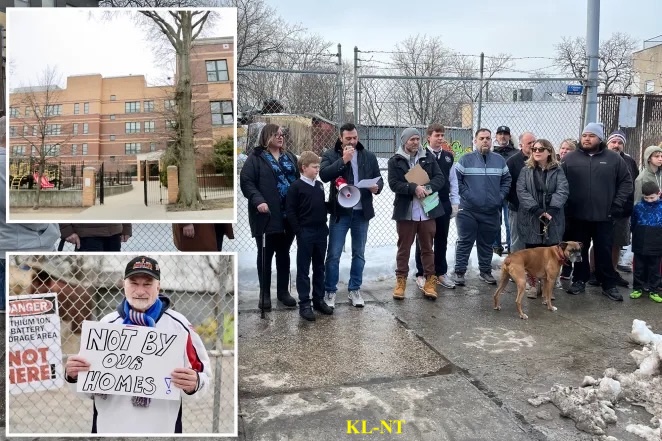
Outraged Big Apple residents and lawmakers rallied in Queens Thursday afternoon to blast plans for a lithium-ion battery storage site next to a school and accusing city officials of quietly fast-tracking permits.
“This is truly unacceptable,” fumed rally organizer Paul Pogozelski as roughly two dozen protesters lined the street near the vacant lot slated for the NineDot Energy battery warehouse in Middle Village.

“While permits were being filed and plans were advancing, our community was told nothing. No public meetings, no notice, no transparency from the company and no transparency from anyone in this neighborhood. That is not representation. That is silence.”
The Democrat, president of the Middle Village Property Owners Association, also claimed the battery storage’s hefty profits will send local prices soaring.
Locals called for the proposed facility at 64-30 69th Place – next to a daycare, preschool, and animal hospital, and across from PS 128 – to be moved to a safer, more suitable location.

Protesters also urged both local officials and Brooklyn-based clean energy firm NineDot to be more transparent about the project.
“We’re here to deliver a really simple message that we don’t want a lithium ion battery plant here,” Queens Councilman Phil Wong said.


“All it takes is one incident to burn down this whole neighborhood. We have seen the fires. If you haven’t seen it, go look it up on YouTube. FDNY cannot even put them out. They just let them burn. Please get NineDot to take our empty lot sites and build it there where it’s much better.”
The batteries store energy, primarily from emerging solar and wind power, to help New York meet targets under the much-criticized Climate Act of 2019 approved by then-Gov. Andrew Cuomo.

The plan calls for New York to reduce greenhouse gas emissions 40% by 2030 and have 100% zero-emission electricity by 2040. That state must also generate 9,000 megawatts of offshore wind energy by 2035, 6,000 megawatts of solar energy by 2025 and build 3,000 megawatts of energy storage by 2030.
Wong said under a key Adams-era initiative dubbed “City of Yes,” projects like this can now be built in residential areas, whereas previously they could

“If they have the permits, whether or not they get the permits, who they spoke to, who they hired to lobby with, they don’t have to tell us, because of the City of Yes,” he blasted.
There are currently 74 existing battery storage facilities in the city – 18 each in Brooklyn and Manhattan, 16 in Queens, and 11 in The Bronx and Staten Island, according to the NYSERDA website.