“WE’VE FOUND LIFE”: Between the Viral Headlines and the Scientific Reality 🌍🚀
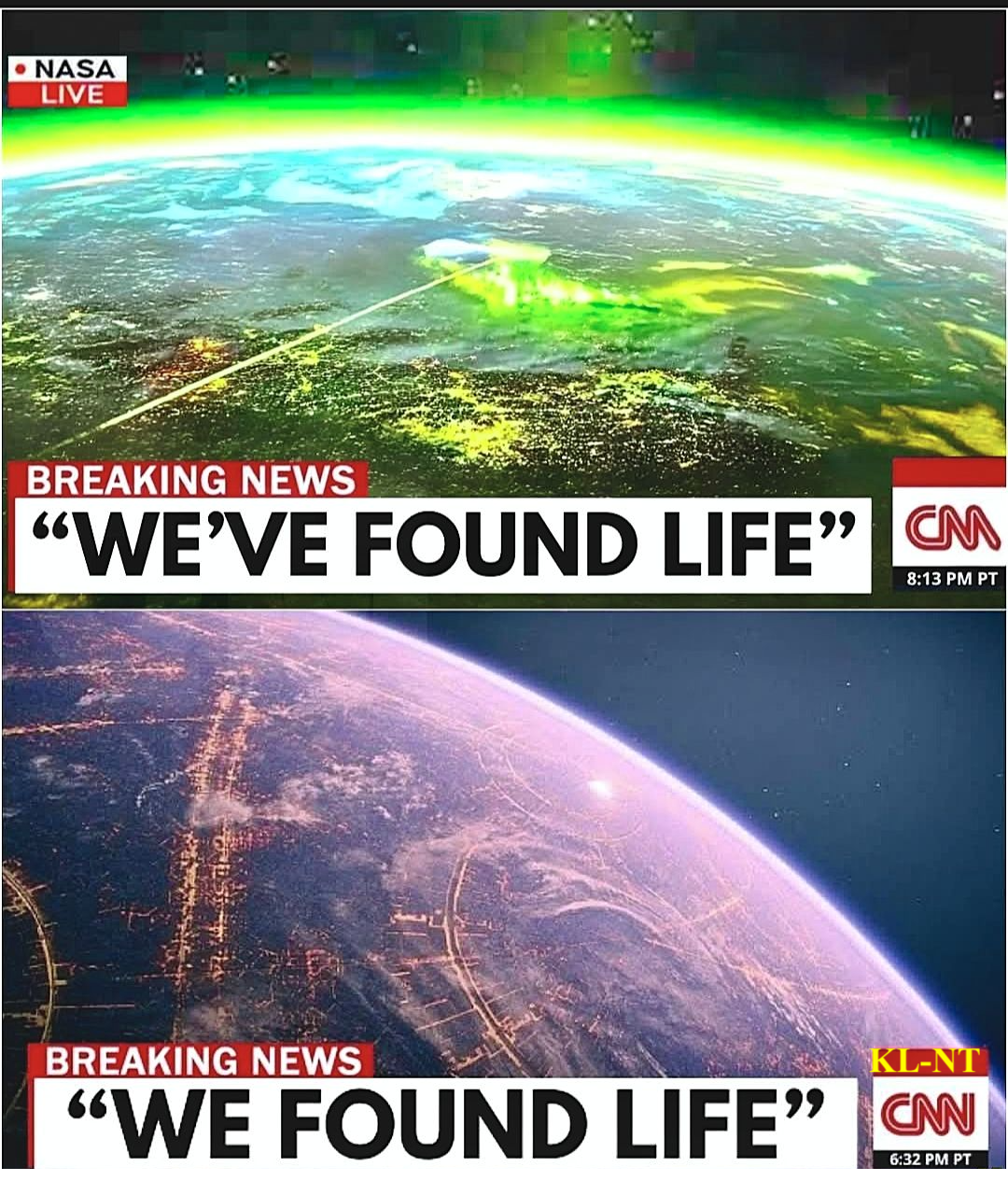
The image of a glowing Earth accompanied by a bold proclamation of life beyond our stars is the ultimate “holy grail” of modern media. But as space agencies like NASA and the ESA dive deeper into the mysteries of the 2020s, the “discovery of life” is unfolding not as a single dramatic event, but as a series of tantalizing chemical puzzles.
The JWST Breakthrough: Searching for Biosignatures 🔭
The most significant “life” headlines of the past year have centered on K2-18b, an exoplanet located 120 light-years away. Using the James Webb Space Telescope (JWST), astronomers have detected carbon-bearing molecules, including methane and carbon dioxide, in its atmosphere.
Even more provocative is the tentative detection of dimethyl sulfide (DMS). On Earth, this molecule is only produced by life—specifically phytoplankton in marine environments. While 2026 observations continue to refine this data, experts warn that “possible biosignatures” are not yet “confirmed life.”

Mars: The Hunt for Ancient Microbes 🏔️🔎
Closer to home, NASA’s Curiosity and Perseverance rovers have turned the Red Planet into a forensic laboratory. In 2025 and early 2026, Curiosity identified the largest organic molecules ever found on Mars—long carbon chains that resemble the fatty acids used by Earth-based life to build cell membranes.
Meanwhile, Perseverance has discovered “leopard spots” in the rocks of Jezero Crater. These mineral arrangements are often formed on Earth through microbial redox reactions. While these findings don’t prove life exists today, they suggest that ancient Mars was a “chemically open system” capable of supporting biological energy cycles.

Ocean Worlds: Life in the Dark 🌊
The focus is also shifting to the “ice moons” of our solar system, such as Europa and Enceladus.
-
Tidal Heating: Scientists now believe that the friction from Jupiter and Saturn’s gravity keeps these moons’ subsurface oceans liquid, providing a stable environment even without sunlight.
-
Chemical Energy: New research suggests that “sinking ice” on Europa could be delivering life-supporting oxidants from the surface down into the lightless depths, potentially feeding chemosynthetic life similar to that found in Earth’s deep-sea vents.

The Verdict: A “3-Sigma” Mystery ⚖️
Most scientific detections of biosignatures currently sit at a “3-sigma” confidence level (about 99.7%). In the world of high-stakes physics, this is “interesting” but not “definitive.” For a discovery to be official, it must reach 5-sigma and withstand rigorous peer review.
As space agencies prepare for the next generation of missions—like the Europa Clipper, currently en route—the world remains in a state of “cautious optimism.” We are closer than ever to answering the big question, but for now, Earth remains the only confirmed home for life in the vast, silent dark.