A 10-Year-Old Girl Who Saved 100 Lives — Because She Paid Attention in Class
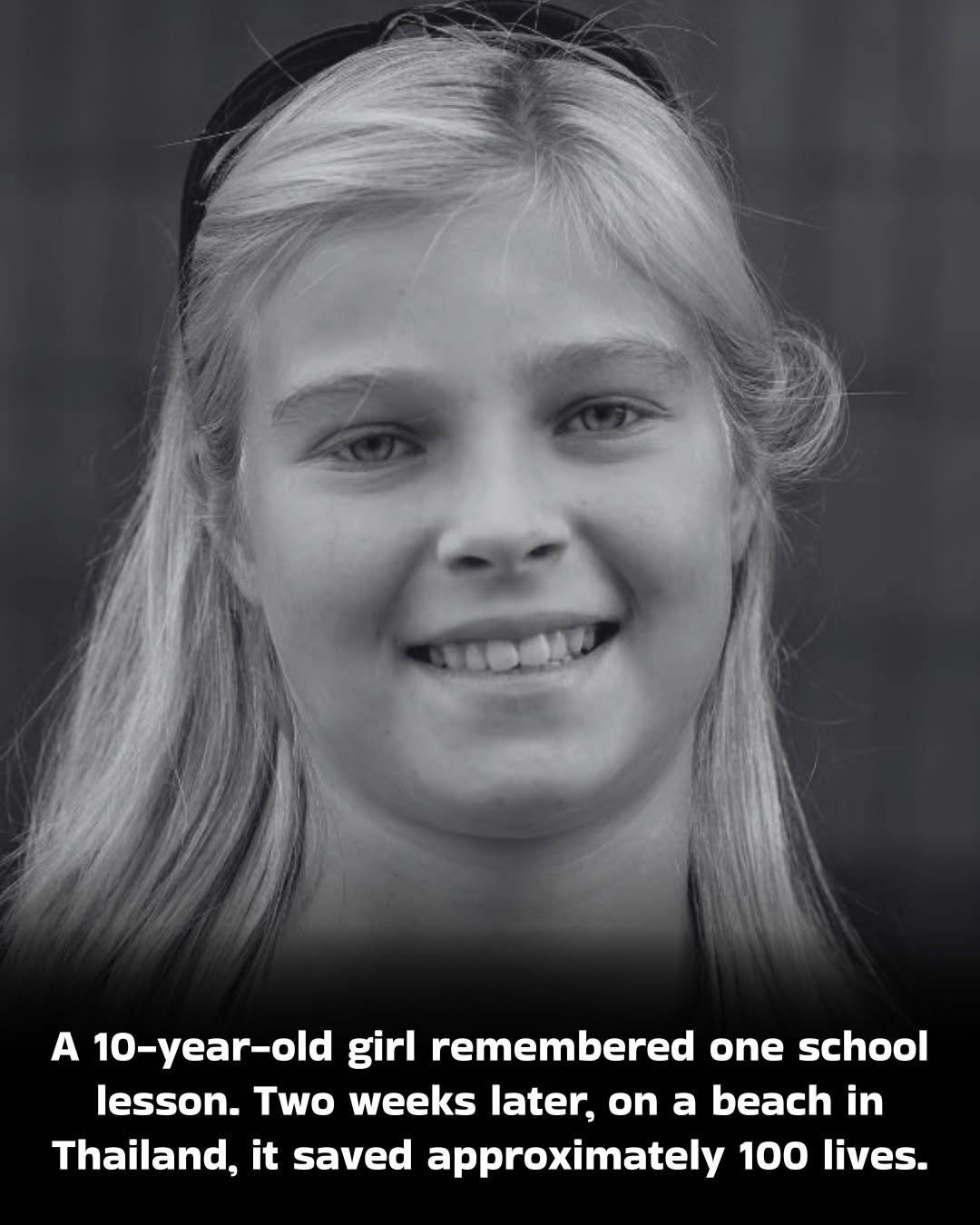
A 10-year-old girl remembered one school lesson. Two weeks later, on a beach in Thailand, it saved approximately 100 lives.
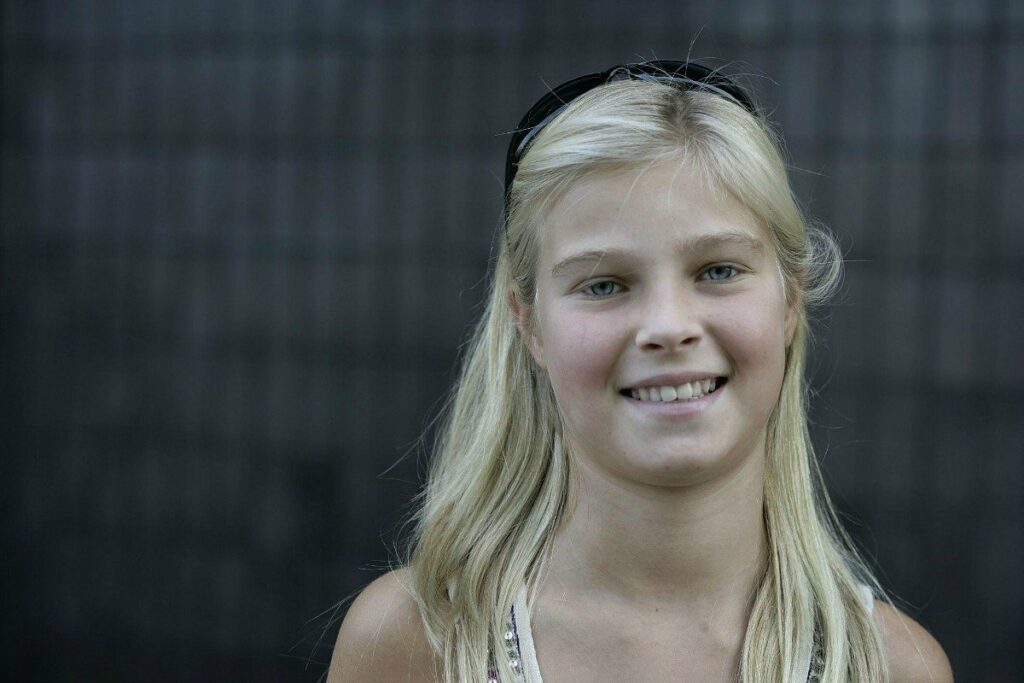
Her name was Tilly Smith.
On the morning of December 26, 2004, Tilly was walking along Mai Khao Beach in Phuket, Thailand, with her parents Colin and Penny, and her seven-year-old sister Holly. It was the family’s first holiday abroad — a Christmas present they had been looking forward to for weeks. The sky was clear. The sand was white. Everything seemed perfect.
But the sea was not right.
Tilly noticed something that no one else on that crowded beach seemed to see. The water was not moving the way it should. It was not ebbing and flowing in its normal rhythm. Instead, it was coming in and in and in — advancing steadily onto the shore without pulling back. The surface had become frothy and white, fizzing and bubbling like foam sizzling in a frying pan.
To anyone else, it might have looked unusual. To Tilly, it looked terrifying. Because she had seen this before.
Just two weeks earlier, in her Year Six geography class at Danes Hill School in Oxshott, Surrey, her teacher Andrew Kearney had shown the class a black-and-white video of a tsunami that struck Hawaii after the 1946 Aleutian Islands earthquake. He had explained the warning signs. The unusual behavior of the water. The thick, frothing surface. The ocean doing things that no longer looked like an ocean.
Standing on that beach in Thailand, Tilly was watching those exact signs unfold in front of her.
She started shouting.
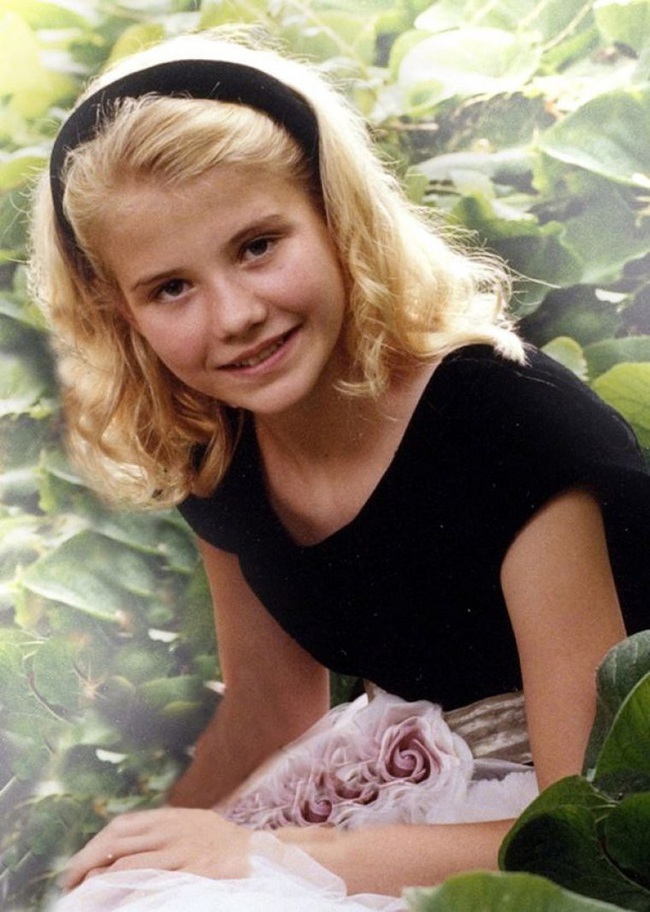
“Mummy, we must get off the beach now. I think there is going to be a tsunami.”
Her parents did not believe her at first. There was no wave on the horizon. The sky was calm. The beach was full of tourists enjoying the morning sunshine. But Tilly did not stop. She grew more and more urgent, more and more insistent. This was not childish fear. This was recognition.
“I’m going. I’m definitely going. There is definitely going to be a tsunami,” she told them.
Her father Colin heard something different in her voice. It was not panic. It was certainty. He decided to trust his daughter. He approached a hotel security guard and said something he later admitted sounded absurd: “Look, you probably think I’m absolutely bonkers, but my daughter is completely convinced there is going to be a tsunami.”
By coincidence, an English-speaking Japanese man standing nearby heard Tilly use the word “tsunami.” He spoke up and said he thought the girl might be right. Together, Tilly’s warning and the man’s support prompted immediate action.
The hotel staff began evacuating the beach.
Tilly’s mother Penny was one of the last to leave. The water was already surging powerfully behind her as she ran.
They reached the upper floor of the hotel with only seconds to spare.
Then the wave arrived.

A wall of water swept across Mai Khao Beach. Sunbeds, palm trees, and everything in its path vanished in an instant. It was not just the water that killed across the region that day. It was everything the water carried with it.
The 2004 Indian Ocean tsunami, triggered by a magnitude 9.1 earthquake off the coast of Sumatra, claimed the lives of approximately 228,000 people across fourteen countries. It was one of the deadliest natural disasters in recorded history.
But on Mai Khao Beach, not a single person died. Only a few minor injuries were recorded. It was one of the only beaches on the entire island of Phuket to report no fatalities.
Because a ten-year-old girl remembered what she had learned in school.
Tilly Smith was called “The Angel of the Beach.” She received the Thomas Gray Special Award for maritime safety from The Marine Society and Sea Cadets. She was named Child of the Year by the French magazine Mon Quotidien. An asteroid — 20002 Tillysmith — was named in her honor.
She appeared at the United Nations in November 2005 and met former President Bill Clinton, who was serving as the UN Special Envoy for Tsunami Recovery. She returned to Thailand for the first anniversary of the disaster and read a poem at the memorial service to thousands of spectators.
Her father Colin later said, “If she hadn’t told us, we would have just kept on walking. I’m convinced we would have died. Absolutely convinced.”
But Tilly herself always said the same thing when people called her brave.
It was not bravery. It was not intuition. It was learning.
“If it weren’t for Mr. Kearney, then I would probably be dead and so would my family,” she told the United Nations. “So I’m quite proud that he taught me that.”
She remembered what her teacher had shown her. She recognized what she was seeing. And she refused to stay quiet, even when the adults around her did not believe her.
Her story is now taught in schools around the world as an example of why disaster education matters. Countries that had no tsunami warning systems in 2004 have since built them, partly because stories like Tilly’s showed the world what knowledge can do when it reaches the right person at the right moment.
That is the power of education. Not just grades on a page or facts memorized for a test. Education at its best plants something inside a person that stays there, waiting quietly, until the moment it is needed most.
Tilly Smith proved that on a beach in Thailand when she was ten years old.
And more than twenty years later, her story still reminds us that what we learn today might save someone’s life tomorrow.